The Idmonsey Shadow Diaries: A Field Account, Compiled Under Protest
by Tuiren Lathra, Ghost Behavioural Specialist, Celestine Scriptorium of Lumenreach
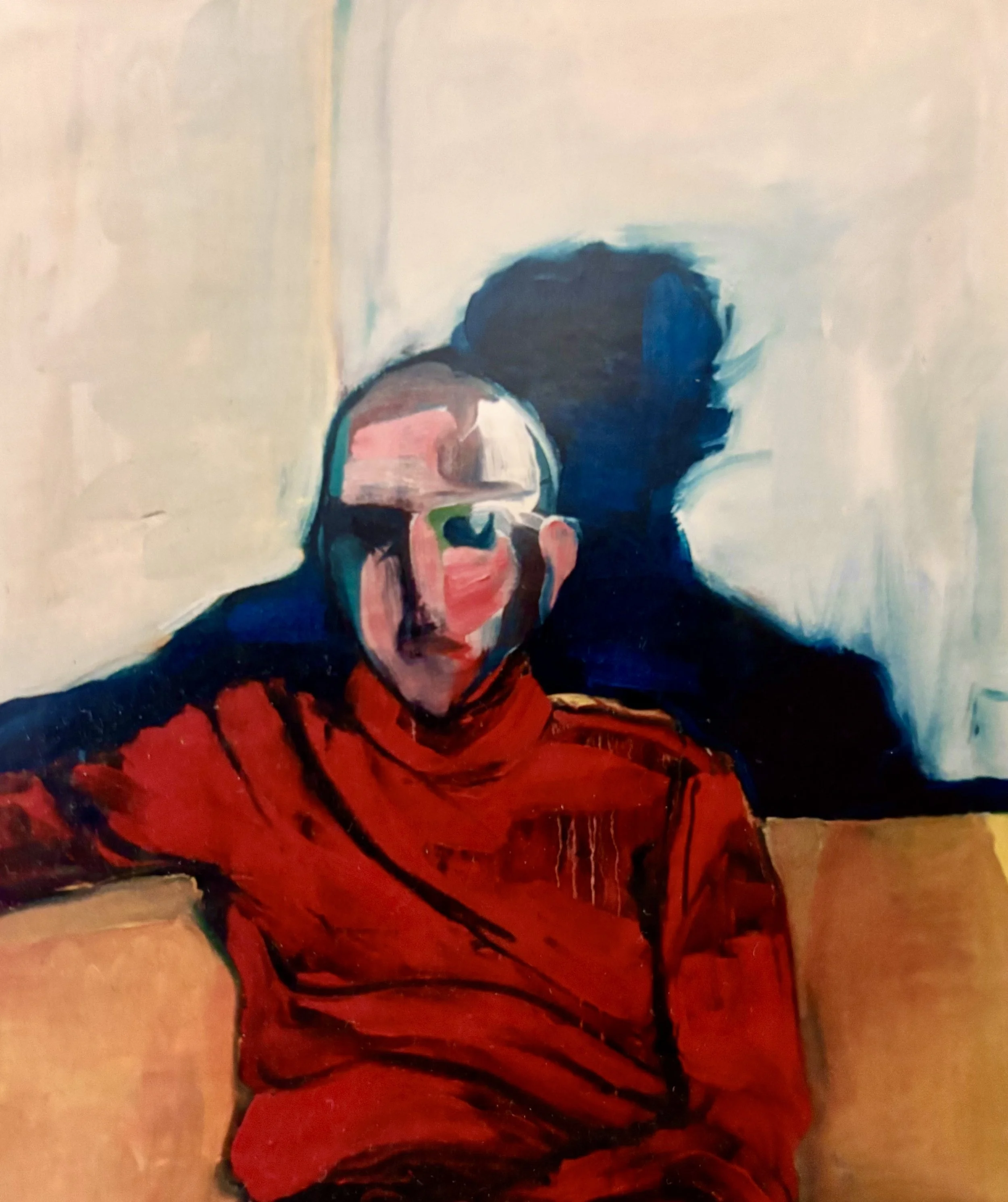
(I painted this with oil paint, linseed oil and turpenoid on stretched and sized cotton duck canvas over 30 years ago. - Chaiga T. Cheska)
(To see my artist mother’s shadow paintings,
please click here and see where I took inspiration for this story.)
~~~
Prefatory Note from the Department
Scholar Lathra was found, for the second time this term, attempting to gain entry to the observatory at dusk under the pretence of “checking a reading.” He was not the only scholar attempting this. He is, however, the only one who was caught holding a chair. He has been dispatched alone, as the Provost feels that correction is best administered without the comfort of company, to investigate a disturbance at Theolora and to keep a full written account of his time there, omitting nothing, on the Provost’s express instruction that Scholar Lathra’s accounts have historically omitted rather a lot.
W. Ashcombe, Provost
Scholar’s Response
I would like it noted that three other members of staff were also near that chair. I will not name them. I have my dignity, or what remains of it after this posting, and I intend to keep the little that’s left.
Day One. Lower Idmonsey.
I arrived a day later than intended, owing to a disagreement with the ferryman at the Tindel crossing about the definition of the word “immediately,” and walked straight into the aftermath of whatever had happened here the evening before I came.
There is no gentle way to describe what greeted me. A thin, greyish figure was standing at the edge of the millpond with its head tipped at an angle no living neck permits, and when I asked, in a voice considerably higher than my usual one, whether it required assistance, it turned towards me with an unhurried, completely wordless attention that I will not soon forget. It did nothing further. It simply looked. I retreated to the inn with what dignity a grown scholar can retain whilst walking backwards into a fence post.
I am a specialist in ghost behaviour. I have catalogued forty-one distinct varieties of restless ghosts and written admiringly of most of them. I would like this recorded clearly, for whoever eventually reads this file, because it will make what follows considerably more embarrassing: I am, and have been since childhood, unable to bear the sight of a shadow behaving in a manner a shadow has no business behaving in. My colleagues have long found this amusing. I do not expect that to change.
The innkeeper, a Mistress Coll, explained matters over a supper I did not finish. A travelling portraitist had come through some weeks prior, painted twelve portraits, and departed. The shadows in those portraits had since taken to wandering the valley on Tuesday evenings, eating nothing but orange food, and returning to no home anyone could identify. She said this in the tone of a woman reporting a leaking roof. I admire that kind of composure. I do not possess it.
Day Three. Lower and Upper Idmonsey.
I spent the day interviewing the sitters, all twelve of whom described the same portraitist: a gentle, unremarkable man who called himself simply “the Painter,” accepted payment in bread, eggs, and one memorable scarf, and left no surname behind him. Nobody thought anything of it until the following Tuesday, at which point everybody thought of very little else.
I confess my interviews were conducted at a greater distance than is customary, owing to the fact that several of the twelve had their shadows in the room with them at the time, going about the ordinary business of existing near a hearth, and I found I could not concentrate on anything else whilst one was present. Mrs Brindle of Upper Idmonsey caught me flinching at hers and offered me a chair “for the shock,” which I accepted, and an apricot, which I declined with more force than the situation strictly required.
Day Six. The Second Tuesday.
There are more of them now.
I counted nine on the green alone, where a week ago the sitters told me there had been perhaps four wandering at any one time. I do not know whether the shadows are dividing, multiplying, or simply growing bold enough to leave their cottages in greater number, and I did not investigate this closely enough to find out, on account of spending a portion of the evening pressed flat against the millhouse wall while three of them passed within arm’s reach on their way towards the treeline.
They are not malicious. I want that recorded too, in fairness to them, since I intend to record a great deal that is not in their favour otherwise. They simply exist, in their thin and hollow way, wanting orange things and finding no home to return to, and something about the wanting and the not finding grows a little more insistent, I think, with each week that passes uncorrected.
The Eldertree Forest turned all nine away at its boundary without so much as a rustle of welcome, exactly as it is reported to have done from the first Tuesday. I went to look at the boundary myself the following morning and found, nailed to an oak at the treeline, a small, weathered sign that read, in a hand I can only describe as bureaucratic: No New Shadows Accepted at Present. Quota Reached For the Season. Enquire Elsewhere.
I have decided not to enquire into how a forest maintains a quota, nor who enforces it. Some doors are better left unopened, professionally speaking, and I have quite enough open doors as it is.
Day Eight. On the Road.
Mistress Coll’s nephew, who does a trade in gossip alongside his trade in eels, mentioned that the Ghostly Institute keeps a registry of staff on unauthorised leave, and that a description matching our Painter, a gentle manner, no surname, a marked fondness for borrowed bodies, had been circulated there some weeks prior. I set out the following morning, glad of an excuse to put several miles between myself and Theolora, and arrived at the Institute rather more relieved to be filling in forms than I ever expected to feel about paperwork.
Day Ten. The Ghostly Institute.
The Painter, once located, proved to be exactly as everyone had described him: gentle, unremarkable, and completely without any sense that he had done something regrettable.
“I only wanted a little holiday,” he said, when I explained the situation. “One doesn’t get much chance to paint in a human way. I didn’t think about the shadows at all. One doesn’t, generally, think about one’s shadow. I’m told that’s rather the point of them.”
I asked whether he understood that his shadows were currently unravelling an whole valley’s Tuesday evenings.
“Oh, I imagine they’re dreadfully bored,” he said, with what I took to be genuine sympathy. “Shadows generally are, shut up in a portrait with nothing to do but be the same shape forever. Shall I come and sort them out? I’ve got my brushes still. I’m not meant to leave the Institute again without a chaperone, but I don’t imagine you’ll tell anyone.”
I did not commit to that. I did agree to the chaperoning.
Day Thirteen. The Third Tuesday. Lower Idmonsey.
I will describe what happened as plainly as I can manage, because plainness is the only thing standing between this account and considerably worse language.
The Painter walked out into the green at dusk, unbothered by the eleven or twelve shadows already assembled and waiting, in their patient, hollow way, for something orange, and set about his work as though correcting an ordinary clerical error. He would approach a shadow, speak to it in a low, unhurried voice I could not fully catch, and touch the tip of his paintbrush to it. The shadow did not resist. It simply drew inward towards the bristles, the way water draws towards a cloth, until there was nothing left standing on the green at all and the brush itself had darkened, briefly, to something deeper than any ordinary paint.
He carried it, still full, to each portrait in turn, applied it to the canvas, and murmured a short phrase over the paint that settled the shadow back into its proper place behind its proper sitter. Over each one, once returned, he drew a faint line around the frame’s edge with the same brush, which he explained, when I asked, was simply to remind the shadow of its boundaries.
“Every portrait has its own patch of ground,” he said. “Once I’ve marked it, the shadow understands the arrangement. It stays on its own real estate from here on.”
I would like it noted that I remained standing throughout the whole of this, at a respectable distance, and did not once retreat to the millhouse wall. I would also like it noted that this required considerable effort, and that nobody present seemed to appreciate quite how much.
By the time the twelfth shadow had gone home to its frame, the green was simply a green again, ordinary and unremarkable in the way greens generally are, and the valley had the loose, released quality of a place that has just stopped holding its breath.
Day Fourteen. Departure.
Mrs Brindle left her apricots out one last time on Tuesday, from habit rather than necessity, and reported the following morning that nothing had come to eat them, with what I can only describe as faint disappointment. She has since begun feeding them to the geese instead. I understand the geese have taken to the arrangement with considerably more enthusiasm than the shadows ever showed.
The Painter returned to the Ghostly Institute under supervision and, I am told, is currently facing a review of some severity regarding unauthorised leave, borrowed bodies, and the general principle of thinking things through before acting on them. I find I cannot muster much sympathy. I spent a fortnight flinching at shadows on his account.
I have written to the Provost confirming the matter is resolved. I have not yet received a reply regarding my probation, my standing with the Buildings and Equipment Committee, or, most pressingly, whether the dome will be open again before the season turns. I am not optimistic. I have, however, catalogued a further behaviour of the restless ghost for my records, filed under a heading I never expected to require: Shadows, Detached, Habits and Remedies Thereof.
I consider that, at the very least, a professional gain.
Signed,
Tuiren Lathra
Ghost Behavioural Specialist, Celestine Scriptorium of Lumenreach
Submitted with reluctance, at the Provost’s insistence, and with one eye still on the corner of the room
Author’s Note:
I hope you found this to be an interesting and useful account and that you’re able to manage your own shadows efficiently without the need of an intervention such as this one documented here.
-Chaiga T. Cheska