The Hexadari Waltz & the Humming Scholar
From The Field Diary of Dr Mikkel A. Silmaretti
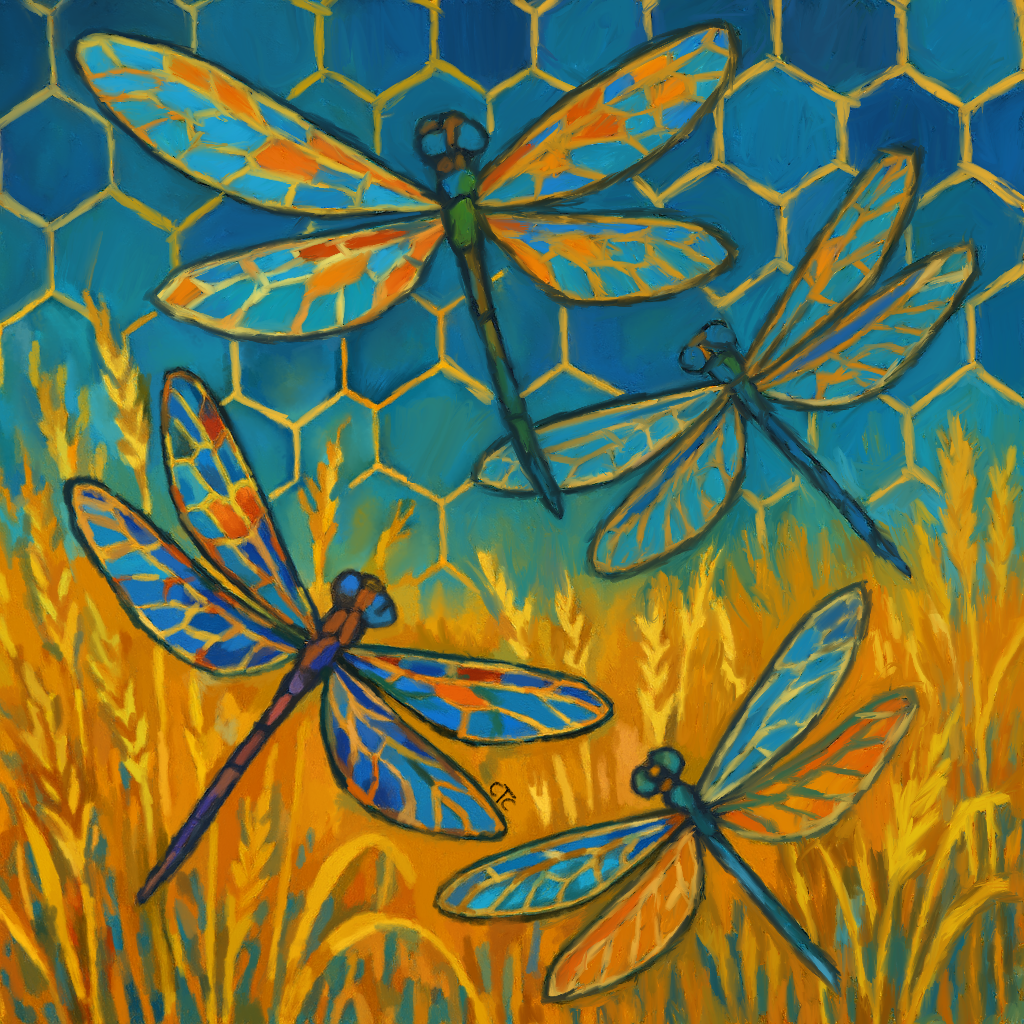
(I drew this in Procreate over 8 long hours, in which I began with the Eaglehawk brush, got bored and ended with the Oil Paint brush and then the HB Pencil. - Chaiga T. Cheska)
——————————————————————
The Hexadari Waltz
Sung in an Inn frequented by Dr Silmaretti
[Verse 1]
Where the basalt breaks even along the cold shore,
And the honeycomb holds what it carried before,
Six-legged and gliding through amber and haze,
The Hexadari moves in its hexagonal ways.
The snowflake that settles at six, never five,
The cell of the bee that keeps sweetness alive,
These are the patterns it follows and knows,
These are the angles where duality goes.
[Chorus]
Oh, turn, Hexadari, turn,
Six legs on the wind and the world holds its course,
Oh, turn, Hexadari, turn,
Neither shadow nor sunrise can alter its force,
Oh, turn, turn, turn,
Where the dark and the daylight must learn,
The Hexadari carries the weight of return,
Oh, turn, Hexadari, turn.
[Verse 2]
Where the light tips too heavy it carries it back,
Where the dark grows too greedy it steadies the black,
A glide through the thermal, a turn through the air,
Six legs weave the balance with infinite care.
The dragonfly’s eye and the carbon’s deep ring,
The tortoiseshell lattice of each ancient thing,
All governed, all gathered, all held in the span
Of six-sided order since the world first began.
[Chorus]
Oh, turn, Hexadari, turn,
Six legs on the wind
and the world holds its course,
Oh, turn, Hexadari, turn,
Neither shadow nor sunrise can alter its force,
Oh, turn, turn, turn,
Where the dark and the daylight must learn,
The Hexadari carries the weight of return,
Oh, turn, Hexadari, turn.
[Verse 3]
You’ll know it has passed by the still in the grass,
By the moment the morning goes clear as cold glass,
Where something that argued finds peace in the pause,
Where something that wavered remembers its cause.
Six legs leave no mark on the meadow at dawn,
Yet something too heavy has somehow been drawn
Back into the centre, the hinge and the seam,
The Hexadari glides where the gap holds its dream.
[Chorus]
Oh, turn, Hexadari, turn,
Six legs on the wind and the world holds its course,
Oh, turn, Hexadari, turn,
Neither shadow nor sunrise can alter its force,
Oh, turn, turn, turn,
Where the dark and the daylight must learn,
The Hexadari carries the weight of return,
Oh, turn, Hexadari, turn.
[Outro / fade]
Oh, turn, turn, turn,
Six legs on the wind,
Where the ending begins,
Oh, turn, turn, turn...
A Fortnight’s Observations Concerning the Hexadari
Fellow of Contested Methods, Chair of the Department of Creatures That Probably Shouldn’t Exist (Eastern Wing/with broken lamp)
Eastern Reaches, Golden Fields.
———————————————
These entries are private. Should Perrow be reading this, I would ask him to reflect carefully on the nature of professional boundaries and then make me a cup of tea.
Day One
Arrived at the Eastern Reaches field station late afternoon. Third hut on the left, as Bramwell’s letter said, the one with the corrugated roof and what I initially took to be an artistic decision regarding the door, but which turns out to simply be rot. Perrow has already organised the equipment with the quiet efficiency that I simultaneously appreciate and find slightly unnerving. Everything is in its correct place. This has never once happened on a previous expedition, and I find it faintly ominous.
The Golden Fields are, I will say, rather extraordinary. They run for miles beneath the ridge in amber waves so deep in colour that the late light sinks into them rather than bouncing off. The ridge itself carries that particular quality of MirMarnian high country where the air seems thinner, not because there is less of it but because something in it is paying attention. I stood at the edge of the upper meadow for a good while this evening, watching the light go off the basalt columns, and felt the particular mood that comes over me when I suspect a thing is going to be significantly more interesting than the Collegium’s briefing suggested.
Bramwell’s letter, which I have read four times now, looking for warning signs I may have missed, contains nothing I would call suspicious. It is warm. It is collegial. It closes with the line: “Do send me your notes. I have a feeling the Hexadari will have something to teach you.”
I am choosing to read this as encouragement, and I am going to stop thinking about it now and go to bed.
Day Two
Found the Hexadari almost immediately, which was gratifying, and then walked into a standing stone at dusk, which was not. The stone is not on any map. It is very much there. My shin can confirm this.
The Hexadari: amber-bodied, six-legged, wings folded so flat against the thorax in repose that at rest they look almost like particularly elegant twigs, right up until the moment they extend and you see the lattice in the membrane and understand that you are looking at something rather more considered than a twig. I counted eleven along the upper basalt ridge before the light went. They were unhurried. They moved with the composure of things that have somewhere to be and know precisely how long it takes to get there.
First impressions: quiet. Purposeful. Absolutely uninterested in me, which I respect and which also makes the work slightly easier.
I cannot find my field glasses. I will look again in the morning.
Day Three
My field glasses were on my head.
They had been on my head since yesterday morning. I discovered this when I removed my hat.
I have decided not to dwell on this. I am recording it purely for completeness.
Day Five
Significant progress today. I’ve established that the Hexadari concentrate most densely near the bee colonies along the upper meadow, and I’ve been watching them long enough now to begin to understand that this is not proximity for its own sake. They are not interested in the honey. They are not interested in the bees. They are interested in the comb, or rather, I suspect, in the conditions that produce the comb: the six-sided geometry that the bees have arrived at not by aesthetic preference but because it is the most efficient distribution of force available to them. Six walls hold more than five, hold more than seven, and waste the least wax in the making. The bees have known this for longer than MirMarnia has had scholars in it.
The Hexadari seem to know it too, and to regard it as a point of kinship. Or perhaps recognition. I am not certain kinship is the right word for a creature whose face communicates nothing warmer than patient attention.
Those compound eyes, I should note, are extraordinary. Deep amber going to gold at the centre. They do not blink. They simply regard. I have been regarded by them now for the better part of three days and I still find it slightly arresting, the quality of being watched by something that appears to have no particular opinion about what it sees but will certainly not miss anything.
Perrow asked this evening whether I had remembered to eat. I had not. This is normal. I thanked him and ate a biscuit and wrote four pages of notes and felt, on balance, that the day had been well spent.
Day Eight
Something I should record properly, as it may be relevant.
I hum. This is known. It is a method. When I am concentrating, I hum, the way some people tap their fingers or chew the end of their pen, and I am generally not aware I am doing it until someone mentions it or, on one occasion in the Collegium’s eastern reading room, until I was formally asked to stop by a note slid across the table from a colleague who I shall not name but who has, in my view, an unreasonable relationship with silence.
I bring this up because on Day Eight I was conducting observations in the lower meadow, on my hands and knees in the clover which is, yes, undignified, but the angle was necessary, and I was making notes and I was, apparently, humming. I became aware of this because I looked up and found fourteen Hexadari perched on and around my notebook with the composed and total stillness of things that have been there for some time and see no particular reason to go anywhere.
They were not threatened. They were not displaying. They were simply present, in the way that an audience is present. Arranged, I noted, with my pen hovering uselessly above the page, in a rough hexagonal formation around the notebook.
I stopped humming. They remained for another moment or two and then, without any visible communication or co-ordination, dispersed back into the meadow.
I am not sure what to make of this. I have written it down and am going to think about it for a while before I decide what it means.
It was a folk tune, incidentally. One I picked up at the village inn on the evening of Day One. Something about the Hexadari, as it happens. One-two-three rhythm, very catching. The sort of tune that gets behind the ears and stays there for days regardless of one’s feelings on the matter.
I am writing to Bramwell this evening. I am going to ask him, in a manner I intend to keep entirely casual, whether there is anything he neglected to mention in his letter of recommendation.
Day Eleven
I would like to record the following clearly and in full, because it is the most compelling thing I have witnessed in thirty-one years of fieldwork.
I was at the northern outpost, pre-dawn, instruments set up, flask of tea at my left elbow going cold because I kept forgetting it was there. The meadow was quiet. Perhaps forty Hexadari distributed along the upper ridge in their usual overnight positions.
Then, over the course of less than three minutes, every single one of them repositioned.
Not randomly. Not in reaction to anything I could see or hear or measure. In a co-ordinated, purposeful movement from the eastern face to a distribution across the full ridge length that I can only describe, having since checked my atmospheric instruments, as a precise counterbalance to a pressure shift that arrived, measurably and unambiguously, six minutes later.
They read it before it happened. They moved accordingly. The shift was absorbed. Down in the valley, the fields continued their morning without event.
I sat with this for a long time. The tea was entirely cold by the time I thought to drink it. I didn’t particularly mind.
I could not find my field glasses during this period. They were, I subsequently discovered when Perrow arrived at seven, on my head. This was the third time. Perrow’s face held the expression it has developed over the course of this expedition, the one that is completely neutral in a way that I am beginning to think requires considerable effort on his part. I thanked him. We proceeded. I wrote six pages before breakfast and considered them the best six pages I have written in some years.
Day Thirteen
I am going to write this entry plainly. I am going to resist the urge to contextualise it, qualify it, or soften it with the kind of scholarly framing that, in retrospect, exists primarily to protect one’s dignity. Here is what happened.
I was at the northern outpost. It was mid-morning, clear sky, good visibility, fourteen specimens visible from my position along the ridge. I was conducting measurements. I was, apparently, also humming. The folk tune. The one from the inn. I know the chorus particularly well by now because it has been residing behind my left ear since Day One and shows no sign of finding somewhere else to live.
I was not aware I was humming. I became aware I was humming at the same moment I became aware that there were no longer fourteen Hexadari on the ridge.
There were, by later count, fifty-three.
And they were turning.
Not landing, not approaching, not displaying in any way I could categorise from prior observation. Turning. In a slow, perfectly co-ordinated spiral with myself at the centre. The radius was perhaps eight feet when I first noticed it. It tightened, gradually, as the humming continued, which it did because I was still conducting my measurement and one does not like to stop a measurement partway through on account of an unexpected development, however arresting.
I finished the measurement. I stopped humming. The spiral dissolved in under thirty seconds. The creatures dispersed.
I put my notebook down. I looked at the valley. I thought about cartography very seriously for a few minutes, in the way I always do when the world has made a very particular sort of point at my expense, and then I accepted, as I always eventually do, that cartography involves triangulation and I cannot count to three reliably without stopping to think about it.
I ate a biscuit. I thought about what I had just observed. I thought about Bramwell’s letter. I thought about the line: “I have a feeling the Hexadari will have something to teach you.”
I am now fairly certain Bramwell knew. I do not know how he knew. I am going to ask him when I return, over tea, in a tone of voice that communicates my warm collegial regard for him and also my specific and detailed awareness of what he did.
Perrow, who had been positioned forty feet away throughout, said nothing until I looked at him. Then he said: “I would have mentioned the humming earlier, but it seemed like it might be important data.”
I looked at him for a moment.
“That’s either excellent fieldwork instinct or a complete absence of professional loyalty,” I said. “I haven’t decided which.”
“I’ve been keeping notes,” said Perrow.
“I know,” I said. “Give me a biscuit.”
Day Fourteen. Final Entry.
I am writing this on the hut step in the last of the afternoon light, which is doing that particular amber thing it does here in the late day, going warm and deep and slightly honey-coloured, as though the fields are breathing out after a long week of holding it together. The ridge is dark against it. Somewhere along the upper basalt, the turners are going about their business, reading the seam between light and dark the way they always have, long before anyone came out here with notebooks and instruments and an involuntary musical contribution.
I have, I think, understood something on this expedition that I will not be able to say adequately in the formal report. The Hexadari are not remarkable because they are strange. They are remarkable because the thing they do, holding the balance, reading the conditions before the conditions arrive, mending the seam between opposing forces, is something MirMarnia itself does, at every level, in every living thing that belongs here. The bee and the basalt column and the snowflake and the frost crystal all arrive at the same geometry because the world under these skies tends toward balance the way water tends downhill. The Hexadari are simply the most visible expression of that tendency. The most deliberate. The ones that have made it, in some sense, their entire purpose.
There is a myth in the village about them. I wrote it down on Day Three. It says the first Hexadari came from the crack between the two skies, when the seam between light and dark began to fray. I believed it was poetic on Day Three. I believe it is true now. Not literally, perhaps. But in the way that the old stories of MirMarnia are generally true, which is to say in a way that formal scholarship catches up to eventually, usually slightly out of breath and having just found its glasses.
Mine are on my head. I am leaving them there.
I am going home tomorrow. I am going to see Bramwell and have tea and a very specific conversation, and I am going to bring him honey from the upper meadow, which is unlike any honey I have tasted and which I suspect he will know the reason for without being told.
He usually does.
Dr Mikkel A. Silmaretti
Third Hut, Golden Fields, Eastern Reaches
Postscript: Perrow’s notebook is missing. It has nothing to do with me. I am entirely at peace.
————————————————————————————
A Note from the Author
Bramwell Corin delivered Dr Silmaretti’s field diary to me with the air of a man who had been waiting some time for someone else to deal with it. He said only that Silmaretti had asked him to “see it found the right readers,” and that the honey was, in fact, exactly as described, and that he was keeping the jar.
The Hexadari themselves came to me in the summer of 2021, whilst I was fighting cancer, when dragonflies began landing on me with the cheerful regularity of creatures with a point to make. I took this, quite rightly, as a sign of transformation and a firm instruction from the universe to stay put and get on with living.
Dr Silmaretti’s glasses are still on his head. Some things in MirMarnia are simply constants.
Chaiga T. Cheska