A Consideration of Sock-Based Economies and Associated Cultural Practices in MirMarnia
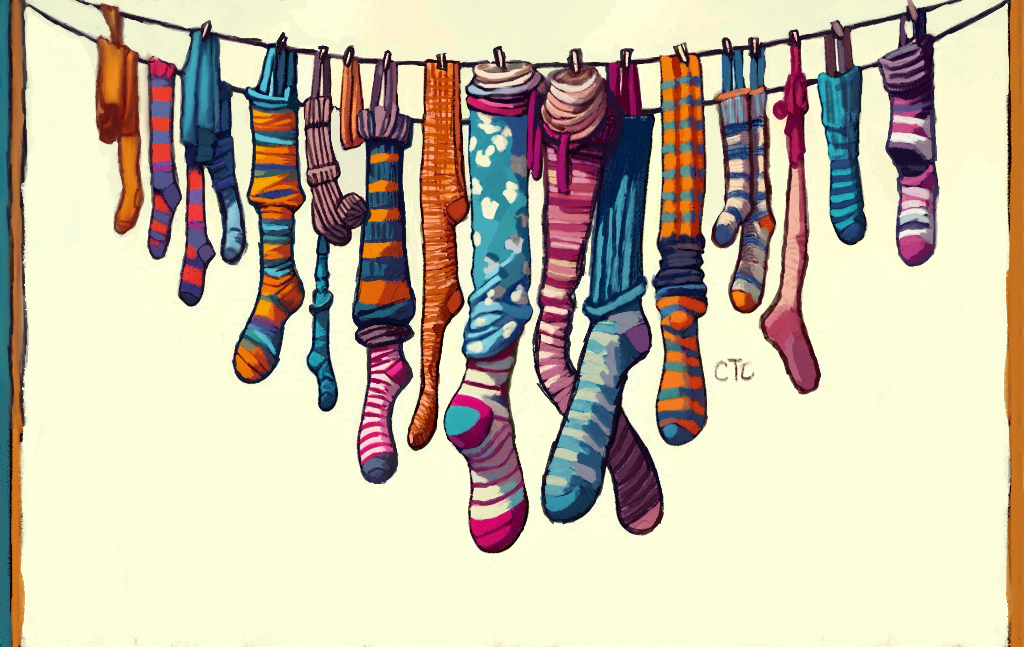
(I drew this image on Procreate using the HB Pencil and Eaglehawk brush on my iPad - Chaiga T. Cheska)
—————————————————————————————————————————————————-
From the Desk of Stanley Augustus,
Senior Research Fellow in Textile Economies,
Retired Financial Advisor of the Sock Exchange,
Keeper of the Lint Drawer,
Reluctant Survivor of the Great Wool Surge
——————————————————————————————————————————————————————————————————
It has been suggested, usually by people who have never attempted to balance a ledger during a regional sock shortage, that the MirMarnian reliance on socks as a form of currency is an affectation rather than a practical system. I can only assume such people have never visited the trading floor of the Sock Exchange during peak season, where market fluctuations move with the unforgiving speed of a dropped stitch. I was there for thirty-two years. I have the emotional scars, the professional commendations, and one very distinguished bruise to prove it.
That bruise, incidentally, was sustained during the Great Wool Surge, when a shipment of unusually soft alpaca socks caused a buying frenzy of such intensity that several junior analysts fainted clean away, one unfortunate intern attempted to stabilise prices by knitting furiously under his desk (admirable in spirit, catastrophic in execution), and the stairwell bannister gave out entirely under the accumulated weight of financial panic. I was standing at the bottom. I have mentioned this bannister to the Board on six separate occasions. They have yet to replace it. I consider this a professional slight of the highest order.
On the Use of Socks as Political Instruments
It is a little-known fact outside academic circles that several of the most contentious MirMarnian political debates have been resolved through the ancient practice of Sock Puppetry. I want to be absolutely clear: this is not a metaphor. Entire legislative sessions have been conducted with elected representatives delivering their arguments through elaborately decorated sock puppets, the theory being that the puppets encourage honesty and discourage the sort of posturing that ends in broken furniture and formal apologies to foreign dignitaries.
Results have been, in the most charitable possible assessment, mixed.
One particularly memorable session concluded when a puppet depicting the Minister for Agriculture bit the puppet of the Minister for Fisheries, an incident that required three hours of mediation and a written statement from both puppets. The Agriculture puppet was later acquitted on the grounds that it had been provoked. The Minister for Fisheries maintains, to this day, that the acquittal was a miscarriage of justice. He brings it up at every civic gathering. I have been seated next to him at dinner twice and have developed a reliable system of appearing to be urgently called away.
Sacred Sock Wells and the Question of Cosmic Significance
In certain regions of MirMarnia, socks are not merely currency but offerings. Sacred Sock Wells, which appear to be natural fissures in the fabric of reality rather than simple holes in the ground, are believed to accept socks in exchange for clarity, luck, or occasionally a faint but persistent smell of lavender that follows the donor home and refuses to leave their coat.
I have visited three such Wells in my lifetime, each time approaching the rim with my notebook open and my pencil ready. On each occasion, my pencil snapped. Not bent, not broken at the tip, but snapped cleanly in two, as though something at the bottom of the Well had formed a considered opinion about academic documentation and acted on it. After the third incident I purchased a pencil of reinforced graphite from a specialist supplier. It lasted until I was within four feet of the Well, at which point it also snapped, along with my spare.
I have chosen to interpret this as a sign of cosmic respect rather than cosmic rejection. My wife interprets it differently. We do not discuss the Wells at dinner.
Romantic Sock Trading and Other Social Peculiarities
Amongst the younger population, the practice of exchanging socks as a declaration of romantic devotion has risen to such prominence that it is now considered entirely unremarkable to present a prospective partner with one’s favourite sock as a gesture of profound trust and emotional commitment. I find this, considered objectively, rather touching. A sock is an intimate thing. It has accompanied you everywhere. It knows your feet.
However, I cannot help but notice the long-term economic implications of removing socks from circulation for sentimental reasons, and I have raised this concern at several academic gatherings with what I consider appropriate urgency. On each occasion, someone has distracted me by mentioning shoelaces. I cannot explain this pattern. Every time the subject of shoelaces arises, my train of thought derails so completely that I lose not merely the thread of the argument but also, frequently, the argument itself and several minutes of the afternoon. It has been suggested that I have an unusual relationship with the topic of shoelaces. I refute this entirely. I simply find them deeply, profoundly unsettling, and I prefer not to discuss them, and I would appreciate it if people would stop bringing them up at conferences. Thank you.
Celestial Alignments and the Constellation Prophecy
No serious discussion of sock-based belief systems would be complete without reference to the Constellation Prophecy. According to this tradition, certain lost sock patterns, if recovered, would map directly onto star formations, suggesting that they served as navigational guides for travellers, philosophers, and, if one older account is to be believed, a baker who insisted that the correct temperature for sourdough was written in the sky and had simply been woven into wool for safekeeping. I remain agnostic on the baker.
What I do not remain agnostic about is the very real and well-documented history of expeditions mounting serious searches for these missing socks. I attended a planning meeting for one such expedition in my fortieth year, having been invited on the basis of my Exchange credentials. The expedition leader unrolled a map and asked if I could identify the region most likely to contain the celestial pattern known as the Wandering Heel. I said that I could not but that I admired his methodology. He seemed gratified. The expedition departed two weeks later, found nothing, and returned smelling strongly of river mud and mild defeat. The leader has since written a book about it. It is selling very well.
The Carnival of Excess and the Display of Wealth
Every year, without fail, the wealthiest families of MirMarnia gather for the Carnival of Excess, an event dedicated with considerable enthusiasm to the celebration of extravagant sock wearing. Participants parade through the streets in towering sock constructions of genuinely alarming structural ambition, some requiring iron frameworks, professional engineers, and at least two attendants whose sole duty is to prevent the whole edifice toppling onto a spectator.
I attended the Carnival once, in my youth, under the impression that it would be an interesting cultural experience. A gentleman in front of me was wearing a twelve-tiered sock construction representing the history of MirMarnian diplomacy. It began to list on the third tier, which depicted the Fisheries Accord of 1142. I was watching it with professional interest when it came down across the street and nearly took me with it. I was found twenty minutes later, beneath what appeared to be the Woollen Age of Early Settlement, in perfectly good health but with a strong personal conviction that one Carnival in a lifetime is sufficient.
Magical Beliefs and the Fading of Sock Magic
There persists, across several generations of MirMarnian folklore, a belief that socks originating from other worlds once carried genuine magical properties, though these powers are said to fade upon entering MirMarnia, much as certain cheeses lose their character after a long journey. Threadweavers tell stories of socks that could predict weather systems, calm tempests at sea, or, in one account I have read three times and remain unconvinced by, recite short poetry when placed near an open flame.
I attempted to test this theory with a sample sock sourced from a reputable dealer in interplanetary textiles. The sock disintegrated when I sneezed. I am choosing not to read anything into this.
The Book of Forgotten Weaves and the Temple of Unravelled Spools
The legendary Book of Forgotten Weaves is said to contain the complete history of every magically intended sock ever crafted, the text woven rather than written, readable only by those trained to interpret the subtle grammar of thread. Scholars believe the book is housed in the Temple of Unravelled Spools, which has the inconvenient habit of relocating itself without notice and without leaving a forwarding address.
I attempted to find it once using a map knitted by an extremely optimistic cartographer. The map unravelled at a junction. Not partially, not at one corner, but completely, from the middle outward, until I was standing at a crossroads holding what amounted to a loose ball of wool and no idea which direction was north. I walked home. The cartographer, when I found him, said this was “entirely within expectations.” I have not commissioned a second map.
Scent Wardens, the Festival of Faded Fragrance, and the Unwashable Sock
The belief that particularly pungent socks hold the strongest magical echoes is not, as casual observers might assume, a folk superstition. It is thoroughly documented, rigorously recorded, and taken with absolute seriousness by the professional community of Scent Wardens, who catalogue olfactory qualities with an attentiveness that I respect enormously and would not personally wish to emulate.
I observed a senior Warden at the Festival of Faded Fragrance inhale the aroma of a notably assertive sock and declare, without hesitation, that it contained memories of heartbreak, professional triumph, and a disappointing lunch. He then recorded this in a leather-bound notebook with the composed expression of a man who found all of this entirely ordinary. I did not ask which lunch. Some information, I have learned, one is better off without.
Legends speak of an Unwashable Sock, still carrying its full original enchantment precisely because no one has ever dared launder it. Several expeditions have sought it. None have succeeded. One returned with a sock of such extraordinary pungency that the entire team was quarantined for a week in a meadow outside the city walls whilst the sock was assessed at a cautious distance by a Warden wearing a dampened cloth over the lower half of his face. The Warden’s official report described it as “promising but inconclusive.” The team described it rather more directly. I have quoted neither in full, as this is a scholarly document.
The Lost Binding Prophecy and the Skyweave
The Lost Binding Prophecy tells of a grand ritual in which thousands of socks, each one read and recorded before inclusion, were bound together in an attempt to rekindle a magic old enough that no one living could quite remember what it had originally done. A storm swept the entire bound collection into the sky, where they vanished.
Some believe they formed the Skyweave, that shimmer on clear nights that isn’t quite cloud and isn’t quite stars, the bound meanings of ten thousand socks drifting silently overhead. Others maintain, with the flat confidence of people who consider themselves practical, that the socks simply blew away.
I prefer the Skyweave theory. It is more dignified. It also explains, I have always thought, a certain quality the sky has over MirMarnia on clear autumn evenings, when the light sits in it at a particular angle and the air carries a scent that isn’t quite wool but isn’t not wool either. I have mentioned this to my colleagues. Most of them looked at me in a way I found difficult to interpret. One patted my arm. I am choosing to take this as a sign of collegial warmth.
Closing Remarks
I am often asked, by students, by colleagues, and on one occasion by a customs official who found my research notes deeply suspicious, why I have devoted my later years to the study of sock-based phenomena when I might instead have retired quietly with a garden and several undemanding hobbies.
The answer is simple. Socks, unlike shoelaces, do not attempt to strangle you. They are reliable. They are expressive. They are occasionally prophetic. They have shaped our economy, our politics, our romantic lives, and our myths. A world that has built its culture around the humble sock is, in my considered opinion, a world with its priorities very nearly right.
I shall end, as is my habit, with a line of verse.
O thread that binds the wandering foot, guide us where the stars are stitched.
I recited this to a group of postgraduate students during a seminar last spring. They applauded with every appearance of sincerity, then filed out before I could reach the section on the dangers of footwear with more than four eyelets. I will get to it eventually. I have a great deal still to say on the subject.
Next lecture: The Eyelet Problem, and Why Nobody Wants to Hear About It.
————————————————————————————————————————————————————————————————————-
Author’s Note:
I sometimes worry that MirMarnia’s scholars are becoming stranger with every passing year, but then Stanley arrives with a treatise like this, and I remember why I love them. His devotion to textile economics is unwavering, his anecdotes increasingly improbable, and his poetry recitations unstoppable. I offer his work here in the spirit of scholarly curiosity and gentle indulgence.
-Chaiga T. Cheska