From the Private Diary of Ravendura Threnmorra, Runethreader of the High Archive of Thornvale
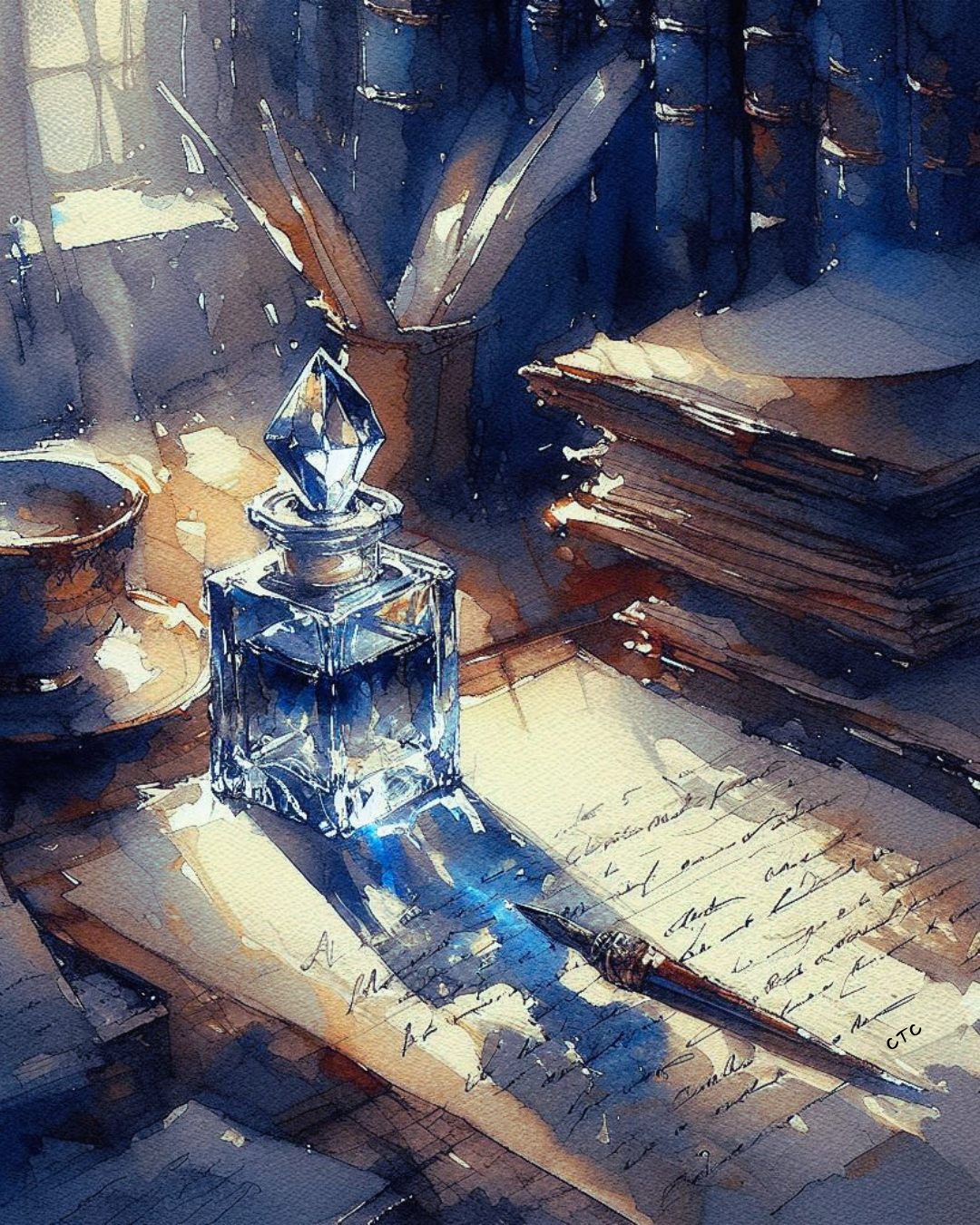
Reproduced here at the insistence of my supervisor, Halvren, who has recently developed strong opinions about scholarly transparency. I have strong opinions about Halvren, but this is not the place
Entry dated: Third Cycle of the Waning Moons
For the record, I had budgeted twelve minutes. Thirteen, if the vellum was in one of its moods, which Archive vellum generally is. I had a cup of tea. I had a perfectly adequate Tuesday afternoon stretching before me, and all I intended to do with it was establish whether Caelvaris Noctis fluctuates in glow intensity with ambient glyph resonance, write four sentences about my findings, and get on with the overdue field report that Halvren mentions every morning with the cheerful persistence of a man who has never once been distracted by anything interesting in his life.
I should note, before I continue, that the corridors moved again last night. Not dramatically. They never do it dramatically, which would at least have a certain honesty about it. They simply shift themselves by increments between the third and fourth hour, so that one arrives at work in the morning confident one knows the way to the east reading room and ends up in a stairwell that was not there on Monday. The High Archive of Thornvale is built into the cliff face at Thornvale’s northern edge, which means that relocating the institution itself is not an option anyone has seriously entertained since the incident of 1203, the details of which are sealed in Chamber 2A and apparently quite upsetting. The corridors know this perfectly well and have been taking advantage of it for centuries. Senior scholars develop what the induction materials call “adaptive navigation instincts” and what the rest of us call “the ability to find the kettle by smell alone.” I have worked here for seven years, and I still occasionally end up on the external walkway in my indoor shoes, blinking at the sea.
This morning it added fourteen minutes to my commute, which I mention only because it contributed to the precise mood of mild irritation in which I sat down to conduct what was meant to be a perfectly routine experiment.
Caelvaris Noctis is, for those unfamiliar with it, a remarkable ink. Star-woven, constellation-caught, shimmering with the faint luminosity of something that was never entirely meant to sit in a vial on a shelf. There is a rather well-known poem about it, which I grew up hearing rather more often than most people, owing to the fact that my father was Lorien Thatch and my father had, by most accounts, the most famous encounter with a bottle of unusual ink in living memory. He dipped a pen into it one evening whilst mapping moonpaths, wrote himself sideways into something the poem describes as “fate’s own lands,” and has not been reliably located since. I have spent sixteen years in this Archive attempting to establish exactly where that is, which is why I studied what I studied and why Halvren, to his credit, has never once suggested I take up something more practical. He does keep asking about the field report, but that is a separate matter entirely and one I intend to address when the corridors stop making it unreasonably difficult to reach my desk before noon.
The point is that I know this ink. I know its history, its properties, its catalogued behaviours, and the precise romantic tendency it has inspired in poets who were not the ones left behind with a rather bewildering inheritance and a specialisation in runethreading. I approached it with professional detachment. I drew a containment sigil, the same one I have drawn approximately four hundred times, a sigil so familiar my hand finds it without any instruction from the rest of me.
The ink pulled the line out of my hand and drew something else entirely.
I appreciate that this requires some clarification. I do not mean it moved dramatically or produced a flash of light or any of the effects the poem describes with such enthusiasm. It simply redirected the stroke, very calmly, the way a more experienced person might adjust a junior colleague’s grip on a pen and produced a path glyph I did not recognise from any catalogue. It had the basic structure of a moonpath sigil, but an early one, the sort made before a mapmaker has learned to be confident. There was a small upward flourish at the end of the final curve, an old habit, the kind that belongs to a particular hand rather than any formal training. My father used to draw them exactly like that, and before anyone notes that I may be seeing what I wished to see, I would point out that I have spent sixteen years being extremely rigorous about precisely that concern and I know the difference.
The vellum warmed. The faint after-images left by previous writers, which are ordinarily about as visible as an apology from the eastern corridors, brightened all at once, rather like a lantern turned up behind frosted glass. The room acquired a quality of depth it had not previously contained. I touched the glyph. It brightened further. I removed my hand and it settled again, and the ink returned to its usual composure as though the entire business had been a minor administrative note rather than the first concrete thing I have had in sixteen years. I attempted to repeat the test. The ink declined, with what I can only describe as the air of something that has said what it came to say and considers further discussion unnecessary. It has, I note, more in common with the corridors than I find entirely comfortable.
The vellum is now sealed in Chamber 7B, still faintly luminous, which I verified twice. I will examine it properly at dawn, assuming Chamber 7B is still where I left it, which on current form is not the guarantee one might reasonably expect from a place of scholarship. The corridors have been particularly restless this week and twice now have deposited colleagues outside on the cliff walkway without apparent reason or remorse. One Archivist Pendrel filed a strongly worded note about the corridor situation in 1219. The corridors responded by relocating his office to the external walkway, where it remained for six months. Strongly worded notes have not been attempted since.
Halvren’s report will keep until morning. This entry will not go into it. I will extract the professionally presentable portions later and write them up with the appropriate detachment that field reports require, which is to say I will make them sound as though I was not sitting very still at my desk afterwards for rather longer than twelve minutes, doing nothing in particular whilst the ink gleamed quietly in its vial and the Archive settled around me with the particular sort of silence that suggests it knows something it is not prepared to share.
Ravendura Threnmorra Runethreader of the High Archive of Thornvale (And not, as Halvren has taken to writing on my correspondence, a Quillwarden. We have discussed this on four separate occasions. I am beginning to think he finds it funny. The corridors, for what it is worth, appear to find everything funny. They have yet to explain the joke.)