A Provisional Librarian’s Survival Guide
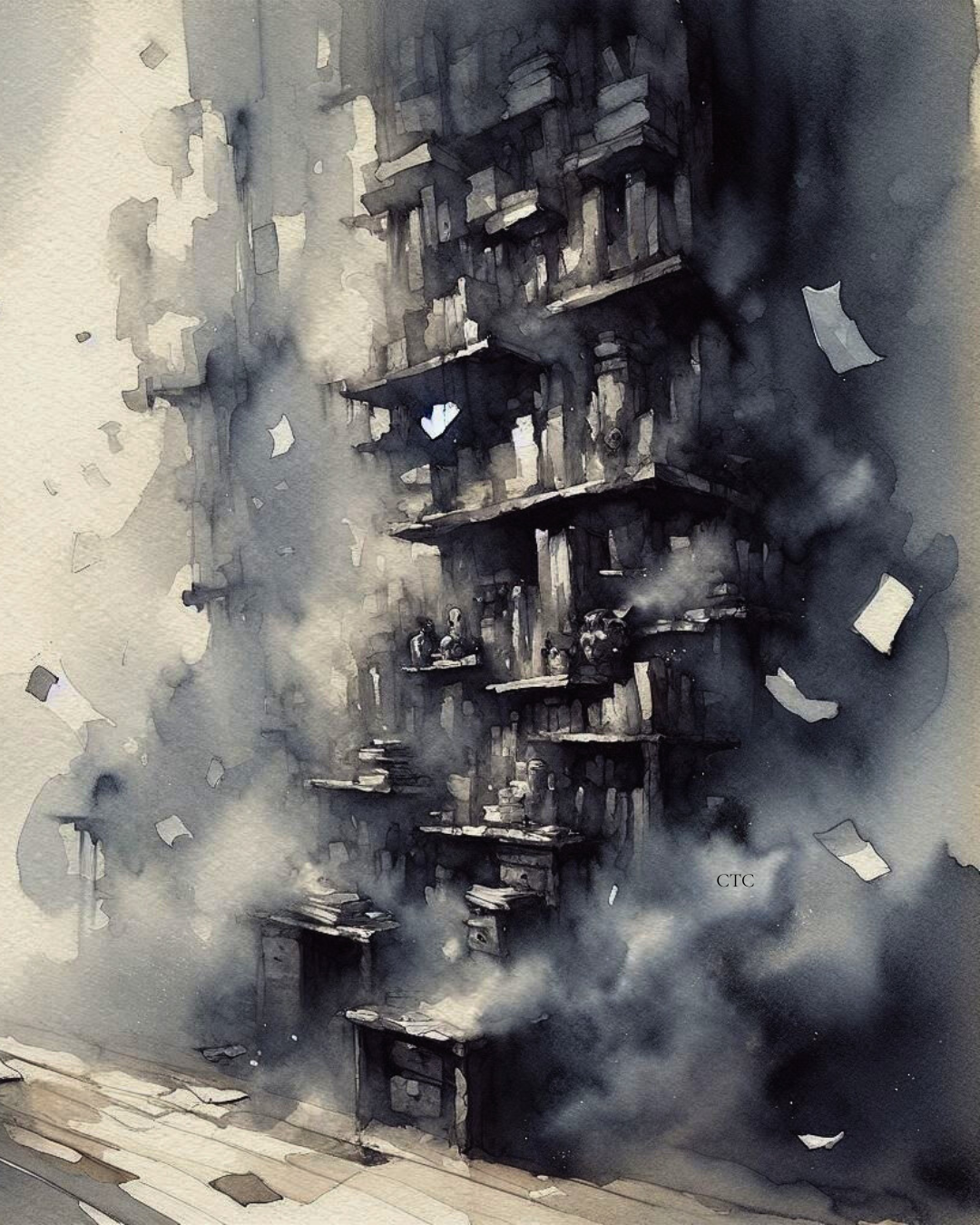
Being a collection of urgent observations by someone who definitely did not sign up for this
By Pip Thimble, Junior Librarian (Provisional) (Apparently) (Help)
I won a raffle I never entered.
This, I have learned, is how the Wandering Library recruits its staff. One moment I was purchasing turnips at the market in Lower Wrenford, the next a rather officious-looking woman with a quill that appeared to be writing in three different tenses simultaneously informed me I had won “a position of great responsibility and moderate peril.” When I attempted to explain that I had not, in fact, entered any raffle, she looked at me with the sort of patience one reserves for the particularly dim and said, “The Library entered on your behalf. It knows what it needs.”
That was six weeks ago.
I have since learned that arguing with a sentient, ambulatory library is an excellent way to find oneself shelving books in sections that did not exist yesterday and may not exist tomorrow. The Library, I am told by Mistress Spine (who terrifies me), has “a nose for potential.” I suspect it has confused potential with desperation, but I am not brave enough to say so aloud. The walls have ears. Possibly literally. I have not checked.
What follows is my attempt to document the peculiarities of working in an establishment that moves, develops opinions, and occasionally rearranges entire wings out of what I can only assume is architectural mischief. I began keeping these notes after my third day, when I opened a door marked “Lavatory” and found myself in a reading room devoted entirely to books about regret. The door had not been there that morning.
On the Matter of Doors
The doors are not to be trusted.
This morning, the main entrance opened onto a meadow near the Pogonariel. By noon, it opened onto a cliff overlooking the Emaris River. At teatime, it opened directly into what appeared to be someone’s root cellar, startling an elderly woman who was in the middle of a conversation with her turnips. She did not seem surprised to see a library. I was too surprised to ask why.
The interior doors are worse. They develop personalities. The door to the Restricted Section has taken a dislike to me and will only open if I apologise first. I do not know what I am apologising for. The door to Mistress Spine’s office hums judgmentally whenever I pass. The door marked “Definitely Not the Lavatory, Don’t Even Try” is, in fact, the lavatory, but only on Wednesdays.
I have learned to knock before opening anything, including windows.
On the Behaviour of Books
The books move.
Not dramatically. Not all at once. But if you turn your back for more than thirty seconds, they will have rearranged themselves according to logic known only to them. Yesterday, every book containing the word “brotherhood” had migrated to the front desk. When I attempted to re-shelve them, they returned by morning. I have given up fighting this.
Some books are friendlier than others. “A Beginner’s Guide to Not Panicking” followed me around for an entire week, appearing on whatever surface I happened to be near. I found it comforting until I realised it was following me because I clearly needed it.
Other books are less helpful. “The Compendium of Things That Went Wrong and Whose Fault It Was” opens itself to random pages whenever I walk past. Last Tuesday, it opened to a chapter entitled “Junior Librarians Who Touch Things They Shouldn’t: A Retrospective.” I have not touched it since.
There is a book titled “Awakening: A Comparative Study of Late Manifestations” that glows faintly after dark. I asked Bramwell about it. He said, “Best not to stare directly at it,” which was not the reassurance I had hoped for.
On the Autocurator
The Autocurator is, I am told, a sentient amalgamation of index cards, loose pages, and the occasional disgruntled bookmark. I have never seen it in full form. I have, however, experienced its presence through:
1. Sudden draughts that rearrange my hair and paperwork simultaneously
2. Notes appearing on my desk in handwriting that is definitely not mine
3. The sensation of being watched by something that smells faintly of old glue and disapproval
Last week, I made the mistake of misshelving a book about mixed heritages. Within minutes, a gust of wind knocked three volumes off a nearby shelf, all of which landed open to chapters about “respecting the natural order of cataloguing.” I have since developed a nervous habit of asking permission before touching anything.
The Autocurator communicates primarily through pointed silences and the strategic relocation of furniture. Yesterday, I arrived to find my desk had been moved six feet to the left. There was no explanation. There was, however, a note that read: “You were too close to the books on premature magical manifestation. They were becoming anxious.”
I did not know books could be anxious. I am now anxious on their behalf.
Things I Should Probably Not Touch Again: An Incomplete List
1. The teacup that sings (it holds grudges)
2. Any quill that sorts itself (they are judging you)
3. Books with titles that change when you look away
4. The entire section labelled “Ephemeral Truths” (I am not convinced it is entirely real)
5. Anything glowing (this should be obvious, but I am including it for thoroughness)
6. The mirror in the second-floor corridor (I saw my reflection blink independently)
7. Books about storm gods (they crackle)
8. The Filing Cabinet of Unresolved Questions (it asked me a question back)
On Visitors
We do not get many visitors, as the Library is rarely in the same place twice. Those who do find us fall into three categories:
1. The Desperate: They arrive looking for answers to questions they can barely articulate. The Library lets them in immediately. Sometimes they leave with books. Sometimes they leave with more questions. Always, they leave changed.
2. The Lost: They thought they were going to the market or the post office. They are confused but not alarmed. The Library gives them tea and a biscuit and sends them on their way with a pamphlet about being more observant.
3. The Summoned: The Library was looking for them specifically. These visitors are rare. Last week, a young person with pale blue skin and green runic patterns arrived asking after texts on Caelvarae heritage. They spoke very quietly, as though unused to conversation. The Library provided three volumes before they had finished their question. I have never seen books move that quickly. The visitor left with the books tucked under one arm, and I noticed the way the doorway seemed to bow slightly as they departed, as though the Library itself were bidding them safe travels.
I asked Bramwell about this. He said, “The Library knows what people need before they know themselves.” Then he returned to cataloguing a book entitled “The Ambiguity of Destiny” and refused to elaborate.
On the Library’s Wanderings
The Library does not consult anyone before relocating. One simply wakes up somewhere new. This week, we have been near the Sentinel Forest. I have seen the trees from the upper windows. They are very large and appear to be watching us. I do not look at them for long.
Mistress Spine says the Library is following a story. She says this with the sort of certainty that makes me afraid to ask which story, because I suspect the answer will be “You already know.” I do not already know. I know very little, in fact, which seems to be a qualification for employment here.
What I do know is this: the Library has spent more time than usual near places where questions gather thick as fog. Near the Emaris River, where the water whispers things I cannot quite hear. Near Drakkensund, where the mist holds shapes, I cannot quite see. Near The Eldertree Forest, where the roots hum with something old and patient.
The footprints we leave shimmer. Villagers collect them. I have stopped asking why.
Closing Observations
I did not choose this position. The Library chose me. Why, I cannot say. Perhaps it sensed potential. Perhaps it sensed confusion and decided that was close enough. Perhaps it simply needed someone to shelve the books about regret, and I happened to be holding turnips at the right moment.
What I have learned in six weeks:
1. Libraries can lay eggs
2. Books have opinions
3. Doors lie
4. The Autocurator is always watching
5. If you are unsure whether something is dangerous, it probably is
6. Do not anger the teacup
7. Something important is happening, and the Library knows what it is
I intend to survive this employment. I intend to learn the filing system, assuming one exists. I intend to stop opening doors marked “Definitely Not the Lavatory.”
Mostly, I intend to pay attention. Because when a library walks on improbable legs toward something it refuses to name, the least one can do is take notes.
Even if those notes will probably rearrange themselves by morning.
Written from my desk (current location: second floor, eastern wing, subject to change without notice). The Autocurator has just moved my chair three inches to the left. I do not know why. I am choosing not to ask.