Part 31: Ceiling Galaxies
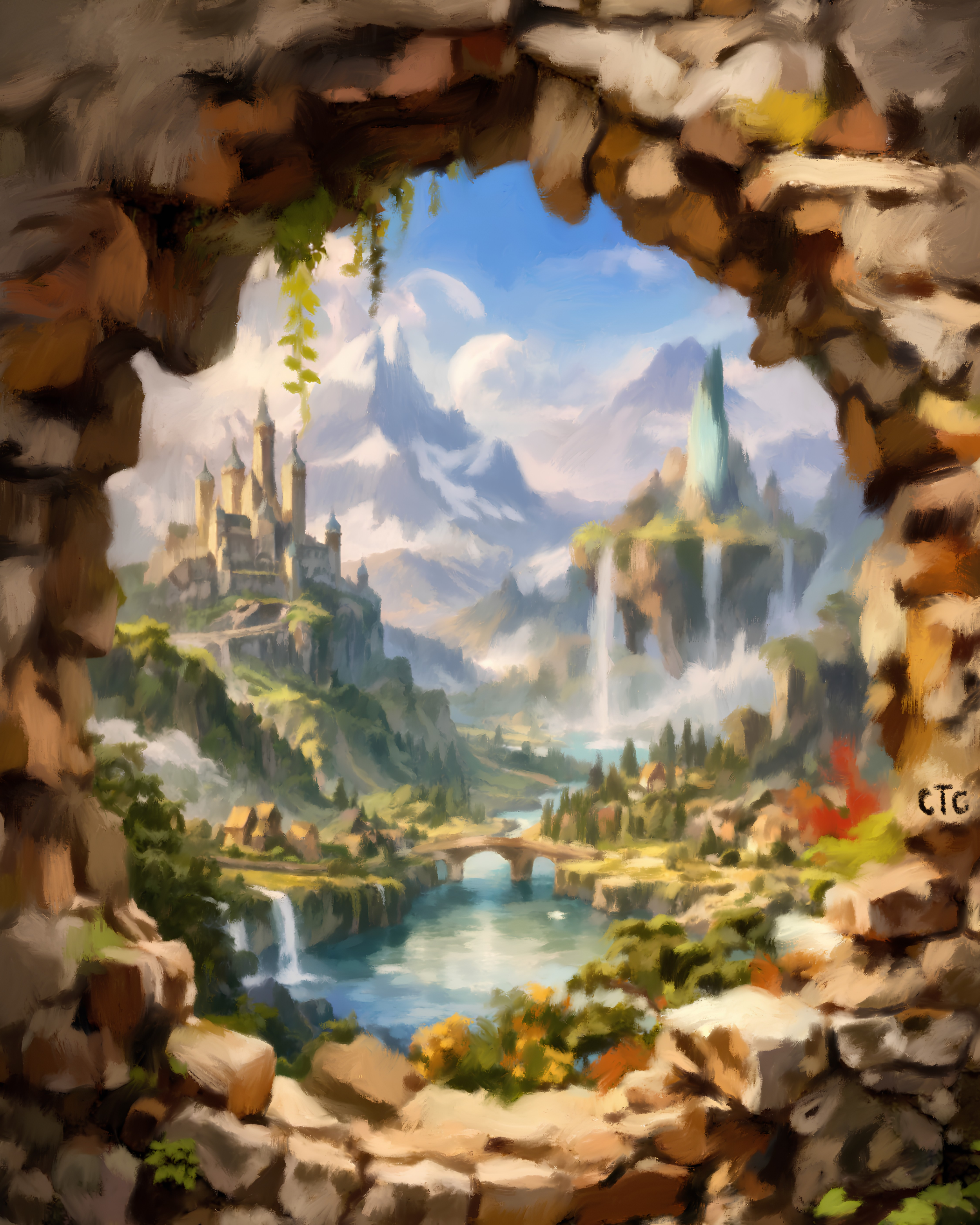
(I painted this in Procreate using the oil paint and turpentine brushes. - Chaiga T. Cheska)
~~~
Being an account of a ceiling that acquired its own heavens overnight, a farmer who mistook a junior librarian for a doormat, a scholar in possession of more spectacles than any two eyes could reasonably require, and a cake that had to be described to us in nebulae.
Compiled by Bramwell Corin, who was up before everyone else, and would like it noted that being first out of bed has never once meant being first to understand.
I was always awake before the rest of the staff, though since taking up residence in the attics I had come to regard it less as a habit than as a post. There was an hour, somewhere between the last of the dark and the first of the proper light, when the window above my bedside table turned the colour of a well-used pewter plate, and the whole Library held itself very still, and nobody anywhere had yet thought of a single thing to ask of me. I would not have swapped it for a fortnight in bed.
I was careful to be as quiet as possible, since my room is next door to my young colleague, Pip, who, at nineteen, still thinks that even nine in the morning is too early. I have now got into the habit of checking each shoe for adhesive when putting them on, as I’m still slightly shell-shocked from recent pranks by my other colleague, Thaddeus.
Since I am always the first up, I enjoy walking from my room down into the main parts of the Library, chatting with our Library, as one does when living in sentient buildings. As most know, our Library likes to communicate with me by dropping books from the ceiling, with its responses written as titles on each book. It may look rather odd to someone not used to this exchange, but I find it stimulating and look forward to our conversations.
That morning, I asked the Library in the usual way, halfway down the second flight, one hand on the bannister. “Good morning. How are you? Did you have a good night?”
The books arrived before I had finished the question.
Not one book, as was customary, laid politely at my feet with a title I could sit with over tea, but a whole shelf’s worth came down in a thudding, slithering avalanche. I caught the first six against my chest like a porter receiving bricks, nearly lost my grip on the bannister, and ended by sitting heavily on the stairs.
I set them out along the step in order of size, which was how I dealt with anything I did not yet understand, and I read the spines.
“An Atlas of the Heavens, With Generous Margins for Wonder”. “Seven Hundred Ways for a Star to End, Most of Them Loud”.
And lying a little apart from the rest, as though it had slid there on purpose: “I Was Awake. Have You Seen How Much of It There Is?”
I took that last one as my answer. I knew the signs. The Library’s enthusiasms came in waves: the ship on the Emaris, the flamenco, the Victorians. This one had begun with many books falling on me, suggesting scale. I went on down, with the mild dread of experience, wondering what form it had taken overnight.
It had taken over all of the ceilings.
The reading room ceiling had always been an honest one: dark wooden beams, a good deal of dust, and a water stain near the chimney in the shape of Lower Hollowmere, of which I had grown fond. The beams were still there, dim and patient behind everything else, like the ribs of a ship glimpsed through deep water. But in front of them, and in every direction I turned my head, hung the heavens.
Not a painted dome of the kind found in a cathedral, with a plump cherub in each corner. This one moved: a small system of galaxies, individual planets, stars, meteor showers, and nebulae turned above the returns desk at the pace of a well-oiled clock, a blue one, a banded brown one with a ring about it like a spinning hoop, and beyond them a great slow spiral of light laid over the dark like cream stirred into tea. Over the Regional Almanacs, a star came to the end of itself and let all its light go in a single unhurried bloom of rose and white, and in the corner by the coat stand, new stars were being lit one after another, like pins spilled on dark cloth.
I stood in the doorway with an armful of astronomy books and, I am sorry to say, had a thought that it was harmless. I set out the reasoning in full so that anyone who comes after me may see precisely where it went wrong.
It was the same in every room. In the staff room, the ceiling was full of falling stars, rather more than seemed strictly necessary, so the whole room looked like a person in a very good mood. I took my tea and toast to my desk, having first examined my chair and sniffed the tea, which was how I began every day by then. Pemberton took possession of one corner of my blotter, on the principle that anyone up and about was probably carrying food.
The others came down in ones and twos over the next half-hour, and every one of them walked beneath the most extraordinary ceiling in MirMarnia without so much as lifting a chin.
Thaddeus came first, Barnaby asleep in the front pocket of his satin waistcoat, and gave me a nod of perfect innocence, which was worse. Lyria came next, a cup in each hand, and offered me a small sunrise, one hand lifting slowly from the flat of her other hand, which I took to mean good morning. Mistress Spine arrived a little before seven, wearing the frown she kept until she had had her coffee, a look of someone personally wronged by daybreak, and went straight beneath a star in the very act of being born to the coffee pot.
Pip came last, as he always did, on the wrong side of consciousness, his top hat askew, as if it had been set there by someone else in the dark, dragging each foot down the back stairs. He ate his cereal as though he had been told to and was doing his best: one eye shut, the other at half mast.
On my blotter, Pemberton made a low remark, a soft, drawn-out cluck she kept for me alone. When were they going to notice? She seemed to say.
Pip finished his cereal and leaned back in his chair, and I could tell from the set of his shoulders that he intended to shut his eyes for just a moment. He tipped his head back, glimpsed the swirling galaxies, and promptly fell out of his chair with a yelp, which I must admit I found rather amusing.
Pip’s Account
I was NOT asleep. I was resting my eyes, which is a totally different thing, and everybody knows it!!! And the ceiling was NOT like that when I went to bed, so who checks the ceiling of a building before breakfast?? Bramwell sat there LAUGHING at me the whole time. He KNEW and said NOTHING, which is basically a prank, so I’m counting it.
Bramwell’s Account
Once Pip had noticed, of course, everybody noticed. Mistress Spine came out of the staff room with her cup and stopped. Thaddeus looked up from Barnaby and kept looking for a long time. Someone said that whatever it was, it could do no harm, being only an illusion, and we all agreed, with the easy warmth of people who had said this in that building before and been proved wrong. We went to our work.
The Library had come down into the village of Trowley Bottom four days earlier, in a valley shaped like a cupped hand, with high fields climbing away on every side, hedged and patched in every shade of ochre and green, and lanes lined with small cherry trees whose leaves had begun to turn the colour of old copper. It was farming country, quiet and sheltered, and that morning the mist lay on the valley floor like milk in a saucer.
At about eleven o’clock, the front doors opened and our first visitor came in from the mist, with a good part of a field on his boots.
His name, I learnt, was Jeremiah Titsworth, and he farmed the slope to the north. He was heavy in the jowl, his stubble the colour of wet slate, and his coat had given up on its buttons some time ago. Disappointment had settled on him like weather. His crops had not come as they should, and that morning his younger son had told him that what the farm needed was a proper book and that the library in the valley was the best place to look. Beneath his temper, and there was a good deal of it, I did not believe he was a bad sort. He simply no longer expected anything to turn out well. (You may wonder how I know all of this about the man before even meeting him; the interesting thing is that after these events listed here and before I compiled my accounts of the events, I ran into his son in the local bakery and ended up chatting with him in the queue whilst waiting for my order of sausage rolls for a staff picnic, hence my knowledge of this farmer here.)
He glanced up once at the whole turning glory of the ceiling, with the flat eye of a man who had spent his working life looking at skies and had never been thanked for it, then looked down again. It was nothing he could plough, so it held no significance.
The first desk by the door was Pip’s. Pip was bent double over a box of old books from the morning’s donations. I watched the farmer give my younger colleague a single look and thought I’d keep my eye out, just in case.
He did not say good morning. He leaned across the desk and thumped Pip on the top of the head with a fist the size of a small loaf, as one raps on a door to find out whether anybody is home.
Pip shot upright with a yelp, both hands to his head. He was nineteen, small, and not by temperament a fighter; his instinct in any confrontation was to become less noticeable, and I saw him try. His eyes went past the farmer’s shoulder and met mine across the room. I was on my feet. I will say, in my own defence, that I did not step in on a junior colleague’s behalf until it was necessary. I was counting to ten in the interests of his dignity and had reached six.
Then Pip did the thing I am proudest of him for in this account. He straightened his waistcoat. He tugged down the tails of his jacket. He set aside the throbbing in his head, which must have been considerable, and said, in his very best public voice, “Good morning, sir. What can I do to help?”
“Book,” said the farmer. “My lad says I need it for farming. I want it now, and I’d be obliged if you’d get on.”
“Of course,” said Pip, who had never in his life been able to let a question go unanswered. “It’s only that we have a very large farming section, sir, which divides into arable, livestock, and orchards. The business side has three shelves of its own, so if you could give me just an idea of which sort of business...”
I watched the farmer’s face as this went on. I had seen a kettle come to the boil with less warning.
“I came in for a book,” he said. “I haven’t come for a lecture.”
“I’m not lecturing, sir. I’m only...”
“Oh, for pity’s sake.”
He swept his arm across the desk. I think he meant to clear it out of his way, as one waves off a wasp, and he did not reckon with the length of his own arm. The inkwell went, and a jar of pencils burst on the boards like a small firework of graphite; and the arm, its sweep unfinished, met Pip across the waist, and Pip, who weighed rather less than the largest atlas, went sideways across the floor like a skittle.
I was out from behind my desk, and Thaddeus was already halfway across the reading room, unfolding to his full height at a pace I had not seen from him since the hedge incident. Neither of us was going to arrive in time.
The Library seemed to have other ideas and began with a single streak of white light that fell from the ceiling galaxy and struck the boards a yard in front of the farmer’s boots with a small, bright, ringing sound, like a spoon against glass. Then more followed, a dozen, then thirty, hard little pellets of light no bigger than peas, rattling down around his feet like hail on a slate roof. The farmer yelped and stepped back, and the meteor shower followed, closing in on the side he had retreated from and leaving only one direction open.
They did not hurt him. I want that clear. They pinged his boots, the backs of his knees, and the hem of his coat with the patient pressure of a collie working a single stubborn ewe across a field, and drove him the length of the reading room to the shelves where we kept books on farming. Once there, one book slid out at head height, turned itself to face him like a pointing finger, hung there a moment to allow him time to read the title, and dropped upon his head with the flat authority of a gavel.
“Sound Ledgers, Healthy Lambs, and the Lost Art of Saying Please”.
He was still clutching it to his chest, dazed, when the front doors flew open before him and the last of the meteors gave him a final shove across the threshold. The doors slammed shut behind him with a sound like a full stop.
Pip’s Account
That rude man THUMPED me. On my HEAD. On PURPOSE!!! And when the meteors came, I honestly thought that thump had made me see things. Then they started herding him like a sheep, which, to be fair, is the best thing I have ever seen in my whole life. Also, before ANYONE asks, my magical wardrobe behaved itself. SOOO glad for my magical waistcoat!!!
I didn’t realise working in a library could be so hazardous! I felt kind of emotional that our Library was defending me!
Bramwell’s Account
For a moment, nobody moved. Pip lay where he had fallen, propped on his elbows, hair on end, staring at the ceiling with the wide, shining look of someone who has seen the impossible yet again.
Mistress Spine’s office door banged open, and she crossed the floor in three strides, coffee still in her hand. “I saw a fraction of that through the glass, and I should like the rest. Pip. Why are you on the floor?”
Pip scrambled off the floor and tried to explain, while I also tried to describe what I had witnessed. At the same time, Thaddeus, who, as you know, only communicates using footnotes, wrote feverishly in his notebook, then strode over to Mistress Spine and attached several small notes filled with footnotes to the side of her face, from temple to ear. Mistress Spine is used to Thaddeus and did not flinch. She took the notes from her face one by one and read them carefully.
“The Library objected. I saw the ceiling change before the meteors fell”.
“I do not believe the ceiling is decorative. I believe it reflects how the Library is feeling.”
She looked at Thaddeus for a long moment. “Good heavens,” she said. “Is that what this is?” Thaddeus inclined his head once.
She looked up at the whole crowded blaze of it. “Well,” said Mistress Spine. “The Library has found a way to work through its feelings and has chosen to do so overhead, which I suppose is more considerate than on the floor.” She turned to me. “The doors will stay shut for the rest of the day, Bramwell. And you had better send word to some sort of scholar who might want to help us navigate this new development.”
There was, as it happened, a pigeon. His name was Nigel. He was a plump grey bird with a green sheen at the throat and the gravity of a small bank manager who had seen a great deal of human folly and had declined to lend against any of it.
I hastily wrote a message, on a slip of paper the width of a bookmark, read: “Wandering Library, presently in Trowley Bottom. Ceilings have acquired galaxies. Library declines to explain. Require scholar of the relevant kind. Tea provided.” With a bored, half-lidded expression, Nigel put out his left leg, toes spread, like a duchess extending a hand to be kissed.
Mistress Spine addressed Nigel, who took her words as a secret mission about to unfold. “We want whichever institute concerns itself with the cartography of galaxies on the ceilings of sentient buildings,” she said. “If there is one.”
Nigel gave a brief nod, the nod of a professional kept waiting by amateurs, and was through the window and away, a grey stroke over the mist and the cherry trees, before Pip had finished waving. I had not, before that day, considered pigeons might keep a directory.
We shut the doors. I did try talking to the Library, once. No book fell. A small comet went over my head as though deliberately not looking at me.
There was a knock at about three, three knocks, evenly spaced, the knock of someone who had measured the door.
I opened the door. The person on the step had to be looked up to; he was a full foot taller than Thaddeus, and he ducked under the lintel, folding at the waist like a carpenter’s rule and unfolding again once inside. He was thin to the extreme, all wrist and elbow, and looked as though a strong wind might carry him off; yet he came in carrying a quantity of equipment, including a brass-bound telescope very nearly as tall as Pip, which he carried as if it weighed nothing at all. He wore spectacles. And on top of his head, stacked in a neat row like the eyes of some small and startled owl, he wore four more.
Pip appeared at my elbow and whispered, with the desperate intensity of a boy who had to know, “Does he know he’s got four pairs of glasses on his head?”
I said I supposed he must.
“Professor Snindle,” said the newcomer, bowing from a considerable height. “Astral cartography. Someone’s pigeon sent for me, and I happened to be nearest.” He looked at all of us, then up at the galaxies above us on the ceiling.
He looked up for so long that Pip, tentatively, looked up too. Then, in the voice of someone addressing a very fine racehorse, he said softly, “Oh, you beauty. Years I have been writing about this, and every colleague I ever had told me it was theoretical. Theoretical! Do you know what you have here, madam?” This was to Mistress Spine, who had appeared beside me without a sound. “I cannot wait to begin.”
He went through the Library room by room with a notebook in one hand and a spyglass in the other, changing spectacles at every doorway, and I went with him as guide and, I suppose, as chaperone.
The Restricted Section was, unsurprisingly, in a temper. What hung above the shelves of Things Best Left Vaguely Understood was not so much a sky as weather: great dark banks of cloud rolled slowly over one another, lit from within by lightning that went off at intervals like someone striking matches in a cupboard. “Turbulent,” said the professor. “Oh, very turbulent. Lovely.” Natural Philosophy had a pale procession of planets, moving in single file across the dark like a committee on its way to a decision. And over Maritime Romance, a single bright planet and a single moon hung close together, never quite touching. I did not point this out to anybody, the Library not having quite gotten over the ship yet.
By five, he had filled thirty pages and gathered us around the long table in the reading room to share his findings, with the Autocurator attending as a bowler hat at head height on the back of a chair.
“What you have above you,” he said, “is neither decoration nor an illusion. It is a chart. A chart of feeling. Each room shows what the Library feels within it, or about it: apprehension in the Restricted Section, which I would call respect; happiness in the kitchen; thoughtfulness in the reading rooms. This morning’s meteoric incident was protectiveness made visible. What we are seeing is a sentient building learning to express how it feels, and finding, rather than words, that it has galaxies as its source.”
The door to Dame Pellifrax’s cottage swung inward with a small click, as it did whenever she felt something had happened. She came into the reading room, stopped beneath the ceiling, and looked up. I watched her face, which went through no arithmetic at all. It simply softened.
“Oh, my dear,” she said to the ceiling. Then to us: “It has begun. Its emotional intelligence, I mean. It is showing us how it feels in every room, and it has found a way to do so without involving the furniture.” She pressed a hand flat to her chest. “That is growing up.”
“How old is the Wandering Library, may I ask?” the professor asked, beaming down at her from a very long way up.
“Six months.” Dame Pellifrax consulted a slim logbook. “Hatched from an egg, with a mental age of ten human child years.”
“Then we are looking at a marker,” said the professor. “A ten-year-old mind it is not, or not any more. Eleven, I should say. Twelve at a stretch. That ought to be marked.”
There was a brief silence in which everyone in the room, and possibly the room itself, reached the same conclusion. It was Pip who said it, his voice cracked with joy. “The Library needs a BIRTHDAY PARTY!”
And it did. We treated it, as we treated every serious matter in the building, with cake.
We went through to the staff room en masse, and Mistress Spine opened cupboards like a general reviewing her supplies: three-quarters of a bag of flour; seven eggs, one of doubtful provenance, of which Pemberton denied all knowledge; and most of a jar of Moonberry preserves, which Pip had been secretly rationing, and which Thaddeus produced from behind the tea caddy with the composure of somebody who had been counting for weeks. It was Pip who thought to ask the Library what kind of cake it would like.
It answered at once, generously, and without words. The ceiling above the staff room table darkened, then slowly poured. A great layered cloud of deep violet unrolled itself over a paler one, the green of the inside of a shell; a thread of rose-gold wound down through the middle of them both like a vein in marble; and at the very top a single small, hard, white star sat as a cherry sits on an iced bun. It was without question a cake, the most magnificent I had ever seen, and nobody in the room had the least idea what to do with it.
The professor, as it turned out, had. He climbed onto a chair and read the ceiling as another might read a recipe, his lips moving. “The violet is plum, or possibly a feeling; I shall say plum. The green is pistachio. That gold is honey, no argument. And the star.” He frowned. “I would not like to say. I think it is a piece of sugar that has had a very good year.”
It had to be done by all of us, Mistress Spine said, because we were the Library’s own staff, and one did not bake for a Library; one baked with it. Pip was allowed to stir, and did so with an intensity that alarmed the spoon. Thaddeus measured to the gram. Mistress Spine kept time by sheer force of looking. Barnaby contributed a crumb of biscuit, which the professor pronounced essential. Pemberton supervised.
And when the bowl held a great many things that had no business being in one bowl together, it was Lyria who stepped into the middle of the room and began to dance.
I had translated Lyria for months, and I could not have put that one into words. It was less a message than a set of directions, addressed to the constellations on the ceiling. Her hands drew each ingredient from the bowl in turn, the honey in a long gold rope, the flour in a soft white cloud, the yolks like small suns, and the whole company followed her in a slow spiral, climbing to the ceiling, where the nebula gathered them in as a house gathers a guest at the door, considered them for a moment, and lowered a finished cake back down to us all.
It leaned gently, like a tower in a good mood. The star sat on top, the size of a pumpkin, which I say as someone who has now seen the pumpkins of Trowley Bottom, and it settled without a tremor on an ornate plate that Mistress Spine had produced from somewhere, like a conjurer producing a dove.
We sang, putting the number six where the number of years usually goes, in three different keys, Mistress Spine holding firmly to none of them.
The Library was delighted. I knew this because the floor gave a single, joyful hop, the way a child hops on the spot when told it may have the last iced bun, except that the child was a building and we were standing on it. We went over like skittles and lay about the reading room for a moment, laughing.
I cut a large round from the very centre of the cake and held it up towards the ceiling on the flat of the blade, feeling, I confess, like the priest of some very small and very peculiar religion.
The ceiling took it. A slow spiral opened in the heavens above the table, like cream into tea, and the round of cake rose from the knife, turning, then was drawn up into the dark and gone. The nebulae closed over the place where it had been and glowed a shade warmer, and from somewhere deep in the walls came the low, contented hum of something enormous, extremely pleased.
The rest of us ate ours standing up, with our fingers, because Mistress Spine had forgotten the forks and nobody could be bothered to say so. It tasted of the first cold morning of autumn, of honey warmed in the hand, of rain arriving over dry ground, and, faintly, of plum.
Pip’s Account
I got to STIR the birthday cake!!! I stirred for the WHOLE LIBRARY!!!! I am never washing this spoon. (Bramwell says I have to wash the spoon.)
Afterwards, I stood a little apart from the others, with my plate and the last of the tea, beside my desk, where a small new star had risen over the inkwells and was beginning, faintly, to shine. Lyria was still dancing, to nothing, in the corner, her paper petticoats rustling like pages.
I’m really pleased for our Library growing up and developing its emotions, even if it’s so strange having galaxies and constellations floating around above our heads. It was a sort of emotional feeling, part of this strange group we are in this wonderful Library! I think the Library knew what I was thinking, as it brightened a little star just above my desk, which felt like a hug.
I can’t wait to see what will happen now that we have galaxies in every room!