Part 27: The Carnival of the River God
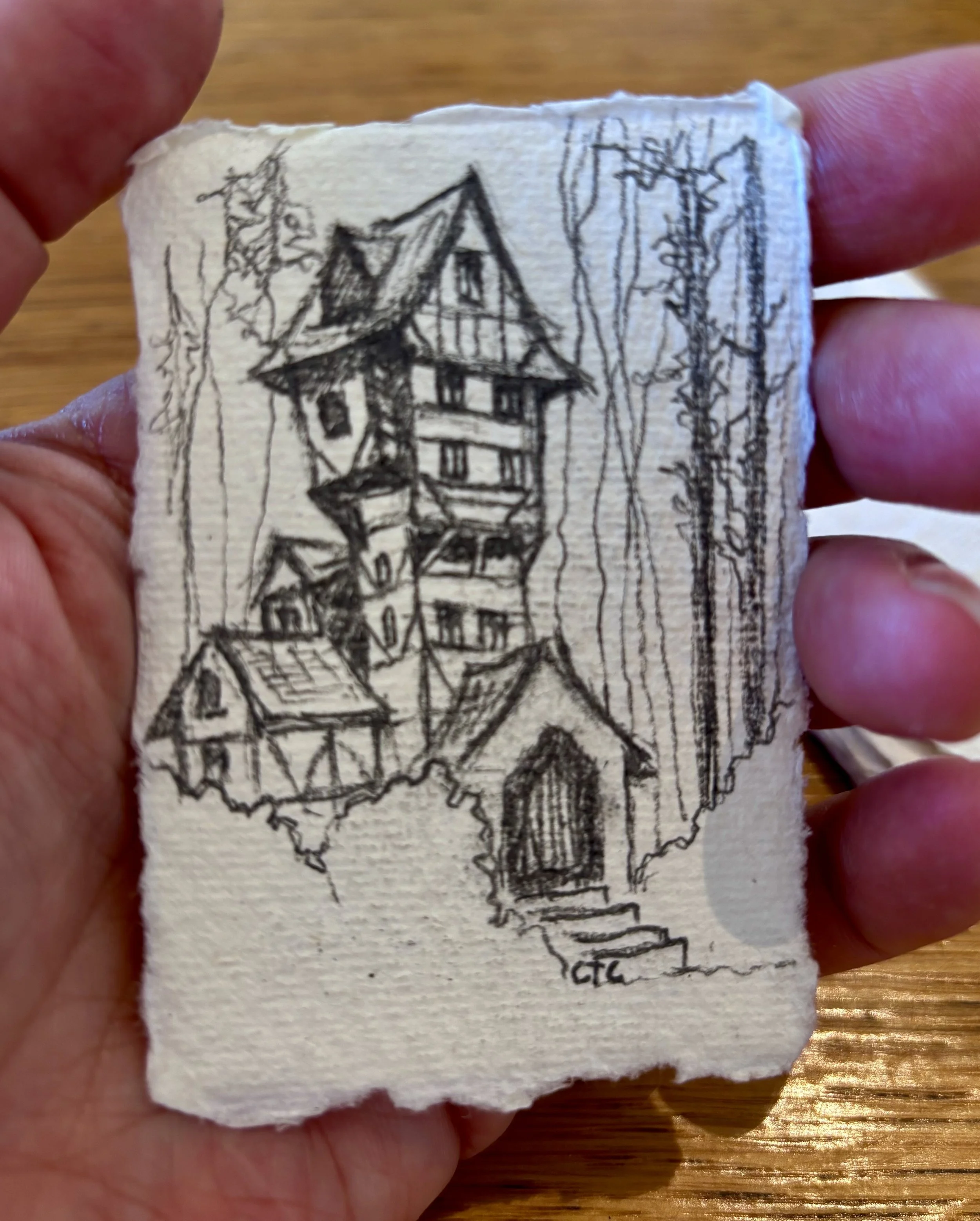
(I drew this on a bit of handmade Khadi paper with a pencil - Chaiga T Cheska)
~~~
Being an account of one poorly timed revelation regarding Junior Librarian attire, a market that dealt in rather more than coin, and the small hours during which the Wandering Library discovered exactly what it is prepared to do to keep its own
Compiled by Bramwell Corin, who would like it noted that he did fully intend to be off those boards in good time
~~~
We had moored along the Emaris river three days previous, in the lazy bend where the river widens and slows and the willows lean so far over the water that their lowest branches trail in it like fingers testing the temperature, and the whole stretch smells, by late afternoon, of warm mud and cut grass and the exact sweetness that only high summer manages, the kind that settles into clothes and doesn’t leave. It is a restful place, as these things go, and after the business of the Footnote fiasco, we were glad of a rest.
Pip had needed this break more than the rest of us. He had spent two full days being very frosty with Thaddeus and myself, on the reasonable grounds that he had recently been launched through a hedge with a rope tied round his middle on our joint instruction, and had only that morning, over breakfast, thawed far enough to pass me the marmalade without comment. I did not push my luck by remarking on it.
His robes had suffered rather worse in the hedge than the rest of him. Torn at one elbow going in, and a second tear had opened slowly along the hem in the days since, the sort of small domestic disaster that nobody quite gets round to mending because there is always something more pressing afoot. There was, that afternoon, considerably more pressing afoot.
It began with an object in motion that had no business being in motion.
I did not see the tea trolley set off. I heard it, a low complaining rattle of china gathering speed somewhere behind me as I catalogued a delivery of Regional Almanacs, and turned in time to watch Pip walking briskly away from it with no awareness whatsoever that the hem of his robe had caught fast on its handle, and that the trolley, with the full tea service upon it, was now following him with the devotion of something that has just found a new best friend.
“Pip.”
“What?”
“The trolley seems to be following you.”
He looked round, saw it, and did the thing people invariably do when a trolley is chasing them, which is to walk faster, which achieves nothing except persuading the trolley to do the same. The teapot, unsecured and increasingly put out by the whole arrangement, began a slow migration towards the edge of the tray just as Thaddeus, without appearing to hurry in the slightest, reached out one long arm from behind the returns desk and caught it by the handle a moment before it met the floor.
He set it down, righted it, without spilling a drop, produced a note from wherever it is he keeps them, and pressed it into my hand without breaking stride.
“That is the third trolley this week that has been caught in Pip’s robes”.
“I didn’t do it on purpose,” said Pip, which was true, and beside the point, since the robe remained attached to the trolley and he had not yet worked out how to free himself from it.
He managed this a moment later with a sharp tug that released the robe but sent him stumbling backwards into the pedestal that holds the Library’s largest atlas, a volume so heavy it takes two of us to shift it comfortably and, on an unlucky day, one of us to regret trying. The pedestal tipped. The atlas came down with it, a great flat slap of a sound that shook dust loose from the shelf above, and Pip stumbled back, sitting hard and wide-eyed at how close it was to his knee; another six inches would have told a rather less pleasant story.
He sat there a moment, breathing hard, regarding the book the way one regards a dog that has, at the very last instant, decided not to bite.
The crash brought Mistress Spine from her office. I heard her before Pip did, which is to say I heard nothing at all, and simply became aware, in the way one does with Mistress Spine, that she was now standing in the room.
Pip yelped and was on his feet and half behind me before either of us had properly registered her arrival.
What follows, of the next several minutes, I leave to her.
Mistress Spine’s Account (Afternoon)
I came through at the sound of the atlas, which is a sound I have learnt, over six months, to take seriously. Bramwell’s atlases do not fall on their own, and when they do, someone is generally underneath.
I found the pedestal down, the atlas down, and Pip on the floor beside both, apparently unharmed, and hiding behind Bramwell. This is not an unusual configuration for the two of them, and I did not remark on it.
What I did remark on was the robe my junior librarian seemed to be wearing, which was in a terrible state of disarray.
It has taken me some time to notice things about this staff that ought to have been obvious sooner. This position has occupied rather more of my attention with the Library’s moods than with the wardrobe of its junior member, but there it was, plain as anything, once I looked properly. A Junior Librarian in full robes, torn at the hem, standing behind Bramwell, the guilt of someone caught doing something he did not know was incorrect.
“Pip,” I said. “Why are you wearing robes?”
He did not answer, which told me a good deal on its own. Bramwell answered for him, working it out, I think, as he said it.
“He’s not a full Librarian yet. Ought he to be wearing robes at all?”
“He ought not,” I said, because he ought not, and because someone in this building has to say it like it is when nobody else will. “Junior Librarians wear sensible clothing. Clothing with pockets. I had assumed this had been explained to him.”
It had not been explained to him. Nor, as it transpired, to Bramwell, who has apparently worn his own robes for quite a while without once questioning whether he was entitled to them, which strikes me as precisely the sort of oversight this building specialises in. Nobody here explains anything to anybody until a chicken and a falling atlas force the issue.
I am aware the Library has moored itself along the Emaris, and that there is a carnival river market arriving with tonight’s moon, selling clothing amongst its stranger wares. I told Bramwell to take the boy and buy him something with pockets, and that I would reimburse it from the general fund provided he kept the receipt, which I am aware is asking a great deal of the pair of them.
I left them to it. I generally find the most efficient way to end a conversation is simply to stop having it.
Pip’s Account
How was I to know that I’m not supposed to be wearing robes as a junior librarian!! No one ever told me! It was soooo embarrassing! I’ve been walking about for SIX MONTHS in Bramwell’s old robes that I spent ages mending in the beginning, so they didn’t trail on the ground cus Bramwell is taller than me!! And I fell over, and Mistress Spine saw it!! Why does this happen to be all in one day!! I wanted to disappear; it was so embarrassing, and I tried to hide under a nearby desk instead, but Thaddeous got in the way and stuck one of his blasted notes to my head before I’d even got halfway under the desk. I peeled off the note and read it:
“Stop being so dramatic. It is only a robe.”
I tried to throw it back at him, but he just smirked at me because the sticky note wouldn’t leave my fingers no matter how I flapped my hand to get rid of it. I think he does these sorts of things on purpose to rile me up!
Bramwell’s Log
I turned around to face Pip once Mistress Spine had gone to find that my younger colleague had solved the matter of the robes rather more decisively than any of us had anticipated, having pulled the whole garment off over his head and dropped it in a heap on the floor. Beneath it he wore his plain tunic and britches he had arrived in, thin at the elbow now, a little short in the leg. I did not remark on it, on the grounds that some observations serve no one.
Thaddeus, who had retrieved the note from Pip’s fingers at some point without either of us noticing, crossed to the window and gestured out towards the riverbank.
A hand-painted sign had gone up sometime that afternoon among the willows, lettering large and looping and rather too bright for the ordinary business of advertising.
THE CARNIVAL OF THE RIVER GOD, it read. ARRIVING WITH THE MOON.
ONE NIGHT ONLY.
I found this fascinating, and said so, and was leaning out over the sill for a better look when a book struck me squarely on the shoulder from somewhere above, which I have learnt, after six months, to take as the opening line of a conversation rather than an accident. I caught it before it could continue its descent onto Pemberton, who was watching the whole proceeding from the windowsill with the fixed, narrow suspicion she reserves for anything the Library does that involves throwing things near her.
The title read: “What the Riverbank Has Been Saying, and Why I Do Not Like It.”
I told the Library, kindly but firmly, that it was almost certainly being jumpy, that a river market advertising itself with a fresh coat of paint was hardly the stuff of nightmare, and that it ought to trust me, on this occasion, to know an old wives’ tale when I encountered one.
I have, on reflection, been wrong before.
The sun went down behind the willows in the slow, deep orange it favours over water in high summer, and by the time the moon had cleared the tree line, thin and silver and climbing fast, the market had arrived.
It came without fanfare, which I found, in hindsight, rather more unsettling than fanfare would have been. One moment the river ran empty and dark below our windows. The next, lanterns hung strung along a shape that had not been there a breath before, dozens of them, small and swaying, throwing a light the colour of old brass across water gone suddenly, glassily still. Planks lowered themselves from somewhere along its flank and settled against the bank with a soft, wooden sigh, and a handful of MirMarnians from the nearby settlements were already drifting down to look, drawn the way people are always drawn to lit windows on a dark night, whatever their better judgement might have to say about it.
Some among them set up a squat mechanical clock upon a post driven into the riverbank, its face lit from within by a single steady candle, and wound it with the brisk, practised air of people performing a small and necessary ritual rather than anything dramatic. I leaned out of the window and asked a passing woman what it was for.
“Moonset,” she said, not stopping. “Off the boards by moonset, or you’re theirs for the turning of the moon cycle. We set it every time the carnival comes through. Keeps everyone watching the time.”
She said this with no more alarm than she might have used to remind me the last ferry left at nine, and went on her way towards the lanterns without a backward glance, which I found, somehow, considerably more unnerving than if she had seemed frightened at all.
I wanted, quite badly, to go and see for myself. Thaddeus, when I turned to him, produced a note that read simply, One night only. I find that a strange thing to boast about, which I took, correctly, as a vote for caution rather than enthusiasm, though not an outright refusal.
Pip’s vote required no note at all.
“No,” he said flatly. “I’ve had quite enough excitement for one week without wandering onto a mysterious boat market that turns up out of nowhere with lanterns and a countdown clock. I’m absolutely NOT going.”
I explained, as reasonably as I was able, that the whole purpose of the outing was to buy him something to wear, and that the something in question was, at present, on the very market he was refusing to approach.
“Then I don’t need new clothes. What’s wrong with what I’m wearing now?”
By the time I had finished explaining that Mistress Spine’s instructions had not, to my recollection, included an exemption for personal preference, Pip had crossed the room at some speed and attached himself, with both arms and, I believe, at least one leg, to the nearest set of shelving, the Regional Folklore of Lower Uttersfield section, as it happened, which shuddered alarmingly under the weight.
I looked at Thaddeus. Thaddeus looked back at me with the long-suffering patience of someone who has done this before, sighed in the silent way only he can manage, crossed the room, and carefully pried Pip clear of the shelving with the brisk efficiency of someone removing a stubborn bramble, one arm at a time, before hauling him over one shoulder.
Pip protested the whole distance to the front doors, a steady stream of complaint that ranged from the general unfairness of his employment to a detailed and largely accurate account of every occasion on which his opinion had been sought and then ignored, and continued, undiminished, across the riverbank and up the gangplank, where Thaddeus finally set him down upon his own feet, one large hand remaining on his shoulder as the boards shifted underfoot with the market’s own slow, unnatural breathing.
Pip’s complaints ended immediately as he looked around.
Pip’s Account
I stopped talking because there wasn’t anything left in my head to put into words. I didn’t want to come to this market!!!!
Lanterns that didn’t flicker right. Too many of them. The smell of woodsmoke and something underneath it, sweet in a way I didn’t trust for one second. Somebody moaning somewhere I couldn’t see. Somebody else screaming, further off, a sound I decided very firmly was a gull and did not investigate further. Stalls going back and back, further than a boat that size has any business holding, and the people behind them weren’t, I don’t think, completely people, not all of them, and I don’t want to describe most of what I saw because writing it down makes it more real and I would rather it stayed the sort of thing you can pretend you imagined.
THERE WERE EYES EVERYWHERE!!!! I mean actual eyes, on actual stallholders, and quite a lot of them were on me.
I don’t remember getting from the gangplank to wherever we ended up. I remember the ground moving in a way ground shouldn’t, and a smell like river water gone stagnant and sweet at once, and a fiddle somewhere playing something in three-time that made my teeth itch, and I remember standing very still with my back against something solid, I didn’t check what, and just staring, because staring felt like the only useful thing left to do.
I wasn’t ashamed of any of that. I was properly, sensibly frightened, and I stayed exactly as close to Bramwell and Thaddeus as I could manage, and if either of them minded me standing on their heels the whole way through that market, they never once said so. No one, in their right mind, should visit that market!! It was beyond scary!!!
Bramwell’s Log
Pip was, by the time we reached the clothing stall, quite beyond usefulness for the purpose of being dressed, which fell, therefore, to Thaddeus and myself. He stood where I put him, more or less, turning every few seconds to face some new sound or shape at the edge of his vision, and Thaddeus and I simply worked around it, holding the waistcoat steady while Pip’s attention went wherever the market’s noises pulled it, neither of us remarking on it, since there was nothing useful to say and a market that unsettling deserved every bit of the attention he was giving it.
I found a stall selling clothing of a cut that would not have looked out of place at any ordinary market, which felt, if I am honest, faintly suspicious in itself, everything else about the place being so thoroughly not ordinary. A deep green waistcoat, well made, caught my eye first for the row of pockets stitched along its front, and Thaddeus, who examines anything requiring precision with a close, methodical attention I have come to rely on, produced a note before I had finished counting them myself.
“Fourteen pockets. I have counted them twice.”
We settled on the waistcoat and a matching jacket, plain but well cut, with a collar high enough to keep out a river chill, and it was only once the decision was made that I had my first proper look at the stallholder, a stooping figure who unfolded to a height that made both Thaddeus and myself take an involuntary step back, and whose smile, when it came, showed rather too many gaps where teeth ought to have been, and a few sharpened ones that were a bit unnerving.
I turned to pay. It was Thaddeus who noticed, before I did, that the merchant’s attention had settled on Pip rather than on the coins in my hand, and it was the merchant himself who said, in a voice like a door that wants oiling, looking past me at Pip,
“Does the boy need all of his fingers?”
I did not, for the first moment, understand the question. I understood it perfectly a moment later.
Thaddeus had Pip by the shoulder and turned half away before I had finished paying, and I did not linger over the transaction, nor look too closely at the several neighbouring stalls that had, without appearing to move at all, turned some part of themselves towards us in the moment the question was asked.
It was only once we were clear of the stall that I looked towards the clock on the riverbank and understood, with a lurch that had nothing to do with the boards beneath us, that we had spent very much longer at that transaction than any of us had business spending. The candle behind the clock’s face had burned to almost nothing. The moon, when I found it, sat low over the water, dimmed and reddening at its lower edge in the way a moon does only in the last hour before it sets.
“We need to be off these boards. Now.”
We were not, I think, more than forty feet from the gangplank when the market first tried to keep us.
I can describe what happened only imperfectly, since almost none of it was visible in any ordinary sense. The lanterns along our stretch of the market dimmed, all together, as though something had drawn a slow breath through them. The music, which had not stopped once since we boarded, faltered mid-phrase and did not resume. And the boards beneath our feet, which had shifted and settled the ordinary way of any structure on water since we arrived, went still and sank a little. Not rotten. Soft and sunken, the way wax goes soft near a flame, giving slightly under each step and closing slowly back over the print our boots left in it, so that walking became a matter of pulling each foot free rather than simply placing it down again.
Every stall we passed had gone silent and was, without exception, watching us go.
Beside me, Thaddeus made a sound I had genuinely never heard from him in six months, low and involuntary, and I understood, with a fear that arrived all at once rather than building by degrees, that whatever this was had frightened him too, and Thaddeus does not frighten easily.
Between us, Pip had stopped trying to walk at all and had simply begun screaming for the Library.
Pip’s Account
I TOLD THEM WE SHOULDN’T HAVE COME TO THIS CREEPY MARKET!!!! Why does no one ever listen to me?! The moment I saw the Wandering Library waiting for us on the riverbank, I began screaming for it to help us, because all I could think about was getting away, as the boards were holding onto our feet while we tried to walk away! It was terrifying!!!
So yes, I admit, I shouted for the Library like it could somehow hear me from the riverbank, because it’s saved us before and I didn’t have a better idea, and it worked, or something worked, because the last thing I properly remember before everything happened at once was the whole shape of it rising up out of the dark ahead of us on the bank, enormous, arms already reaching, three of them, and I have never in my life been so pleased to see a building.
Bramwell’s Log
I felt an arm close round me before I understood what was happening, a great sweep of woven page and binding, warm and solid and nothing at all like the market’s cold, clinging pressure, and then the ground was gone from beneath my feet altogether as the Library lifted the three of us clear in a single motion and threw us, without ceremony, through its own front doors.
The doors slammed behind us with a finality I felt in my teeth.
We landed in a heap on the reading room floor, myself, Thaddeus, and Pip tangled together in a manner that did none of us any credit, and it was from somewhere in the middle of that tangle that a furious, high-pitched shrieking began directly above my skull. I opened my eyes to find Pemberton standing on my head, wings half raised, delivering what I can only assume was the single strongest opinion of her whole life directly into my left ear, and there she remained for a good while yet, since untangling from Thaddeus and Pip took rather more urgent priority than untangling from an outraged chicken.
Through the reading room windows, in the few minutes it took the three of us to sort ourselves out, I could feel that the Library had planted itself squarely on the bank, all three arms extended, which we saw through the windows, their fingers pointing at the river market and wagging, unmistakably, as if delivering a stern word down the river after the market, which was by then withdrawing at considerably greater speed than it had arrived. From somewhere in the walls came a low, continuous mutter, not words, nothing so precise as words, but the rise and fall of an argument, dozens of voices layered over one another, indignant, learned, thoroughly affronted, the exact sound I imagine several hundred scholarly volumes might make if every one of them were muttering their objections to an unforgivable breach of manners all at once. It lasted only as long as the river market remained in sight. By the time the last lantern had vanished round the bend, the muttering had stopped, the arms had drawn back in, and the Library, but for a faint tremor still running through the floorboards, was still.
It was in the quiet that followed that I caught, at the far end of the corridor beyond the reading room doorway, a soft moving light drifting between two stacks, there and then not there, the unhurried way the Lantern Bearer has of being present without ever quite being encountered. None of us remarked on it. None of us looked at it directly either, which is, I have come to understand, the correct way to acknowledge the Lantern Bearer at this hour, and it passed on into the deeper stacks and left us to our own trouble.
Mistress Spine’s Account (Before Dawn)
I was woken by the sound of the front doors, which is not a sound that requires investigation on most nights, this building rarely closing them so forcefully, and came through still in my dressing gown, a hot water bottle clutched to my chest, which I keep filled through the summer regardless of the season, since the nights here cool faster than the days would have anyone believe.
I found three of my staff members in a heap upon the reading room floor, a chicken standing on Bramwell’s head continuing to make her feelings known, and, through the windows, the last lantern light of a market vanishing downriver while the walls around us muttered their disapproval into the dark. It was not, on the whole, an unfamiliar scene, this building having furnished me with several of comparable strangeness over six months, though the hour was later than most, the sky beyond the windows already beginning, very faintly, to grey at its eastern edge.
“Bramwell,” I said.
“Mistress Spine.”
“The Library has learnt to set a boundary. Make a note of it. And whatever that noise is, coming through the vents, wants proper study. I should like a full report.”
I let my gaze move to Pip, taking in his new waistcoat, still, remarkably, buttoned correctly despite everything that had evidently just happened to its wearer.
“Much better,” I said, and went back to bed, as the hour did not call for further conversation, and that whatever remained of the night was better spent asleep than standing about in a dressing gown discussing chickens.
Bramwell’s Log
I untangled myself from Thaddeus and from Pip, Pemberton still very much in residence upon my head and showing no immediate sign of vacating it, and produced my notebook to write Mistress Spine’s observation down before it could slip my memory, on the grounds that a woman assessing scholarly vent noises as a research opportunity at half past four in the morning was not the sort of remark one wished to lose.
Thaddeus pressed a note to the end of my nose.
“I am going to bed. You should try it.”
I removed the note, wrote in my own notebook a firm reminder to raise, at the earliest suitable opportunity, the question of appropriate placement for these communications, my nose being, in my professional opinion, considerably outside those bounds, and looked up to find he had already crossed to his desk, gathered a drowsy Barnaby from the empty teacup where the hamster had spent the better part of the night, and tucked him into the front of his coat before heading, without a backward glance, towards the stairs.
Pip climbed to his feet slowly, reached up, and lifted Pemberton down from my head with a gentleness that suggested he, at least, held no grudge against her for the shrieking, and stood a moment with her cradled against his chest, taking deep breaths as if steadying himself, which appeared to help the chicken also.
I crossed to the window myself. The last of the market’s lantern light had long since gone from the river, and the sky over the water had begun, in earnest now, to lighten towards the colourless grey that comes an hour or so before proper dawn.
It was Pip who noticed the waistcoat first.
“Bramwell. Is my waistcoat meant to be doing that?”
I looked. It was glowing, faintly, along every seam, a low, cool light not unlike the moon we had left the market beneath, and when I reached out to touch the fabric, I felt it give the smallest shiver under my fingers, as though something inside it had noticed the attention and did not welcome it.
I helped Pip remove the waistcoat and the jacket with it before Pip had finished asking his question and hung both on the coat stand beside the door with rather more speed than the action strictly required. Both of us perhaps a little spooked by the attire.
“Daytime wear, I think, for those. Bed, for the rest of us. It has been a very long night.”
Lyria met us in the corridor, drawn, I suspect, by whatever quieter sense tells her when the building’s temper has finally settled. She performed a short sequence I understood, with reasonable confidence, to be an invitation: both hands cupped and raised, a small stirring motion, a tilt of the head towards the staff room beyond her.
“Cocoa,” I translated, for Pip’s benefit, though I suspect he had already worked it out for himself. “She’s asking whether we’d like some.”
We followed her through and settled at the battered table with mugs cupped between our hands, the steam curling soft and sweet through what remained of the night, the window beside us paling by degrees.
It was Pip who broke the quiet, some minutes in, with the firmness of someone who has been turning a sentence over in his head and has finally decided to say it aloud.
“I would like it understood that in future, I would rather be consulted before anyone decides anything on my behalf. Even if it’s for my own good. Even if you’re right. I’d just like to be asked.”
Lyria and I looked at one another and agreed, gravely and sincerely, that this seemed a perfectly reasonable request, both of us aware, I think, without needing to say so, how difficult a promise that would be to keep in a building that regularly requires someone to be launched through hedges, carried over shoulders, or plucked from the jaws of a moonlit river market with no warning whatsoever.
My Observations:
Bramwell’s account ends with the cocoa. What happened afterwards, in the empty staff room, he did not see and does not know, because only Pemberton remained awake to watch it.
On the coat stand by the door, the waistcoat lifted at the sleeve. There was no draught in the room to account for it, no window left open to the night, and yet it rose, slowly, the way a hand rises when it means to reach for something and settled again. A light ran along the seams, cold and pale, not the light of any lamp in that library, brightening and fading, brightening and fading, in a rhythm too even to be mistaken for the wind. On the floorboards beneath it, the shadow moved a fraction of a second before the cloth did, so that for one long moment the dark was ahead of the thing that cast it.
Pemberton did not look away. She watched until the light dimmed with the first grey of morning and the waistcoat hung still, ordinary, as any garment ought to hang, and even then, she did not close both eyes at once.
-Chaiga T. Cheska
P.S. Artwork, lyrics and song were also created by me.