The Wandering Library of MirMarnia: A Series
Part 25: The Chocolate Wing
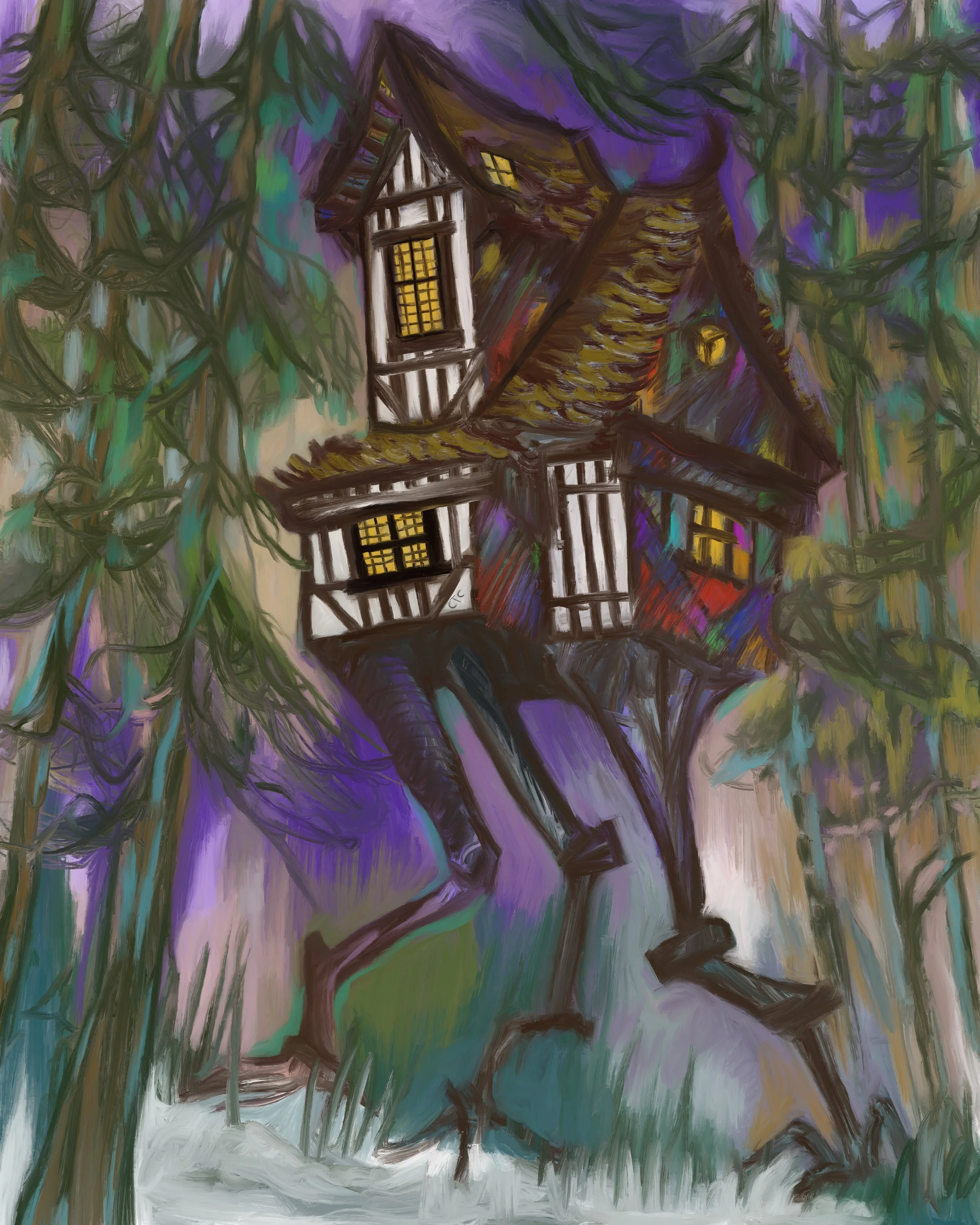
Being an account of an unscheduled confectionery outbreak, a great many overheated children, and the day Bramwell Corin became, briefly and against every instinct he possesses, the most beloved man in Lower Bottomsly
Compiled by Bramwell Corin, who wishes it noted for the permanent record that none of this was his idea
~~~
There is a particular quality of heat that descends upon this corner of MirMarnia perhaps once a decade, the sort that makes church bells sound reluctant, causes cats to abandon dignity altogether and lie flat upon the flagstones like discarded rugs, and persuades even the most stoic of postmen to admit that perhaps, today, the second delivery might wait until tomorrow. Lower Bottomsly, a hamlet whose name I am reliably informed was settled upon by a committee sometime in the fourteenth century and never revisited despite several subsequent centuries of obvious regret, was enduring this heat with the specific martyrdom of a village that possesses one shop, no shade worth the name, and a duck pond currently reduced to something closer to a suggestion of a duck pond.
We arrived on a Tuesday, though the Library rarely consults the calendar and I stopped enquiring why some months ago. I woke to find us settled on the village green, legs folded beneath it in that particular arrangement it favours when it means to stay a while, the grass beneath them gone the colour of digestive biscuits, and the sign over the door hanging so still in the windless air that it might have been painted there.
By nine o’clock, it had become apparent that Lower Bottomsly’s school holidays had brought the customary seasonal phenomenon familiar to any village with children and insufficient occupation for them: a great quantity of small persons roaming at large, sunburnt, overexcited, and largely unsupervised, as such villages manage every summer without anyone finding it remarkable. By ten o’clock, their parents, sweltering through a fete committee meeting in the village hall that had nothing to do with the children and everything to do with escaping them, discovered a strange building sitting placidly on the green and did what any sensible person facing a heatwave and an unfamiliar structure would do. They knocked and, with the desperate courtesy of people who had not had a moment’s peace in six days, asked whether the children might possibly come inside somewhere cool for an hour or two.
I should say, for the record, that the Library consulted no one on this matter, myself and Mistress Spine included. It simply opened its doors rather wider than usual, in a manner I can only call eager, and admitted every child in Lower Bottomsly at once.
Mistress Spine, I ought to explain, was elsewhere for most of what follows, occupied with what she had described that morning as “a meeting of some administrative importance” in a wing of the building that relocates itself whenever she requires privacy. She was therefore blissfully unaware of events three floors below her for the better part of the day. I have come to think this a mercy, on balance, for all concerned.
The chocolate section appeared, so far as I can establish, within the first quarter of an hour, in a wing that had that very morning been dedicated to Agricultural Treatises of the Lesser Emaris Valley. I do not know how the Library manages this sort of thing structurally, and after some months of employment here I have made my peace with not knowing. What I can report is that a child called, I believe, Tilly, wandered off in search of somewhere cooler and returned at a dead sprint, red in the face, shouting the words “CHOCOLATE ROOM” with a conviction that brooked no argument whatsoever.
A book fell on my head as I went to investigate, which, for readers unfamiliar with our arrangements, is generally how the Library prefers to open a conversation with me. I stopped taking it personally some time ago. This one was titled An Afternoon’s Diversion for the Overheated and Underoccupied: A Practical Guide, and I confess I did not need to open it to grasp the Library’s intentions.
The room itself defied straightforward description, though I shall attempt one regardless, as that is, after all, my function here. The walls had abandoned all pretence of shelving books and arranged themselves instead into something resembling a confectioner’s fever dream: alcoves lined with volumes that dripped, very slightly, at the corners; a reading table that had, in the space of twenty minutes, developed an unmistakable smell of warm cocoa; and, running the length of the far wall, a shelf from which chocolate now issued in a slow, unbothered stream, the colour of the Emaris at dusk, finding its way with the patient inevitability of all rivers towards the nearest doorway.
Nearby, a slim volume titled A Modest Provision, In Perpetuity sat open on a stand, producing chocolate buttons at a rate of one every two seconds or so, each dropping with a small, resigned plink onto an increasingly alarming pile beneath it, the book itself emitting, with every button, the faint and rather put-upon sigh of something that has been asked to do considerably more than it originally signed up for.
It did not take the children long to realise that the Library was, in a manner I found faintly alarming, listening. A boy near the doorway shouted, mostly, I suspect, to see what would happen, that he wanted balloons made of sweets. Within moments, a great cluster of them drifted towards the ceiling, translucent and faintly sour, bobbing against the beams like a shoal of peculiar fish. Someone else, encouraged rather than deterred, called for a paddling pool and got one, a wide, shallow basin unfolding itself from what had until recently been an armchair, filling steadily with chocolate soup of a consistency best described as swimmable, if regrettable, into which four children promptly launched themselves with the sort of joy that makes the subsequent laundry entirely their parents’ problem.
I would like to state clearly that I did not request a chocolate hat. I do not know which child suggested it, nor why the Library found the suggestion so immediately appealing. I became aware of its existence only when something warm and unwelcome began melting down the back of my collar. Pemberton, who had taken up a position on the reading table with the air of someone reviewing a battlefield, took one look at the hat and at me, and let out a sound I can only describe as a scream of pure disapproval, the sort of noise one associates less with poultry than with the final act of a Greek tragedy.
Pip found this extremely funny.
~~~
Pip’s Account: Bramwell had a HAT made completely of chocolate! It was melting down the back of his collar, and Pemberton looked like she was about to declare war. I know I shouldn’t have laughed. I really shouldn’t, but I couldn’t stop. I actually couldn’t physically stop. Bramwell turned round and gave me such a LOOK, and I thought, right, that’s fair. I would be cross too, but I kept laughing anyway. I’m not proud of it. I’m a little proud of it.
~~~
I will admit I made one profoundly undignified attempt to remove a rapidly softening piece of hat and deposit it upon Pip, who had made the tactical error of standing within reach whilst laughing at me. He dodged with an agility I had not previously suspected he was capable of.
Another child, at some point I did not fully witness, asked that I also be given chocolate shoes, and the Library, apparently delighted by the theme, obliged. After that, walking became an endeavour requiring real concentration, a squelching, deliberate stride I associate with low tide. I left, over the course of the afternoon, a trail through the building that Thaddeus later informed me resembled nothing so much as the wanderings of a very large and very confused snail.
A note, appended without ceremony to my sleeve, in Thaddeus’s small, careful hand: You have been walking in a figure of eight for eleven minutes. I have been counting. I do not know why either.
The ceiling, not to be outdone, produced streamers, long ribbons that, on the single occasion I was persuaded to try one, tasted unmistakably of warm toffee-apple rings, that particular sweetness of an autumn fete transplanted into the height of summer, sticky and faintly cinnamon-edged, though I could not account for the cinnamon and had, by that point in proceedings, decided against asking.
I have never been able to account for what happened next, and after some reflection I have decided not to try, since every explanation I have considered seems less plausible than simply accepting the facts as they occurred. The children of Lower Bottomsly decided, collectively and without any discernible cause, that I was wonderful.
I do not say this with any pride. I say it with the bewilderment of a man who has spent months being regarded by this building’s staff with a fondness that stops well short of physical affection, and who, within the space of an hour, found himself embraced about the knees by no fewer than six children simultaneously, sat upon by two more who had claimed my feet as furniture, and burdened by the small, determined hands of at least one child who had taken up permanent residence in my coat pocket, from which she periodically issued observations about my person that I found, on the whole, unflattering.
Pemberton, meanwhile, had reached the limits of her tolerance for small persons some time earlier, and had elected, as chickens do when overwhelmed by circumstance, to seek higher ground. My shoulder was her first port of call. My head, reached via a brief and undignified scramble across my face that I do not wish to relive, was her second and final destination, from which vantage she delivered a continuous, furious commentary directly into my left ear for the better part of two hours, her opinion of the entire day communicated with a volume and specificity that required no translation whatsoever.
I attempted, throughout, to preserve what I could of the collection. I waded, in my chocolate shoes, from shelf to shelf, children clinging to various limbs, chicken affixed to my skull, rescuing volumes that had strayed too near the pool, steering a balloon-related skirmish away from the Devotional Poetry of the Talanooks section (I do not know where the swords came from; I chose, again, not to ask), and generally trying to hold back a tide that had, some hours earlier, stopped listening to reason. On at least two occasions, when I had become sufficiently overrun and forward motion was no longer strictly possible, Pip waded in and extracted me, prising small, determined fingers from my coat with a patience I would not otherwise have credited him with, though he was laughing too hard throughout to make either rescue especially dignified.
It was during one particularly enterprising assault on the Devotional Poetry of the Talanooks section, now largely coated with chocolate, that I discovered, quite by accident, where the parents of Lower Bottomsly had got to. I had assumed, reasonably, I thought, that they might be assisting, or at the very least watching their enthusiastic, sticky offspring. Instead, I found them in the reading room at the western end of the building, arranged across every armchair, sofa and window seat the Library possessed, fast asleep, several snoring with the profound, unguarded relief of people who had not slept properly in a week and had suddenly, unexpectedly, been given the chance.
I did not wake them. I confess I did not have the heart. Besides, the Library, which I noticed had drawn the curtains in that room and softened the light to something closer to dusk, regardless of the hour, had rather more sympathy for exhausted parents than for me, three rooms away and currently drowning in chocolate soup and sticky affection.
The day ended not because anyone had resolved anything, but because it was five o’clock, and the Library, whatever its other eccentricities, has always kept fairly conventional hours. It was Pip who was dispatched, some minutes past the hour, to rouse thirty-odd sleeping parents from their unexpected sanctuary. He did so with a gentleness I had not previously realised he was capable of, moving from armchair to armchair, murmuring to each in turn, and receiving in return the specific groggy gratitude of people waking from the best sleep they’d had all summer.
They collected their children with the practised, slightly glazed efficiency of parents everywhere, and here I observed a skill I have come to recognise as universal amongst them: the ability to look directly at a scene of considerable carnage, chocolate rivers included, and see nothing out of the ordinary.
“Did you have a nice time?” one mother asked her son, stepping over a puddle of something that, several hours earlier, had been the Agricultural Treatises of the Lesser Emaris Valley.
“BEST DAY EVER,” the boy informed her, at a volume calibrated for someone standing considerably further away. She smiled the fond, exhausted smile of a woman who has stopped asking follow-up questions, and led him towards the door.
They left in this fashion, one by one, chattering children trailing sticky fingerprints and breathless accounts of chocolate rivers and paddling pools, which their parents nodded along to, without, I am fairly confident, absorbing a single word. The door closed behind the last of them. I heard it lock, with what I can only describe as a note of finality.
Which left Pip and myself alone in a building that looked as though it had been recently and enthusiastically ransacked by an army with a serious sweet tooth.
I turned to Pip, who was still grinning, in the manner of a young man who had not yet registered what was coming.
“Pip,” I said, “you seem to be enjoying yourself far too much!”
“Yes, it was quite fun, wasn’t it?”
“Pip!”
“What?”
“You laughed for six hours. Whilst I was hugged, sat upon, worn as a chocolate fondue fountain, and screamed at directly into the ear by a chicken who has never once, in months of employment here, screamed at me with that level of commitment.”
“I was a witness,” said Pip, backing slightly towards the door, “not a participant. There’s a difference. I can’t be held responsible for finding something funny. Is that a crime now?”
“It should be.”
Pemberton, by this point, had abandoned my head somewhere around half past four and installed herself on the topmost shelf of the Local Magical Ferns of the Upper North section, from which position she made it very clear, through posture alone, that she had no intention of coming down that evening, that week, or possibly ever again. I did not blame her. I would, given wings and the choice, have joined her.
I was obliged, at this juncture, to take stock of my condition, which I shall summarise briefly for the sake of completeness: sticky from collar to boot; missing one shoe, the other having apparently dissolved somewhere near the pool; and, I noted with some alarm upon catching sight of myself in the second-floor corridor mirror, wearing considerably more of Pemberton’s feathers than I had begun the day with, several of which had adhered permanently to the chocolate still clinging to my collar.
Pip, observing all this, began to giggle again, a fresh, delighted peal, and it was this, more than anything preceding it, that finally exhausted what remained of my professional restraint. I do not remember deciding to cross the room. I remember only that I did, with a speed that surprised us both, and that within moments, for the first time in either of our professional histories, Pip found himself in a headlock.
I would like it noted that this was not, strictly speaking, an act of violence. It was closer to an act of punctuation.
At precisely this moment, Mistress Spine chose to return from her meeting.
I released Pip immediately, which did nothing to improve the impression already formed. Mistress Spine stood in the doorway, surveying the room, then me, then Pip, who had retreated to a position directly behind me with the particular haste of a younger colleague who has not completely outgrown his fear of the Head Librarian, despite months of otherwise perfectly cordial working relations.
“Bramwell,” said Mistress Spine, in the tone of a woman choosing her first question with great care from a long list of options, “why are you covered in feathers?”
“It has been an unexpectedly interesting day, Mistress Spine.”
“And sticky. You appear to be sticky.”
“Also accurate.”
“And why,” she continued, turning her attention to the space just behind my left shoulder, “did you have your colleague Pip in a headlock?”
Lyria, who had appeared at some point during this and had been watching from the doorway with the stillness she reserves for moments of significant interest, chose this juncture to offer her own account. She moved to the centre of the room and, with the fluid, deliberate grace I associate with her explanations, performed a sequence I can only render, in translation, as follows: a slow unfurling of the arms, suggestive of chaos arriving gradually and then all at once; a series of small, darting steps, which I took to represent the children; a long, wavering gesture towards the ceiling, presumably indicating the balloons; and finally a brief, sharp movement, both hands raised and dropped, palms up, the universal gesture of a woman who has seen everything and is declining to comment further.
“She says,” I translated, with the usual degree of confidence I bring to these interpretations, which is to say very little, “that, on balance, it was a reasonable response to the circumstances.”
Mistress Spine looked at Lyria, who looked back, quite unrepentant.
Mistress Spine did not respond immediately. She looked instead around the room, at the chocolate river now congealing gently into something resembling a bog, at the balloons, half-deflated and stuck fast to the beams where they would evidently remain until someone braver than myself fetched a very tall ladder, at the streamers drooping in long, sticky ribbons, and at Thaddeus, who had appeared at the far end and, with the quiet, competent strength I have always found faintly reassuring in a man who cannot speak, was easing a considerable oak shelving unit back into its rightful position, notes fluttering from his sleeves as he worked.
Mistress Spine was quiet for what felt, to a man still wearing a chicken’s worth of feathers, like an age. When she finally spoke, it was not with the fury I confess I had been bracing for.
“The Library,” she said slowly, looking not at me, nor at Pip, nor at the wreckage, but somewhere above them all, at nothing in particular, “is rather pleased with itself, isn’t it?”
I had not, until that moment, considered it, but she was right. There was a warmth to the building that had nothing to do with the temperature outside, a settled, satisfied hum running through the floorboards. I recognised, now she had named it, as something close to contentment. And I suspected, watching her watch it, that, given the choice, it would do the whole thing again tomorrow without the slightest concern for anyone’s opinion on the matter.
Mistress Spine did not say any of this aloud. What she said was, “No further unsupervised confectionery manifestation without prior notice to my office. Forty-eight hours, minimum.”
She turned and left by the way she had come, her footsteps unhurried.
The moment the door closed behind her, Pip, who had emerged from behind me the instant her back was turned, began backing rapidly towards the far end of the room.
“For the record,” he said, “I want it formally noted in whatever log this ends up in that none of this was my fault. I didn’t ask for the chocolate section. I didn’t ask to be adored slightly less than you were. I have, at various points today, been extremely helpful, and I strenuously object to any suggestion otherwise.”
I took a step towards him. I suspect my expression conveyed something of my feelings on the matter, because Pip yelped and stepped back, and might well have continued in this fashion indefinitely, quite possibly out of the front door and across the green, had Thaddeus not intervened, appearing between us with the quiet efficiency he reserves for moments requiring diplomacy, and pressing a single folded note into my hand.
I unfolded it. It read, in Thaddeus’s small, careful script: You are both exhausted, sticky, and, between you, covered in feathers and chocolate. Nothing productive has ever come from chasing a colleague around a library in this condition. Sit down. I will find tea.
I sat down. Pip sat down cautiously at some distance away, and after a moment drew slightly nearer.
Thaddeus was as good as his word. Tea arrived, delivered by a small, apologetic trolley that had evidently been repurposed from somewhere in the day’s chaos and, on close inspection, still bore a faint smear of chocolate along one wheel. We drank our tea amongst the wreckage, Pemberton still refusing to descend, Lyria settling nearby to watch the last of the balloons sag against the ceiling, and somewhere beneath us, through the floorboards, I could feel the Library settling too, into whatever passes, for a sentient perambulating building, for a satisfied and thoroughly tired sleep.
I do not know whether Lower Bottomsly will remember us as the strange building that appeared on a hot Tuesday and gave their children the best day of the summer, or as a cautionary tale about accepting hospitality from architecture. Both, I suspect, are probably true. I know only that when I finally climbed the stairs to my own quarters that night, exhausted, sticky, considerably lighter in the feather department than I had been an hour before, having at last persuaded Pemberton down with the promise of extra corn, I found one final book waiting on my pillow.
It was small, warm, and titled simply: Well Done.
I did not open it. I did not need to. I set it on the shelf beside my bed, where it remains.
Written from my quarters, second floor, presently stationary, though I have learnt not to trust that state of affairs to last. The chocolate river has, Thaddeus informs me this morning, mostly set. Mistress Spine has requested a full inventory of losses. The Library, via a book that landed on my desk at breakfast, considers the exercise a success on balance. I am inclined, against my better professional judgement, to agree.