The Wandering Library: A Series
Part 20: A Study in Architectural Overreach, & Why Buildings Should Not Have Them
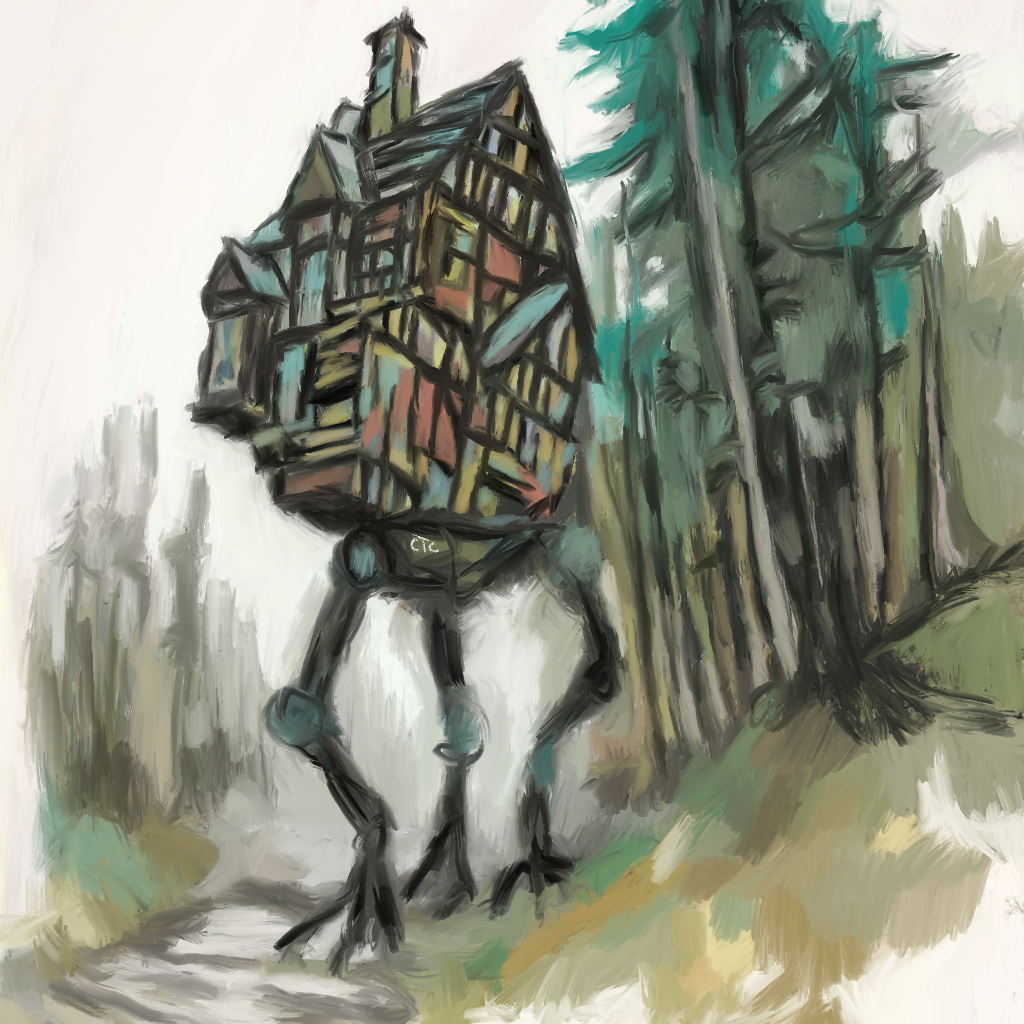
(I painted this in Procreate using the oil paint brush - Chaiga T. Cheska)
Being an account of the time our workplace attempted alpinism
Compiled by Bramwell Corin, who has since developed strong opinions about mountains
Preface
Those of you who read Part Nineteen of this series will recall that the Wandering Library, during its dancing phase, developed an internal gravity system. A remarkable achievement. Books stayed on shelves. Tea stayed in cups. Staff stayed on the floor, which is where staff belong. I wrote about it with what I believe was appropriate professional satisfaction and considered the matter thoroughly documented.
I would like to state, for the record, that the gravity system works beautifully when the Library is calm.
I would also like to state, for the record, that the Library is not always calm.
What follows is a full account in which our workplace decided that its natural habitat, that being the ground, was insufficient, and that Mount Cragwyn, which is not the ground and is in fact the opposite of the ground, represented a more interesting prospect. I have compiled this account from staff recollections gathered after the fact, once everyone had recovered sufficiently to speak in complete sentences and Pemberton had stopped making the noise she makes when she is deeply and personally offended by recent events.
I have tried to be accurate. I have tried to be fair to the Library, which did, in the end, find its own way through this. I have not tried particularly hard to be kind about the mountain.
The mountain knows what it did.
Part One: The Decision
We had been stationed in the valley below Mount Cragwyn for two days. It was, by any reasonable measure, a pleasant valley. Good light. Decent for Pemberton. A stream that minded its own business. Nobody had any complaints.
In retrospect, the stillness should have concerned us. The Library is a building that moves, and when it stops moving for longer than a single night, it is generally because it has noticed something. We had grown comfortable enough with the valley to stop asking what.
Bramwell noticed first. He always does.
“The Library is looking at the mountain,” he said at breakfast on the second morning, without looking up from his tea.
Pip looked up from his notes. “Perhaps it’s enjoying the view?”
“It’s looking at the mountain, with intent,” Bramwell said again.
Pip looked at the windows. Every one of them was oriented toward the peak of Mount Cragwyn with the focused, building-wide attention the Library reserves for things it has decided are important. The card catalogue had rearranged itself overnight. Three titles sat on Bramwell’s desk that had not been there the previous evening: A Practical History of Summits, a slim pamphlet titled On the Subject of Heights and What They Offer, and, most troublingly, What a Building Might Achieve, Given Sufficient Ambition.
“Oh,” said Pip.
“Quite,” said Bramwell.
They had perhaps four minutes before the Library took its first step toward the mountain. Bramwell used two of them, finishing his tea. This was, he has since maintained, the correct decision, and nobody who has read the rest of this account is in any position to argue with him.
The Library began to climb.
The gravity system failed at the precise moment the valley floor stopped being level, which is to say, immediately. The Library was not calm. The Library was thrumming with the specific excitement of a building that has decided to do something it has never done before, and excitement, as we had learned during the dancing, is the one condition under which the gravity system becomes decorative rather than functional.
Everything not secured to a wall slid to the rear of the building. The tea trolley. Four chairs. Approximately three hundred books that had been left on reading room tables overnight. Pemberton, who had been sitting in her window with the proprietary air of a chicken that has earned a pleasant view and intends to have one, and who was now sliding backwards across the floor with an expression that suggested she was cataloguing this event for future grievances.
The Library stepped upward, found its footing on the lower slope, and continued climbing.
Inside, we held on to whatever had been bolted down, and looked at each other, and said nothing, because there was nothing useful to say.
The mountain climb had begun.
Part Two: The Ascent
Staff Recollections, compiled afterwards
Bramwell:
The lower slopes were manageable, in the sense that nothing was actively catastrophic. The angle was perhaps thirty degrees. Steep enough that the floor had become a slope and the rear wall had become a floor, but not so steep that one couldn’t find a handhold on something structural and simply wait for the Library to come to its senses.
It did not come to its senses. It climbed.
The gravity flickered occasionally. In the moments when the Library paused to assess the next section of rock, some fragment of calm would settle over it, and we would feel the floor become briefly, wonderfully, properly floor-like again. Books would stop sliding. The pile at the rear wall would stop growing. I would think: here it is, it’s remembered, we’re going to be all right.
Then it would find its next foothold, and the excitement would return, and everything would slide again.
I spent a considerable portion of the lower ascent wedged between the wall and my desk, which I had secured to the wall for unrelated reasons some months earlier. I had my notebook, but I did not take notes. Some experiences lie outside the scope of professional documentation, and this was one of them.
Pip:
The narrow path was the worst part of the lower climb. There was a section, perhaps two-thirds of the way up the first face, where the path reduced to something a mountain goat might have found challenging, and the Library, which is not a mountain goat and is in fact a building, attempted to navigate it anyway.
Half of us slid to the window side. We were pressed against glass that looked directly onto a drop I do not intend to calculate. The valley was very far below. The stream that had minded its own business was now a silver thread I could cover with my thumbnail.
I am not going to pretend I wasn’t frightened. I was frightened. I was pressed against a window on the wrong side of a mountain inside a building that was navigating a path designed for creatures considerably smaller and less architectural than itself, and I was frightened.
Bramwell, from somewhere across the tilted room, began talking about the cataloguing system. Calmly. Methodically. The winter acquisitions. The problem with the Maritime section’s self-sorting shelves. The ongoing question of where exactly the Impossible Texts annex begins and the Theoretical Silence collection ends. He talked and talked in that steady, unremarkable voice of his, and I held onto the window frame and listened, and it helped more than I can account for.
Mistress Spine:
I attempted, at several points during the ascent, to reason with the Library by speaking directly to the nearest wall. I am aware of how this reads. I stand by it as a strategy. The Library has always responded to direct address, and I saw no reason to abandon the approach simply because we were at an inadvisable angle on a mountainside.
The Library did not respond. Or rather, it responded in the only way available to it, by continuing to climb.
I noted that Lyria, at some point during the steeper section, performed a brief sequence of movements that I can only describe as a building stretching toward something just beyond its reach, straining upward, then a separate movement suggesting that the thing being reached for and the thing reaching were perhaps not well matched in scale. She looked at me afterwards. I nodded. We did not discuss it further.
Thaddeus (Note slipped under office door at some point during the ascent, exact timing uncertain):
“I remain under my desk. The desk has migrated. I have migrated with it. We are now in the corner. I have my annotated index of the Impossible Texts and half a packet of digestives. Do not attempt rescue. I will emerge when the floor is a floor again. -T.”
(Postscript, added later: “The digestives are gone. Morale is holding. -T.”)
Part Three: Stuck
Staff Recollections, compiled afterwards
There is a specific quality to the silence of a building that has run out of mountain to climb.
Not the silence of rest. Not the silence of the Library in one of its contemplative moods, settled in a meadow with every window open to the evening air. This was a different silence altogether. The silence of something that has reached the limit of what it can do and is in the process of understanding that.
The Library had met a section of rock that defeated it. Too steep for its legs to find purchase above, too committed to the climb to simply reverse. It hung there, at an angle that made the word “floor” largely theoretical, and did not move.
And the gravity held.
This was the thing none of us had expected. In all the hours of climbing, the gravity had flickered and failed and returned and failed again, tied to the Library’s emotional state, reliable only in the pauses when excitement dipped toward something quieter. But stuck, genuinely stuck, unable to go forward or back, the Library found a stillness that excitement had never allowed it, and the gravity came on and stayed on.
Fear, it turned out, was a better anchor than joy.
We could feel it, the quality of the building around us shifting. Not the frantic, thrumming energy of the ascent. Something heavier. The Library understanding, in whatever way a building understands things, what it had done. Where it had brought us. What it had risked in the pursuit of something it had wanted without asking whether the wanting was wise.
Bramwell sat on what was now a passable approximation of a floor and did not speak for a while.
Pip’s hands had been shaking. They stopped shaking.
Mistress Spine, from her doorway, said quietly, “Finally,” and nobody asked her what she meant, because we all knew.
The mountain held us. The Library held us within it. We waited.
Part Four: The Book
Nobody saw it appear.
One moment, Bramwell was sitting against the wall with his notebook open and nothing written in it. The next, something hit his shoulder with a soft, definitive weight, the way books sometimes migrate to unexpected places in the Library, and he caught it without thinking, the reflexive catch of a man who has spent years in a building that occasionally throws literature at people with purpose.
He looked at it.
A small volume. Slim. Warm to the touch, the warmth of something recently made rather than recently held. The cover was plain, and the title, in the Library’s own preferred typeface, read:
The Directory of Unexpected Doors That Lead Elsewhere.
Bramwell read the title. He was quiet for a moment. Then he stood up, crossed to the nearest window, opened it, and threw the book out.
Pip stared at him, aghast.
“Bramwell,” Pip said. “That was a book.”
“Yes,” said Bramwell.
“You threw it out the window.”
“Very observant, Pip,” said Bramwell.
“We are on a mountain.”
“Yes, I have noticed,” said Bramwell and latched the window back.
The book fell. And opened, pages flapping as the Library jumped sickeningly off the mountain and into the book and the mountain, the view, the cold air, the terrible angle of everything, all of it simply stopped.
There was a sound like a very large, very decisive pop.
And then the floor was the floor.
Part Five: The Return
It is difficult to describe what the inside of the Wandering Library looked like in the immediate aftermath of the jump, because looking at it required a degree of composure that nobody present possessed for some minutes.
The gravity was back, fully and without negotiation. This was, without question, welcome. The manner in which it was back was somewhat less so. Everything that had spent the better part of a day migrating to the rear wall of the building, all the books, the chairs, the tea trolley, three tables, Pemberton, Thaddeus’s desk and Thaddeus alongside it, had now simply been returned to the general space of the Library with no specific attention paid to where any of it had started.
Pemberton was briefly airborne. She has not forgiven this.
Thaddeus and his desk arrived in the reading room. Thaddeus had not previously been in the reading room. His desk had not previously been in the reading room. Neither of them looked pleased about it.
The Maritime section had redistributed itself across the Natural Philosophy shelves. The tea trolley was upright, which was frankly more than anyone had managed during the climb, though it had shed its contents comprehensively across the floor of the eastern corridor. Someone’s annotated index of the Impossible Texts was open on Bramwell’s chair. It was not Bramwell’s annotated index.
Bramwell’s notebook was open on the floor. Still blank. He picked it up.
Outside the windows, the valley. The stream, minding its own business. The good light, the decent grazing. Mount Cragwyn visible in the middle distance, exactly where it had always been, unreachable, exactly as mountains are supposed to be when one is a building and has given the matter proper thought.
The Library was still. Not the fraught stillness of the stuck section, not the thrumming pre-decision stillness of two mornings ago. Quiet. The particular quiet of something that has had a very long day and knows it.
Somewhere in the pile of books near the reading room door, a slim volume sat with its cover face up. The Directory of Unexpected Doors That Lead Elsewhere. Back inside. Nobody had brought it in. The window was still latched.
Nobody mentioned this. There are things that are better left as facts without commentary, and this was one of them.
Bramwell walked past it on his way to find the tea things. His hand touched the nearest wall as he passed, briefly, the way he does when he thinks nobody is watching. He didn’t say anything.
He never does. He doesn’t need to.
Afterword
Pip’s Reflection
(Written several days later, once the reshelving was mostly complete and Pemberton had resumed her window seat, conditionally)
I have been thinking about the fact that Dame Pellifrax did not come.
Not because she wasn’t needed, or because we couldn’t have used her. There were moments on that mountain, if I’m honest, when I would have been very glad to hear her voice. But the door to her cottage never opened. The Library didn’t call for her. It got itself stuck on a mountain through its own ambition, and it got itself off the mountain through its own resourcefulness, with nothing but Bramwell’s reflexes and a book it apparently made for the occasion.
I find this unexpectedly moving, and I am aware that Bramwell would find my finding it unexpectedly moving to be, itself, somewhat unexpected. He would say something like, “It threw a book at my shoulder, Pip; it didn’t recite poetry,” and go back to his cataloguing. But I think that is rather the point. The Library did not recite poetry. It made a practical object and delivered it to the one person it trusted to understand without explanation. That is not nothing. That is, in fact, quite a lot.
We have all been here long enough to watch the Library learn things. How to keep us steady while it dances. How to let a ship go. And now this: how to find its own way out of its own mistakes. How to make the door it needs when no door exists.
I don’t know if buildings grow up. I don’t know if that’s a thing that happens or a thing I’m inventing because it makes a better story. But I know that when we settled back into that valley, and the mountain went back to being a mountain, and the floor went back to being a floor, the Library felt different. Not smaller for having failed to reach the summit. Something else. Something that is perhaps what you feel when you have discovered the precise shape of your own limits and found that knowing them is not the same as being defeated by them.
Pemberton is in her window. The valley moves past in the afternoon light. Somewhere behind us, Mount Cragwyn is getting on with being a mountain, and we are getting on with being a library, and I think, on balance, that this is the correct arrangement for everyone involved.
Bramwell has already reshelved The Directory of Unexpected Doors That Lead Elsewhere. He put it in Arcane Reference, between A Practical Companion to Inconvenient Magic and The Field Guide to Misplaced Destinies. He did not annotate the catalogue entry.
He did, however, leave it slightly further out from the shelf than the books on either side, so that the spine catches the light.
I noticed. I didn’t say anything.
Some things are better kept quietly.
Compiled over one inadvisable fortnight on the eastern face of Mount Cragwyn. The Library has not looked at the mountain since. Mount Cragwyn, for its part, has declined to comment. Normal operations continue at ground level, where they belong.
Author’s Note:
The Library has returned to its usual meanderings, and I have returned to mine. Should it develop further ambitions involving altitude, I will observe from a safe and sensible distance.
-Chaiga T. Cheska