On the Runic Courtship Habits of the Rúnsylf
With Notes on Several Incidents the Author Would Prefer Not to Have Documented
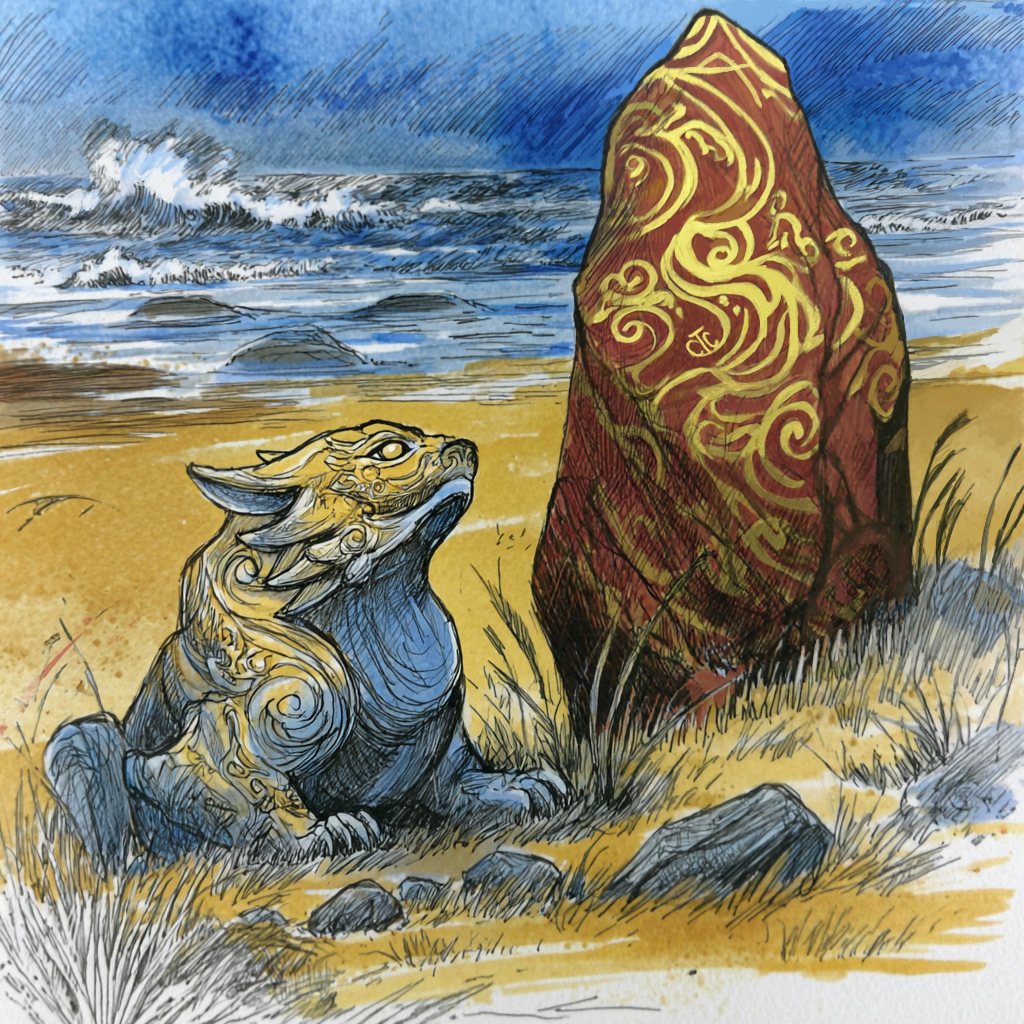
(I painted this first on paper with watercolour and ink pen, then edited it in Procreate with the HB Pencil and Water brush - Chaiga T. Cheska)
———————
Field Diary of Dr Fenwick Lorne
Senior Researcher in Runic Fauna,
MirMarnian Institute of Natural Peculiarities
(Personal field notebook. Not intended for publication. Please return if found mid-dance.)
The following entries are submitted in fulfilment of the Institute’s field documentation requirements. The author wishes it noted, for the permanent record, that several incidents contained herein would not ordinarily be committed to paper, and that their inclusion represents a professional sacrifice of some considerable magnitude. Science is demanding. The author is aware of this. He was rather less aware of it nineteen days ago.
——————-
Entry 1: 3rd Day of Late Spring
Location: Western Coastal Path, near the newly inscribed monolith.
I arrived at the field site at 08:47, notebook prepared, pencils sharpened to points I considered admirably precise, thermos of tea secured under one arm. The morning was clear and cold in the particular way of coastal spring, the kind of cold that suggests summer is considering the matter but has not yet committed. I was in good spirits. I had prepared thoroughly. I felt, on the whole, equal to whatever the day might produce.
The Rúnsylf was already present, seated beside the standing stone with the composed air of a creature that had been there considerably longer than I had and intended to make me aware of it. The stone itself was remarkable at close quarters. The inscriptions covered its western face in layered spirals that caught the morning light along their edges with a faint luminescence, as though the glyphs were still warm from the carving. I took up a position directly before the inscribed face and began my preliminary sketches, noting depth, curvature, and the spacing between marks with what I consider commendable precision.
At precisely 09:14, the monolith emitted a sound. It is difficult to describe accurately. A hum understates it somewhat. It was the sort of sound that arrives not through the ears but somewhere in the vicinity of the sternum, a deep and resonant pulse that seemed to bypass the usual mechanisms of hearing entirely.
At 09:15, I found myself performing what I have since identified, on reflection and with the assistance of a dance encyclopaedia, as a foxtrot.
I have no training in the foxtrot. I had no prior indication that I possessed any aptitude for it. The performance lasted approximately forty-five seconds, during which my pencil departed my hand and embedded itself in the gorse at a confident angle, as though it had somewhere better to be. The Rúnsylf observed throughout with the focused attention of an audience member who has secured a good seat and intends to get full value from the experience.
When the enchantment subsided, I retrieved my notebook. The sketches had survived. My composure took rather longer to locate.
Note for tomorrow: must investigate whether the effect is triggered by proximity, by eye contact, or by the creature’s appalling sense of timing.
———————
Entry 2: 5th Day of Late Spring
Returned this morning with earplugs, a fresh clipboard, and a conviction that the enchantment is auditory in nature and therefore blockable. My reasoning was not unreasonable. Sound produces the effect; blocking sound prevents the effect. The hypothesis had a clean and satisfying logic to it.
It was entirely wrong.
The Rúnsylf was carving upon my arrival, working at the upper register of the stone with the focused deliberation of a creature that has never heard of interruptions and does not intend to start now. I positioned myself before the inscribed face at a cautious distance of approximately six feet and began recording the new glyphs, which had multiplied overnight in formations of considerable intricacy along the stone’s left edge.
At 10:02, the monolith released what I can best describe as a melodic pulse. The earplugs performed admirably in their intended function. They blocked a perfectly ordinary quantity of sound. The spell, however, appeared entirely indifferent to them, as though it were operating on some mechanism the earplugs were not equipped to address, which, I now suspect, they were not.
At 10:03, I was singing. Loudly, and according to a passing fisherman, “in a surprisingly decent harmony with yourself.” I do not produce harmony. I am a man of data and careful observation. The fisherman applauded, which I found unhelpful. I declined to acknowledge him.
I should note, for completeness, that the clipboard, which I had brought as a writing surface, briefly functioned as a percussion instrument. I have no record of deciding this. The decision appears to have been made without consulting me.
Conclusion: the enchantment is not auditory in its mechanism. The earplugs are useless for this purpose. I have retained them in my field kit as a reminder that the obvious hypothesis is not always the correct one, and that confidence in a theory is not the same as evidence for it.
———————
Entry 3: 7th Day of Late Spring
Attempted a stealth approach today, advancing from behind a coastal dune on the reasoning that if proximity from the front is the triggering condition, an approach from a concealed angle might circumvent the effect. I planned the route the previous evening using a sketch of the site drawn from memory, which I believe was accurate to within a reasonable margin.
The approach itself was successful. I crested the dune without incident, descended the far side in a controlled manner, and had covered approximately two-thirds of the remaining distance before I trod on my own bootlace at 09:51 and slid, with rather more velocity than I had anticipated, directly down the remaining slope and into the spell’s influence.
The resulting performance was witnessed by a woman exercising her dog, who described it afterwards, entirely unprompted and with evident satisfaction, as “a spirited but misguided waltz with the sand.” I had not asked for her assessment. She offered it as though it were a courtesy.
The Rúnsylf clapped. It brought its small stone paws together three times in what I am reluctantly recording as appreciation. I find this professionally vexing on a number of levels.
I did manage, during a brief pause in the enchantment’s activities, to collect a small sample of runic dust from the base of the monolith. I lost it during an involuntary spin approximately eight seconds later. The sample is somewhere in the dune. I have not retrieved it.
One observation worth recording: on each occasion I have been affected, I have been facing the monolith. Directly, with the inscribed face before me. I am not yet prepared to draw conclusions from this. I am noting it regardless.
Tomorrow I shall try approaching backwards.
———————-
Entry 4: 10th Day of Late Spring
The backwards approach was designed to test whether the enchantment responds to the visual orientation of the researcher, on the hypothesis that direct visual contact with the inscribed face might be a triggering condition. If the spell requires the researcher to be looking at the stone, approaching without looking at it should, in theory, prevent the effect from taking hold.
I can confirm that it does not require the researcher to be looking at the stone.
At 14:27, advancing backwards along the coastal path with my gaze directed firmly towards the sea, I began to hum. This was not my intention, and I attempted immediately to stop. At 14:28, I was performing a full choreographic sequence of enthusiastic ambition and no restraint whatsoever, conducted entirely without my cooperation and in clear view of a section of path that I would have preferred to be rather less populated. At 14:29, I reversed into a shrub. The shrub sustained damage I can only describe as significant. I have written a note of apology to the relevant coastal authority.
The Rúnsylf appeared genuinely distressed by the shrub’s condition. It approached the damaged vegetation with evident concern, considered it for a moment, then apparently concluded that the most constructive response available to it was to inscribe a new rune. This was perhaps well-intentioned. The new rune triggered a further enchantment. I pirouetted. The shrub did not benefit from this.
My hypothesis log now contains four failed theories, one bruised elbow, and a shrub fatality. I remain no closer to understanding the mechanism. What I can say with increasing confidence is that the enchantment operates independently of sound-blocking, visual orientation, angle of approach, and every research distance I have yet attempted. There is something I am missing. The shape of it is beginning to suggest itself, but I lack sufficient evidence to commit to it in writing.
I shall continue to observe.
———————
Entry 5: 12th Day of Late Spring
Attempted today to sketch the creature’s markings from a safe distance using a telescope, reasoning that magnification would bring the necessary detail close without requiring me to be anywhere near the stone. I positioned myself on a low rise a considerable distance along the path, pointed the instrument at the monolith, and settled in to work.
I should note, and I note it now with the particular irritation of hindsight, that in pointing the telescope at the monolith, I was facing it. Directly. Eye to the instrument, instrument aimed squarely at the inscribed face. I had achieved proximity to nothing. I had achieved, however, perfect directional alignment.
At 11:03, with my eye at the telescope and my attention on the glyph formations along the stone’s lower register, I began to jig. Whilst still holding the instrument to my eye. The resulting introduction between my eyebrow and the telescope’s casing was forceful and immediate. I have a bruise. It is recorded here as a field injury sustained in the course of legitimate scientific enquiry, and I would request that framing to stand unchallenged in any future review of this documentation.
However, I am now prepared to commit to the hypothesis I have been avoiding.
Every incident. Every single incident. I have been facing the monolith. Not merely near it, not merely within earshot of it, but positioned squarely within its facing arc, looking towards the inscribed surface. The rune does not broadcast in all directions. It broadcasts in one direction, the direction it faces, and anyone standing in that line receives the full benefit of it.
I am going to test this tomorrow with a controlled approach from the side. If I am correct, I shall feel considerably more capable than I have done for the past ten days. If I am incorrect, I shall at minimum have eliminated another hypothesis.
—————
Entry 6: 14th Day of Late Spring
The Council has requested a formal interim report. I attempted to dictate it this morning at my desk, which faces the window, which overlooks the coastal path, which affords a clear line of sight to the monolith. I was, in the terminology, I am now applying with the confidence of a man who has recently worked something out, positioned directly within the facing arc.
Halfway through the sentence “The Rúnsylf demonstrates no malicious intent, and its inscriptions appear to function as courtship signals directed outward from the stone,” I produced a baritone. I have no reliable access to a baritone under ordinary conditions. The stenographer, a composed and experienced professional who has served the Institute for eleven years without incident, left the room with a briskness that suggested she had no intention of returning.
The remaining three paragraphs of the interim report were dictated to an empty chair. The chair did not applaud, which I found relatively dignified under the circumstances.
I have moved my desk.
I am now confident in the directional hypothesis. The enchantment travels outward from the inscribed face in the direction the rune faces. It is not proximity. It is not eye contact. It is not sound. It is orientation. Stand within the facing arc, and the spell finds you. Stand to the side, or behind the stone, and it does not. The mechanism is, in retrospect, rather elegantly simple, in the way that most things are simple once one has spent a fortnight being involuntarily waltzed across a coastal path before working them out.
I am, on reflection, deeply annoyed with myself for requiring six entries to arrive here. I have noted this without further comment, as I feel the facts are sufficiently eloquent on the matter.
—————-
Entry 7: 16th Day of Late Spring
Hypothesis confirmed.
I approached the monolith from the north this morning, positioning myself perpendicular to the inscribed face. I stood there for four minutes and forty seconds. Nothing occurred. My legs remained entirely my own. I took notes. The Rúnsylf carved. A remarkable and novel experience, an uninterrupted field session.
I then moved to approach from behind the stone entirely. Walked around it. Stood within arm’s reach of the uninscribed back face. Continued notes. Still nothing. The creature glanced at me once with what appeared to be mild curiosity, then returned to its work.
At 10:44, I stepped around to stand directly before the inscribed face, at a distance of approximately four metres, as a final and definitive test.
At 10:44 and some seconds, I executed what I am recording as a brief but committed series of steps. It lasted until 10:46.
The hypothesis is correct. The enchantment travels in the direction the rune faces, like light projected from a lantern: it illuminates everything within its beam and misses entirely what stands outside it. The Rúnsylf does not intend this. The creature is simply carving its courtship inscription with complete and earnest sincerity, unaware that its feelings are broadcasting outward in one specific direction and that any person unfortunate enough to be standing in that direction will find themselves abruptly engaged in interpretive movement.
I have mapped the safe approach corridor in my field notes. I have marked it clearly. Tomorrow I shall conduct a proper, uninterrupted study. I am almost looking forward to it.
——————-
Entry 8: 17th Day of Late Spring
(A day I shall henceforth refer to, in the privacy of my own recollection, as the Incident of Too Many Movements.)
I set out this morning with the firm intention of conducting a rigorous, uninterrupted observational study. I had a confirmed hypothesis. I had a mapped safe corridor. I had fresh pencils, a thermos of tea, and what I considered an admirable and well-earned clarity of purpose. My resolve was, I felt, beyond reasonable criticism. Heroic, even.
Upon arrival, I found the creature perched beside its monolith, humming faintly and looking insufferably pleased with itself. The markings had multiplied overnight in elaborate spirals that curled across the full face of the stone with the editorial enthusiasm of a creature that has never once considered restraint. I took up my position in the safe corridor, slightly north of the inscribed face, and began sketching.
It was going exceptionally well. My notes were clean. My observations were precise. My legs were cooperative in all respects. The Rúnsylf carved a new glyph along the stone’s lower register, and I saw at once that its curvature was distinct from the upper markings, tighter, more concentrated, suggesting a different runic function entirely. I needed a closer look at the detail. The detail was, unfortunately, on the lower right section of the inscribed face. To examine it properly, I would need to move forward and, just slightly, to the right.
I moved forward and, just slightly, to the right.
At 09:42, the monolith chimed. At 09:43, my left foot began to tap. Gently, like a polite suggestion. I attempted to redirect it. My right foot joined the conversation. Within thirty seconds, I was waltzing, without a partner and without any memory of having decided to begin, my pencil describing a confident arc through the morning air before coming to rest in the turf at a jaunty angle.
The Rúnsylf watched with the expression of a creature whose courtship broadcast has found an unexpected audience and is not fully certain how to classify the experience.
I attempted to reassert control of my limbs through the application of academic willpower. I can confirm, for the Institute’s records, that academic willpower is not an effective countermeasure to runic enchantment. The monolith chimed a second time, and I transitioned, without my consent, into what I can only describe as a sweeping theatrical gesture that might have appeared impressive had it been intentional. It was not intentional. My thermos toppled. Tea seeped into the coastal soil. A genuine loss.
By 09:47, the enchantment had escalated to full-bodied involvement. I was singing. The lyrics were improvised and, I regret to report, rhymed. I do not rhyme. I am a man of science and careful measurement. Yet there I was, on a coastal path in late spring, extolling the glimmering shimmer of runic stone in a baritone I appear to possess only under magical compulsion.
A passing dog walker applauded. I did not acknowledge this.
When the enchantment subsided, I retrieved my notebook. It contained one wobbly line drawn during an involuntary spin and three words of observation that had clearly been attempted whilst my hand was doing something else entirely. I attempted to resume work. The Rúnsylf, apparently encouraged by my participation, began carving a fresh rune with the earnestness of a creature composing a declaration to the horizon.
I approached again, more carefully this time, angling from the north. At 10:03, absorbed in the new glyph’s detail, I drifted, by perhaps half a pace, back into the facing arc. The monolith pulsed. I attempted to retreat. My legs had, by this point, formed their own opinions regarding the direction of travel. They propelled me into a jig of such vigour that it would have delighted a village fête and was entirely inappropriate for a man engaged in serious runic fauna research.
By 10:11, I had stopped resisting and was simply standing, hands on hips, waiting for the enchantment to conclude on its own schedule. It concluded at 10:14.
At 10:26, the creature approached me directly. It placed a small pebble at my feet. I have noted before that I believe this to be a gift of some kind. What I had not anticipated was the bow. I produced a sweeping bow, followed by a flourish of the arms of such theatrical ambition that a gull on the nearby rocks took to the air in alarm.
I have now retreated to a safe position with my notebook. My tea is gone. My notes contain approximately one useful observation. My legs ache in ways that suggest I have danced more today than in the previous four decades of my life combined.
I am placing the pebble in quarantine upon returning to my lodgings. I shall return tomorrow. With firmer boots. And, I am given to understand, knee supports.
——————-
Entry 9: 18th Day of Late Spring
I must include, in fulfilment of the Institute’s guidelines on comprehensive field documentation, a note regarding local folk customs.
Yesterday afternoon, returning along the coastal path, I stepped briefly and through pure inattention into the facing arc of a secondary monolith I had not previously catalogued. It stands near the bakery, at the edge of the coastal village, and appears to have been inscribed recently. The resulting incident lasted perhaps thirty seconds and would have been entirely unremarkable had it occurred in an unpopulated section of the path. It did not occur in an unpopulated section of the path.
Several residents, who were demonstrably acquainted with both the phenomenon and the socially appropriate response to it, immediately began to sing. The song, which I am including below in full because the Institute’s documentation guidelines on locally significant cultural phenomena are, on this matter, specific and non-negotiable, is a piece of folk music that appears to be well established across the coastal villages of West MirMarnia. The residents performed it with the precision of people who have had considerable practice. The baker came to the doorway. She clapped along. She appeared to be enjoying herself enormously.
I have transcribed the song from memory. My memory, on this occasion, is unfortunately excellent.
——————
“Caught in the Rune Again!”
A MirMarnian folk song, included for the purposes of comprehensive field documentation and for no other reason whatsoever.
———-
(Verse 1)
Oh, look who’s stepped too close again,
The stone has caught their feet,
They’re twirling like a windswept broom
Right in the middle of the street.
Don’t worry, love, it happens lots,
Just let the rhythm win,
We’ll clap along and sing this song
‘Til you stop spinning round in tin!
(Chorus)
Hey-ho, round you go,
The Rúnsylf’s got you in its glow!
Kick your heels and wave your arms,
It’s only runic coastal charms!
Hey-ho, don’t you fear,
You’ll get your dignity back this year!
Caught in the rune, caught in the rune,
Caught in the rune again!
(Verse 2)
Your voice has gone all operatic,
Your stance is pure ballet,
You only came to buy some bread
And now you’re in a cabaret.
Just ride it out, dear dancing soul,
The spell will fade anon,
And when it does, we promise you
We’ll still be singing on!
(Chorus)
(repeat, with increasing enthusiasm and no consideration for the feelings of the person still involuntarily dancing)
————
The song lasted, in live performance, considerably longer than my involvement in the spell itself, as the singers continued through the chorus a second time after I had regained full and complete control of my limbs and was standing perfectly still on the path. They seemed in no particular hurry to conclude. I have filed the song under Local Cultural Phenomena, Runic Courtship Season, and a third category I have created specifically for this field diary, which I have titled Significant Professional Inconveniences.
————
Entry 10: 20th Day of Late Spring
Some progress.
I tested today a runic dampener borrowed from the Institute’s equipment store, a small device designed to reduce the resonance of known inscriptions. With the dampener active, approaching the monolith within the facing arc produced only a mild involuntary swaying, which I am choosing to classify as within acceptable tolerances and which I will not be documenting in any greater detail than that.
However, the Rúnsylf had carved three new glyphs overnight along the stone’s upper right section. These are unknown inscriptions, and the dampener has not been calibrated to account for them. When I turned to examine them directly, the device offered no useful protection whatsoever. I swayed, briefly and then decisively, and removed myself from the facing arc before the situation could develop further.
I am recording this as a qualified success. The day produced one complete page of legible notes and zero incidents requiring formal documentation. That constitutes progress.
The creature itself sat beside the monolith throughout, observing my careful lateral movements with what I can only describe as the puzzled patience of something that does not understand why I keep approaching from angles but has decided to tolerate it. The Rúnsylf is not unkind. It is simply operating within a framework of romantic urgency that leaves little room for the concerns of researchers attempting to stay out of its broadcast radius.
It presented me with another pebble this afternoon. I believe it has exhausted its other ideas.
I have placed the pebble in quarantine alongside the first two. I now have three pebbles in quarantine. They are, upon examination, ordinary coastal pebbles of no detectable magical significance. I have elected to keep them quarantined regardless. One cannot be too careful.
—————
Entry 11: 22nd Day of Late Spring
I am concluding field research for the season.
At approximately 10:15, I stepped a fraction too far to the right whilst measuring the uppermost glyph’s curvature, drifted into the facing arc, and produced what I am told was a particularly vigorous polka. This would have been unremarkable by recent standards. The audience was less so.
There were fourteen of them. They had brought stools. Several had refreshments. The baker was present. The dog walker was present. The fisherman was present. Three people I have never seen before in my life were present, which I find troubling in ways I do not have the emotional resources to fully examine at this time.
What none of them had considered, in their enthusiasm to position themselves as close as possible to proceedings, was that several of those stools were arranged directly within the facing arc.
At 10:16, the enchantment found them.
Seven of the fourteen joined me. The baker waltzed. The dog walker performed an enthusiastic gavotte. The child in the front row stood up and jigged with an expression of pure delight and absolutely no regard for the half-eaten pastry she dropped into the sand. The remaining seven, safely outside the arc, found this the funniest thing that had ever happened in the entirety of their lives. The song was performed at full volume by people simultaneously unable to breathe from laughing. The fisherman, who was dancing, attempted to sing along regardless. It did not improve matters.
At this point, I made the professional decision to collect my equipment and withdraw from the field site with dignity.
What actually happened was that I grabbed for my bag, caught the leg of my folding stool instead, lurched directly back into the facing arc, and departed the coastal path at considerable speed in a manner that combined fleeing with a foxtrot, yodelling, and the progressive loss of three pencils, my field notebook, and the stool leg, which I was still holding and which I have not since recovered. I do not yodel. I have never yodelled. I cannot account for it.
I am told I was visible from the village for quite some time.
The pebbles remain in quarantine. This is a precaution, not a sentiment.
End of field diary.
—————-
Author’s Note:
Should this report have caused any snorting, wheezing, or undignified laughter, rest assured: I experienced the same while writing it. The Department of Seasonal Disruptions has been informed, though they have offered no help.
- Chaiga T. Cheska