On the Miniaturisation of Senior Scholar Dr Hib C. Snortleweather
To: Professor Brindle, Head of Department, Institute of Natural Curiosities
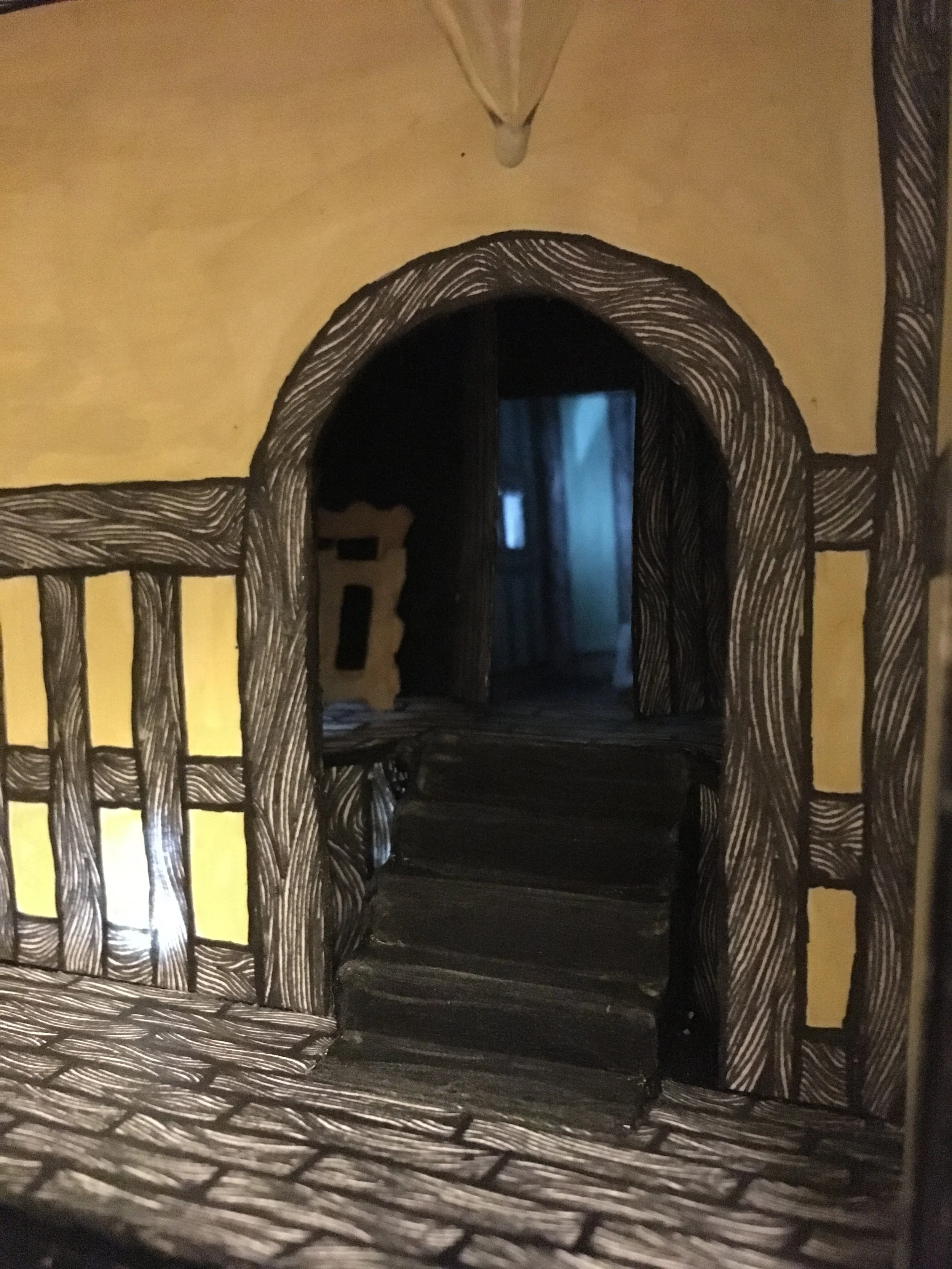
(I made this miniature using old food packaging containers, which I put together to create two rooms and a corridor with some stairs. I then drew details in each room with a fine ink pen and lit it from within to create the scene you see here. -Chaiga T. Cheska)
~~~
From: Miss Lysa Penniworth, Assistant to Senior Scholar Dr Hib C. Snortleweather
Date: The Eleventh Day of the Month of New Buds
Re: Events of the month, submitted in full, as required
Dear Professor Brindle,
I submit this report in keeping with the terms of my post, which require a complete account of the month’s events, however embarrassing, minor or seemingly unconnected any occurrence might at first appear. I have never yet left anything out on the grounds that it reflected poorly on someone, myself included, and I do not intend to begin the practice now. What follows is, to the best of my knowledge, everything of note.
The Incident
Dr Snortleweather had been at his sketching for the better part of four hours when it happened, crouched over the leaf in the South Thicket in the position he favours for close observation, which I have on previous occasions likened to a heron considering a pond and shall not apologise for. I was seated a little apart, recording his notes as he called them out, when a shimmer rose from the settlement below.
I did not think much of it at the time. Shimmers of that sort are not unusual over a village of that kind, and I confess I have a fair instinct for which ones matter and which do not, gathered, I suppose, from long enough spent watching this particular study. This one mattered. Dr Snortleweather straightened, declared himself acknowledged at last, and was gone before I had finished writing the sentence.
I found him a moment later standing on the leaf itself, now reduced to the height of an acorn and shouting up at me with a volume his new lungs had no real business producing. He was, I should record, not frightened. He was furious, which I took as a reasonably good sign.
Retrieval and Immediate Care
I collected him with care, using a clean teacup lined with a handkerchief, the weave loose enough not to catch at such a small scale, a thing I judged correctly without needing to think about it, and have never been able to say where I first learned. He objected to being carried, insisted he was capable of climbing into the cup himself, and yet after such a declaration was unable to climb into the teacup. I did not argue the point with him. There seemed little to be gained by it, and a great deal of ground still to cover before dark.
The walk back to the Institute took considerably longer than usual, because I had to keep the cup level, and because Dr Snortleweather spent most of it informing me, at some length, that he had been acknowledged and that the village’s subsequent refusal to restore him was therefore an act of considerable ingratitude. I recorded his views. I did not share them, though I have kept my reasons for that to myself, as they did not seem relevant at the time.
The Departmental Debate
I attended the meeting convened on his return, serving as minute-taker rather than participant, and shall summarise it here for completeness. Several colleagues proposed that, having brought the matter upon himself, Dr Snortleweather ought to take up residence beneath the leaf with the community he had spent so long attempting to study. Dr Snortleweather rejected this firmly, stating that the villagers were a private people who had made their wishes on the subject very clear. I noted this down without correcting it, though I might have added a great deal to it had I been asked.
You concluded, rightly in my view, that the Institute could not reasonably expect a scholar to live beneath a leaf indefinitely, and accepted responsibility for his continued employment. I have recorded this as departmental resolution rather than personal opinion, though I will say I thought it the correct decision, and said so to no one.
Negotiations with the Settlement
The delegation sent to discuss the matter with the village did not fare well, and I do not think it fair to lay the whole of that at the village’s door. They approached at midday, when the shutters there are customarily closed against the heat, and from the leaf’s shadow side, which I understand is not the side from which visitors are received. I mentioned neither of these things beforehand, as no one asked, and I did not think it my place to offer guidance on customs I had no easy knowledge of.
The village’s answer, when it came, was unambiguous. No outsider, miniaturised or otherwise, would be permitted to settle beneath the leaf. I cannot say I was surprised by the refusal, only by how mildly it was delivered. They are not an unkind people. They are simply not an open one, and I have found, on the whole, that a closed door is easier to respect than to resent.
Establishment of the Teacup Wing
With the settlement refused, the Institute turned its attention to building proper accommodation, and I am pleased to report that the Teacup Wing now stands complete: scaled lecture halls, a library of appropriately sized volumes, and a residential suite furnished with walnut-shell chairs, the proportions of which I was able to advise on, I am told, with unusual confidence for someone who had never built furniture at that scale before. I put this down to a good eye and have not enquired further into the matter myself.
The Wing has not remained a single-occupant concern. I record the following additions to the household, as the stipulation requires, briefly.
Scholar Marlo Finch was miniaturised whilst attempting to present the village with a walnut by way of a polite introduction. The walnut was declined. I retrieved him myself and have since taken to carrying a second, empty teacup on all field visits, as belongings tend to scatter badly during the process and there is nothing more dispiriting than a scholar’s notes drifting off across a leaf whilst he himself sits fuming in a cup.
Dr Pella Wint, miniaturised whilst attempting to measure the shimmer with an instrument of her own devising. The instrument went with her and remains too small to be retrieved without risking further miniaturisation for whoever attempts it, so it sits in the Wing’s laboratory, of considerable interest and no present use.
Scholar Emeritus Brannock Hale, miniaturised whilst informing a colleague that he was immune to the phenomenon on account of his professional gravitas. I was not present for this one, but I understand his gravitas remained unaffected by the change, which he has taken as vindication rather than the reverse.
Each has settled into the Wing with reasonable good humour, and I visit daily to ensure nothing is wanted.
My Own Arrangements
I should record, for the sake of thoroughness, that I do not fit inside the Wing myself; its corridors were built to a scale I was never meant to share, and my duties have had to adjust accordingly. I attend Dr Snortleweather each morning from a stool positioned outside whichever room he is working in, my eye and the greater part of my nose pressed to the appropriate miniature window, through which we conduct the whole of the day’s business. He reads his notes to me through the glass. I pass instruments and correspondence through a hatch cut for the purpose. It is not an elegant arrangement, and I have twice fallen asleep on the stool and woken with a windowsill’s imprint across my cheek, which I mention here only because the stipulation permits no exceptions for dignity.
I do not mind it. I would rather sit outside a window I cannot pass through than not be there at all. Dr Snortleweather has never once, in four years of my service, made me feel the arrangement was anything less than sufficient.
I believe that covers the whole of the month’s business.
One further matter, included here for completeness, as nothing is to be omitted regardless of relevance: I was born beneath that same leaf in South Thicket, one of seventeen who came forward when the village first tested whether its shrinking charm could also be worked in reverse, and I have felt no wish, in the years since, to return to it. They are a careful people, and a closed one, and I found I preferred a world with rather more room to move about in.
Yours in continued service,
Miss Lysa Penniworth
Assistant to Senior Scholar Dr Hib C. Snortleweather
Institute of Natural Curiosities
P.S. The villagers presented a song from their point of view, sung in the Way of Lon*, the natural language of MirMarnian beings.
Author’s Note:
Did you work out who Miss Penniworth was before that last paragraph, or were you just as baffled as the rest of us?
-Chaiga T. Cheska
*Way of Lon is a constructed language of mine that I’ve been developing since the 1990s and has undergone many evolutions, but recently has found solid grounding inspired by the Anglo-Saxons.