On the Matter of the Lower Sniggleswick Tiles
By Dr Percival Quillmoth, Fellow in Threshold Disturbances, with a Conclusion by Dr Hester Bramblecott, Senior Fellow in Wayside and Hedgerow Botany, Institute of Liminal Phenomena
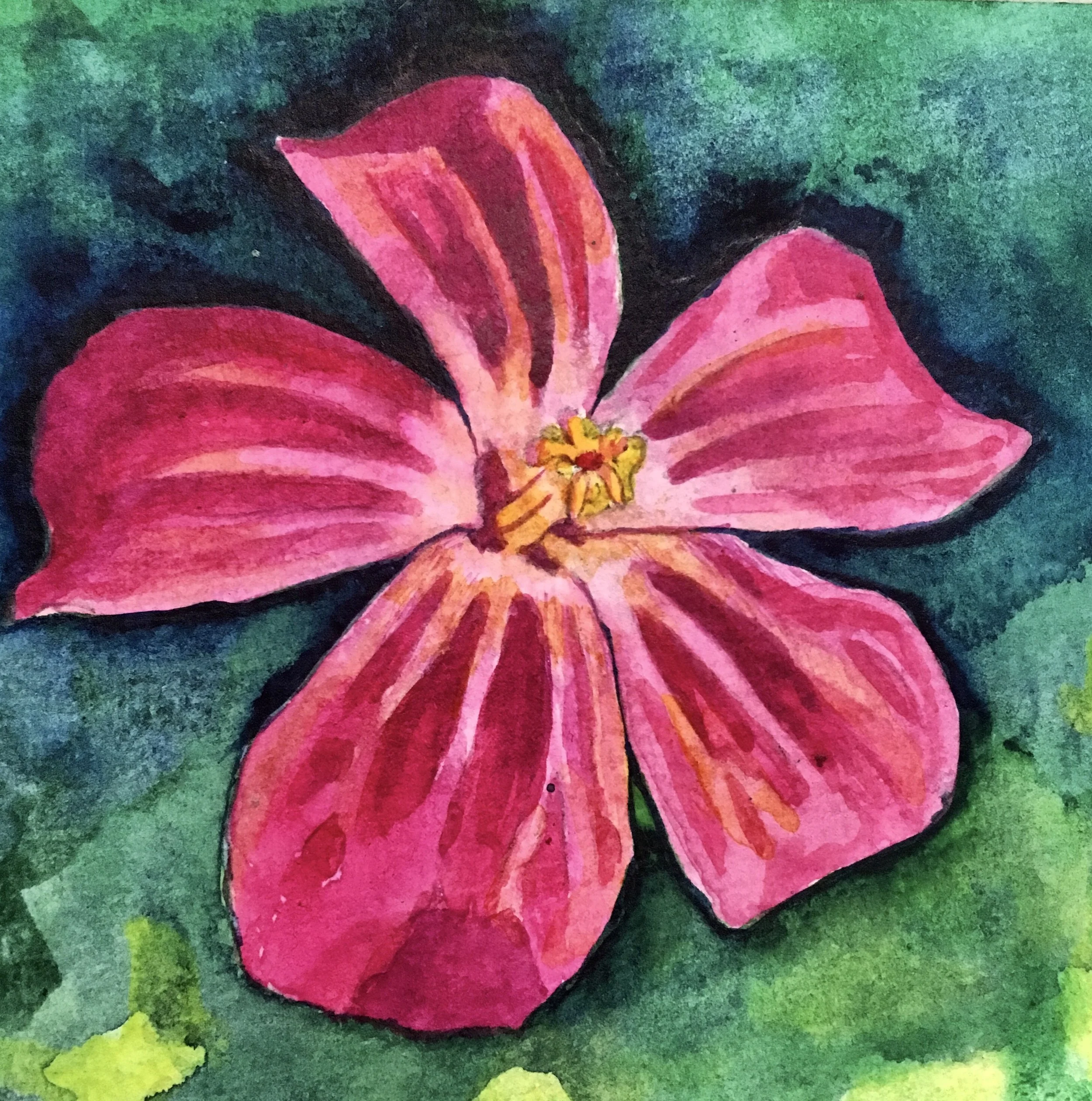
(I painted this using watercolours on paper. - Chaiga T. Cheska)
~~~
Submitted to Director Wendeline Ashgrove, on the Eleventh Day of the Month of Falling Leaves
Dear Director Ashgrove,
You will recall handing me the Sniggleswick Gazette across your desk on the first morning of the month, whilst you were eating a boiled egg. You tapped the letters page twice with your spoon and said, “Thresholds, Percival. That’s you.” A small piece of yolk then landed on the word hamster, which I took at the time as a coincidence and now regard as an omen.
The letters were one long howl from the residents of Lower Sniggleswick, who had been trying to pass through the fare gates of their Waggon House to catch the morning waggons into Mirhaven, but had instead, on several occasions, arrived on the far side as giant hamsters. One signed herself “A Hamster, Formerly and Very Possibly Again.” Another had written “WHY” eleven times, underlined, and then, in smaller letters, “also my cheeks still ache.”
Arrival
The evening waggon set me down in a mist so thick that I stepped straight into a puddle that came up to my shin.
The Waggon Master met me at the door. Mr Obadiah Crumble wore the expression of a man who has been asked the same question four hundred times and means to keep answering it politely until one of them wanders off.
“You’ll be the Institute,” he said, looking at my leg. “I see you’ve met Old Gerald.”
“Who?”
“Locals call the puddle Old Gerald.”
“Um… right,” I said, and felt I had arrived somewhere very odd indeed.
Chalked beside the new green tiles before the fare gates, in letters that grew larger and more frantic as they went along, were the words MIND WHERE YOU TREAD, then NO REALLY, and finally, very small, PLEASE, I’M BEGGING YOU.
“My words,” said Mr Crumble, smiling grimly.
The Tiles
The next morning I met Mr Dunstan Grout, foreman of the tiling crew, who was on his knees, polishing a tile with his sleeve and humming to himself.
“Lovely glaze,” he said. “Look at the depth of that.”
I looked. It was, I admit, very deep. “You are aware some of these turn people into hamsters?”
“Not these ones,” he said, deeply wounded. “The ones by the gate.”
That afternoon, having polished the whole hall in beeswax until it shone like the inside of a spoon, Mr Grout did not mention it. I walked in with my spectacles pushed up on my forehead and my notebook held before my face, and I put one foot on the first tile.
I went over backwards. I then travelled the entire length of the fare hall on my back, spinning gently, with my notebook held aloft like a waiter carrying soup, before coming to rest against the fare gate with my hat over my face.
“You alright?” called Mr Grout.
“I am a scholar,” I replied from under the hat, which was probably a strange response, “at the Institute of Liminal Phenomena.”
“That’s nice. Mind my glaze.”
Case One: Mrs Clara Sillywhiskers
Mrs Sillywhiskers received me with seed cake and sunny delight.
“Oh, it was wonderful,” she said. “I was late, you see. I ran for the Mirhaven waggon, and the next thing I knew, my nose was going like the clappers, and I was looking at the fare gate from a good foot higher up. I thought, well, hello.” She beamed. “And then I smelt Mr Pottle’s shop.”
Mr Alfred Pottle, a greengrocer, describes the next quarter of an hour as a man recalling a shipwreck. Mrs Sillywhiskers tried to enter headfirst and did not fit. Mr Pottle got behind her with a broom and pushed. There was a noise he calls “a sort of pock,” and she shot into the shop, taking the door frame with her. Mr Pottle landed face first in the potatoes.
She ate his front display, including “every radish in the parish,” climbed into the window of Tuffet’s Millinery, knocked every bonnet off its stand, and went to sleep on the claret velvet chaise. Mrs Tuffet put a card in the corner that read “ON LOAN” and sold eleven bonnets by closing time, each tagged “As Slept On”.
“I woke at about three, with a bonnet on,” said Mrs Sillywhiskers. “I’d eaten the trimming off it, I’m afraid.”
Every other case on record lasted a full day and a night. Hers lasted barely seven hours. I put this down to her having lost track of time, which is common amongst people who are enjoying themselves, particularly those who have recently eaten a greengrocer’s.
She saw me out and said, rather wistfully, “If you find out which tile it was, would you tell me?”
I asked why.
“No reason,” she said, and became transfixed on the wall as if it was the most interesting thing.
Case Two: Mr Roddy Warmfluff
Mr Warmfluff was not enjoying himself, and I do not believe he has enjoyed himself since.
I found him on the bench beside the booth, clutching a brand-new leather briefcase to his chest like a man holding a lifebelt in a storm.
“I was early for the quarterly assessment,” he said. “Then I realised I had left my second-best pen on the kitchen table, and by the time I returned, the waggon was at the gate, and I ran. I am not a running man. The one time in nineteen years I ran, the floor took offence.”
“It’s not personal, Mr Warmfluff,” said Mr Crumble, passing with a broom.
“It felt personal.”
Mr Warmfluff became a smoky-grey hamster, absolutely livid. He ate his briefcase, ledgers and ham and mustard roll and all, then left a deposit behind the ticket booth which Mr Crumble described to me, in a flat and haunted voice, as “forty-one pellets, each about the size of a plum.”
“I counted,” said Mr Crumble. “Somebody had to.”
Apparently, Mr Warmfluff then vaulted the fare gate and got into the waggon to Great Muddlecombe, where he stuck halfway along the aisle and became, in the driver’s words, “a furry cork.” A farmer’s wife who tried to pull him free was lifted off her feet along with her goose, which spent the rest of the journey standing on his head, honking.
“It just wasn’t my day,” he said, looking down at the new briefcase. “This one has nothing in it. It is purely for show.”
A Working Theory
I recorded seventeen transformations in all, and on my fifth morning I noticed Winnie.
Winnie Crumble, the Waggon Master’s granddaughter, is seven, with hair the colour of new rope, and spends her mornings threading the little red flowers from the verge into chains, and hanging them round her own neck and, on one occasion, mine, whilst I was asleep on the bench. She crosses every one of the forty-eight tiles twenty times a day.
She never turns into a hamster.
“Leave the rut-poppies be, Winnie,” said Mr Crumble. “They’re only weeds.”
“They’re pretty weeds,” said Winnie.
I began to watch the feet instead of the tiles. But every one of the seventeen had been running for a waggon. The tiles are interested only in people in a hurry.
“So what you’re saying,” said Mr Crumble, when I told him over tea in the booth, “is that if everyone would only slow down, none of this would happen.”
“That is my working theory.”
He looked at me for a long time with his cup halfway to his mouth. “I’ve been telling them that for forty years,” he said. “Nobody listened to me either.”
I recommended notices asking passengers to walk. Mr Crumble pointed silently at the floor, where the chalk now read “I HAVE RUN OUT OF WAYS TO SAY THIS”.
Addendum, Written in Haste at the Waggon House, the Morning of the Harvest Fair
I am writing this on the bench by the ticket booth because I have a very bad feeling and want it on paper.
I came down early and found Mr Grout on his knees with a trowel. “Bit of reordering overnight,” he said happily. “Pattern looked better the other way round.” He has re-laid all forty-eight tiles in a new order. I have no idea which of them are dangerous.
But the Guild has sent word that the Harvest Fair is opening an hour early, and Mr Crumble has come out onto the step with his brass bell.
He rang the bell.
I can hear them. The whole of Lower Sniggleswick is coming down the High Street in their Fair best, and every one of them is running. I have to reach the gate first and make them stop. If I walk, I shall not make it.
I shall have to run.
I ran. I have reached the gate. They are pouring through the doors, a great wave of best hats, and I am waving both arms and shouting at them to stop, and my voice
My voice is very high.
Everything smells of apples. Everything is enormous, or I am enormous. Every one of the feet on the green tiles is now a paw. A hamster in a bowler hat has just gone past me for what I believe is the fourth time. Somewhere at the back of the crowd I can see a new leather briefcase, a charcoal coat, and a…..
Conclusion, by Dr Hester Bramblecott
Dear Director Ashgrove,
The pigeon from Lower Sniggleswick reached the Institute on the morning of the Fair. It flew in through your office window, missed the perch, and landed in your boiled egg. The message on its leg read: YOUR MAN IS A HAMSTER. SO IS EVERYONE ELSE. PLEASE SEND SOMEBODY SENSIBLE.
You sent me, which I took as a compliment. I resolved to walk everywhere, on the grounds that a careful man had gone to look into this and was now a hamster, and I should prefer to stay the shape I was.
The Yard
I reached Lower Sniggleswick a little after eleven and found the yard full of bewildered hamsters the size of ponies, most still in their hats. One wore the chain of office of the Mayor of Lower Sniggleswick and was trying to cut a ribbon with its teeth. By the fare gate stood a light tawny hamster in a waistcoat, wire spectacles hanging from one ear, pointing very firmly at the floor. In the middle of the fare hall a large grey hamster with a white bib lay on its back with all four feet in the air, slowly eating a new leather briefcase.
“Second time,” said Mr Crumble, leaning on his broom. “He came down early so he wouldn’t have to hurry. Then the bell went, and everybody ran, so he ran, so as not to get trampled by the running. He was hurrying so as not to be in the way of the hurrying. I don’t think the floor cared for the distinction.”
The Mayor chose this moment to back into me and sit on me, so that my investigation began from underneath a Mayor hamster.
The Question of the Bonnet
A small girl with hair the colour of new rope and a gap where her front teeth were coming in held out a sheaf of papers, nibbled at one corner. “It’s the scholar hamster’s,” said Winnie Crumble. “You can have it for a humbug.”
I paid her, and read Dr Quillmoth’s report on the bench. Winnie’s chains of red flowers. And Mrs Sillywhiskers, a hamster for barely seven hours, who woke having eaten the trimming off a bonnet.
Dr Quillmoth had put this down to her losing track of time. I did not think Mrs Sillywhiskers was a woman who lost track of anything. I thought she was a woman who knew exactly what time it was and had decided not to mind.
Mrs Tuffet brought out the bonnet: cornflower blue, with a single green stalk pinned to the band where the trimming ought to be. “Rut-poppies,” she said. “Weeds, really. But such a lovely colour.”
Mrs Sillywhiskers, who had come down to see what all the squeaking was about, remembered the rest. “I woke about noon, and there was this lovely red thing by my nose that smelled of honey and summer, so I ate it and went straight back to sleep. I woke again on the church bell at three. There was a crowd outside clapping. I did a little bow.”
The Poppies
I would not permit anyone to hurry, so the picking party went up and down the verges in a stiff-legged, elbows-out walk that must have looked, from a distance, like a very slow, very angry race. The hamsters, meanwhile, did not wait quietly. A quarter of an hour in, every hamster in the yard sat bolt upright, their faces set with sudden, terrible industry, and began to gather. For the next hour, the Waggon House was given over to what I can only describe as a stocktake conducted by fine artists. The apples went first. The brass bell went into the Mayor’s left cheek, so that every time he chewed, a faint, muffled clonk came from inside his face.
By one o’clock, we had a poppy for every hamster in the yard. I asked Dr Quillmoth first, as a courtesy between colleagues. He nodded so hard that his spectacles flew off his ears, then took the poppy delicately in both hands and ate it.
There was a small, polite pop, like a cork leaving a bottle in a library, and Dr Quillmoth was a man again, sitting on the cobbles in a waistcoat that now fitted, patting the ground for his spectacles.
“I should like it recorded,” he said, “that I did not pouch.”
“One each,” I called to the yard. “Chew. Swallow. Do not pouch.”
They went off all over the yard, pop, pop, pop, until it was full of people in their Fair best, sitting on the cobbles with apples rolling out of their sleeves, looking extremely surprised and checking that they had all their buttons.
Mr Warmfluff pouched his, and then, when the basket came round again, pouched the lot, until his face was almost perfectly square. He turned his back on me and lay down with a thump that rattled the fare gates.
Mrs Sillywhiskers went and sat beside him in her straw hat, with a cup of tea he could not drink. “Try a poppy; they’re quite delicious, you know!” I heard her say.
Mr Warmfluff sneezed. Twelve poppies came out of him and went all over Mrs Sillywhiskers, who sat spangled with wet red petals. She picked one off her hat and held it up to him. He looked at it for a very long time. Then he ate it.
Pop.
Mr Warmfluff sat up on the green tiles in his charcoal coat, buttoned to the chin, with a petal stuck to his cheek. He looked at his watch.
“I am four hours late for the quarterly assessment,” he said, with a sort of dawning wonder. “But that poppy was unexpectedly delicious!”
Mrs Sillywhiskers handed him the cup of tea. He drank it, and said it was the best cup of tea he had ever had, and I did not think this was all about the tea.
That left the Mayor. The Mayor had pouched his poppy beside the bell, discovered the wheel of the last Fair waggon, climbed inside, and begun to run, overcome by an irresistible need to go somewhere without going anywhere. The waggon began, very slowly, to roll down the lane, clonk, clonk, clonk, the two horses still harnessed at the front and walking ahead with the air of elderly gentlemen forced to join in a dance.
Mr Crumble set off after it. He did not run. Nobody ran. The whole village went down that lane in a furious, rigid-backed, arms-pumping walk, elbows everywhere, and every time anybody broke into a trot, the others hissed “Walk!” at them. It was the fastest I have ever seen anyone not run. At the ford, the horses flatly refused to go further, and the Mayor climbed out and lay down in the shallows with the water running through his fur.
“Swallow, Mr Mayor,” I said, from the bank.
He swallowed. Pop. The brass bell fell out of his mouth and floated away down the river, ringing.
Conclusions
For the Institute’s records: the tiles punish haste, and a single rut-poppy, chewed and swallowed, undoes the damage on the spot. A hamster kept waiting for its poppy becomes ferociously busy, and anything within reach, including apples, bells, waggons and Mayors, is at risk. The poppy must not be kept in the cheek, and anyone who does so should be approached from the side.
Above the fare gate hangs a new sign: BETTER LATE THAN FURRY.
The remedy had been growing beside the path every hurrying passenger took. The one person in Lower Sniggleswick who had properly looked at it was a seven-year-old girl who has never in her life been in a hurry for anything.
As I left, I saw Mrs Sillywhiskers coming down Tanner’s Row in her good coat and straw hat, with the brisk, purposeful step of a woman who has somewhere very particular to be, and who was, I could not help noticing, walking a great deal faster than was strictly necessary.
Behind me, from the fare hall, came a small and delighted squeak.
Yours, in continued and unhurried service,
Dr Hester Bramblecott
With thanks to Miss Winnie Crumble, without whom this report would be considerably furrier.