On The Lytharudu
By Pelwick Dorn, Junior Fellow in Stellar Fauna Studies
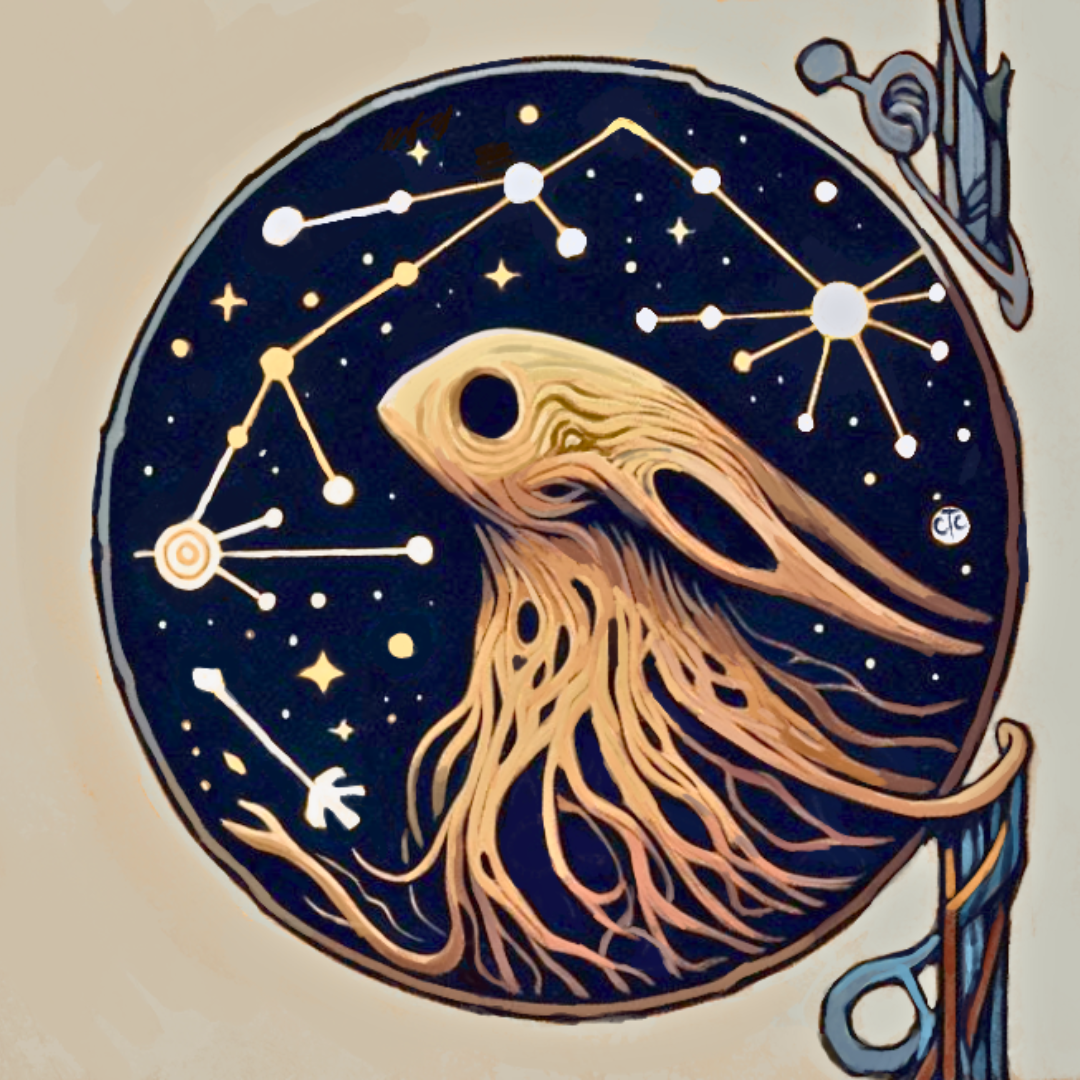
(I painted this in Procreate using the Eaglehawk brush and the HB Pencil - Chaiga T. Cheska)
———————-
Being a Full and Largely Honest Account of Ten Years' Observation of the Most Serene Creature in MirMarnia,
Conducted from Various Heights with Varying Degrees of Success
——————-
By Pelwick Dorn,
Junior Fellow in Stellar Fauna Studies,
Collegiate Institute of Celestial Observation, Mirhaven
—————
I should explain, before anything else, how I came to spend the better part of a decade in an elevated state. Not in the philosophical sense. In the quite literal sense of being repeatedly very high up and occasionally on my way down, rather faster than I had planned.
The stars aligned. That is the plain fact of it. Once every three hundred and twelve years, a specific convergence of celestial currents causes the uppermost layer of the MirMarnian firmament to descend by approximately seventy feet for the duration of a decade. To most of MirMarnia, this is mildly interesting and then forgotten about over breakfast. To the Lytharudu, which ordinarily drifts in the upper dark well beyond the reach of any earthbound observer, it is the difference between being theoretically documented and being actually documentable.
The Institute of Celestial Observation identified this as a research window of “exceptional and unrepeatable scientific value,” convened a committee, formed a sub-committee, had a lengthy argument about funding, and then assigned the project to me. I was the most junior Fellow present at the meeting. I had moreover recently submitted a paper on an entirely different subject, which the committee described as “showing promise,” and in Institute parlance, this means that you are about to be given something considerably more difficult to do.
I am writing this in the forty-ninth week of the tenth year. The alignment closes in eleven days. I have four notebooks, a persistent twitch in my left eye that the Institute physician says is not serious, and rather more to report than I expected, though not always about the creature.
On the Nature of the Lytharudu
The Lytharudu is a creature of the upper sky, formed from sky-grain: the residue shed by the constellation waves that move through the MirMarnian firmament in the cold hours before dawn. Sky-grain resembles driftwood in almost every respect. The one distinction that matters is that it has never been anywhere near water. The smoothness of it, that pale, warm, polished quality visible even at a considerable distance, comes not from the patient work of tides but from years of drifting in the vast, dark, unhurried quiet between stars. It has been worked on for a very long time by nothing in particular, and the result is a timber that the sky has, over centuries, made beautiful.
When sky-grain comes to rest within a circle, natural or incidental, it begins to listen. This is how a Lytharudu becomes alive, and it is where the creature and the ordinary piece of wood diverge most completely. The wood sits and waits. The Lytharudu sits and attends. These are not the same activity.
The creature feeds on starlight, though not the visible kind. What it drinks is the pattern-eddy released when constellations shift, breathe, or realign. Patterns are its native language, and the great geometric arrangements of the night sky are, as far as any observer can determine, a source of profound and uncomplicated happiness. A Lytharudu in the presence of a strong constellation alignment does not move, vocalise, or perform any action that would communicate joy to a casual observer. It simply becomes, by increments, more luminous. The lumen-veins that thread its grain, pulse a little more brightly. The cold light that fills them deepens, in the way that a fire deepens when someone finally puts more wood on.
It is not an especially demonstrative creature. It does not need to be. It has the patience of something that was formed by the sky and intends to return to it eventually, and has no particular urgency about anything in between.
It also, I must report, has absolutely no idea that I exist.
Year One: The Tree
The first approach seemed very straightforward. The oldest Eldertrees in the southern groves reach heights of two hundred feet, and the Institute’s calculations suggested that a researcher positioned in the upper canopy during clear conditions ought to have a workable view of any Lytharudu drifting at the lowered firmament level. I had my notebooks. I had a rope. I had, I felt, a reasonable plan.
The lower branches of a mature Eldertree begin at approximately forty-five feet from the ground. I had not, until that morning, properly considered what forty-five feet looks like from below. It looks, for the record, like rather a lot.
I spent three days attempting various approaches before managing to reach the first branch via a system of ropes and a grappling hook borrowed from a river vessel whose captain made no effort whatsoever to conceal his opinion of the plan. From there, the upper canopy was, in theory, simply a matter of continuing upward. In practice, it was a matter of continuing upward whilst the tree moved in the wind in a way that did not appear on any of the Institute’s structural diagrams, which I now suspect were produced by someone who had never actually been in a tree.
On the seventh day, I reached a height from which I could see the lower boundary of the alignment zone. A single Lytharudu drifted at perhaps thirty feet above my position, pale as birch bark and glowing with a cold, faint internal light, turning very slowly in the upper air with the unhurried contentment of something doing exactly what it had always meant to do. It was, briefly, everything the Institute had described.
Then the branch made a sound.
I have no notes from that day. The notebook and I parted company at different velocities and were reunited four days later when a woodcutter found it in a ditch two miles from the tree. How it travelled so far remains, scientifically speaking, an open question. I was retrieved considerably sooner, which I count as the single unambiguous success of that first year.
Nothing was broken. The Institute physician wrote this down and said “remarkably” whilst she did it, and I chose to take it as a compliment.
Year Two: Further Trees, Briefly Summarised
Eleven more attempts across four different trees produced three partial observations of reasonable quality; one excellent observation cut short when it began to rain with what I can only describe as deliberate timing; two notebooks ruined by circumstances I will not recount in full as one of them involved a bird’s nest and the relevant parties have feelings on the matter that I consider worth respecting; and one occasion on which I reached the canopy in fine form, settled myself with considerable satisfaction, looked up into the alignment zone and found it entirely empty.
The Lytharudu was approximately fifteen feet to my left. It had drifted. I had not accounted for drifting.
I have since accounted for drifting.
Year Four: The Mountain
In my fourth year, I produced a detailed map of all potentially useful high points within a reasonable distance of Mirhaven and identified a ridge on the northern slopes whose summit sits, during alignment conditions, at precisely the right elevation for observation. Unlike a tree, a mountain cannot shift, sway, or make sounds that suggest it has reconsidered the structural arrangement. I considered this a point firmly in the mountain’s favour.
A mountain can, however, generate weather. This is something I had noted in a general sort of way without thinking it through carefully enough. The northern ridge produces its own weather system between early autumn and late spring, and this weather system has opinions about visitors and does not keep them to itself.
On my first attempt, the summit was simply not visible. On my second, it was visible but covered in the kind of frost that announces itself through the soles of boots and does not stop there. On my third attempt, I reached the top on a morning that felt almost reasonable, opened my notebook to a clean page, and had four lines written before the cloud came in.
The four lines read: “Pale grain, warm in tone. Lumen-veins active, pulsing steadily. Pattern engagement clearly visible in [illegible]. Does not [illegible].”
The fifth line begins with “The” and does not continue.
I descended by a route that can most accurately be described as involuntary for the lower portion of it. The Lytharudu, when I looked back from the valley floor, was still exactly where it had been. Its lumen-veins were still pulsing. The cloud did not appear to bother it. The cold did not appear to bother it. The general situation did not appear to bother it in any way.
Years Five Through Eight: A Partial Inventory
I will not catalogue every attempt in full, partly for the sake of brevity and partly because the Institute has requested that I exercise some discretion regarding the rope incident, which I am prepared to do. I will note only that the rope did not break, and that this is not where the difficulty originated.
Further approaches during this period include: one promising observation platform rendered useless when the platform’s position turned out to be six feet lower than the calculations required, a margin of error the Institute’s mathematics department has since described as “within acceptable range,” which tells you something about the mathematics department; one borrowed position in a signal tower that was excellent until the tower’s regular occupant returned early from leave and expressed herself on the matter at considerable length over a period of roughly twenty minutes; and two further mountain attempts, one of which produced genuinely useful observations and one of which produced a medical certificate.
In year six I also attempted to reach the relevant altitude via a hot air mechanism designed by a colleague at the Institute, which rose beautifully to exactly the right height before the fuel situation became urgent in a way that required the kind of decision-making I prefer not to conduct at altitude.
Year Nine: The Tower
In the ninth year, my colleague Prethwyn Aldas, who teaches Mythic Topography and has never in twenty years of acquaintance expressed any interest in stellar fauna whatsoever, happened to mention a watchtower on the eastern ridge that had been standing unoccupied since a clan abandoned the settlement below it several generations ago. He mentioned it because he was looking for someone to confirm it was still structurally sound before he used it himself for a completely different purpose.
It was structurally sound. The stairs had a handrail. The upper floor had an open section of roof through which one could see the alignment zone directly overhead.
I spent the next six months there.
From that position, on clear nights in the alignment season, I could observe Lytharudu at between fifteen and forty feet. Close enough, on the clearest nights, to see the individual grain of the star-timber and the fine branching of the lumen-veins within it.
The sky-grain from which the Lytharudu is formed has been polished by its long passage amongst the stars to a smoothness entirely unlike anything worked by water. It is warm in tone, pale, very finely grained, and there is a quality to it in the dark that suggests it was made to be looked at from a great distance, or perhaps from a great height, and that being observed from six feet away by a slightly cold scholar in a draughty watchtower was a circumstance it had simply not anticipated. This seems fair. I had not anticipated most of it either.
It feeds with its full attention directed upward. The lumen-veins pulse in rhythms that correspond to the specific signature of whichever constellation is strongest overhead, and when several are active at once, the creature’s grain becomes a slow, intricate conversation of light, each vein carrying its own rhythm, the whole of it shifting and deepening as the patterns above it shift and deepen. In the privacy of my own notebook, which I am aware the Institute may read, I have described this as beautiful. I stand by this. The Institute may raise it at the next committee meeting if they wish.
When the constellation pattern above is particularly strong, the Lytharudu becomes, by small degrees, more luminous. The cold glow in its veins deepens and slows, the way breathing slows when something is genuinely satisfying. It is, as close as I am able to determine from thirty-seven nights of observation, very happy. It is, in fact, the most comprehensively contented creature I have encountered in twenty-three years of scholarly work, and I say this having once spent a fortnight documenting a colony of cloud-nesting voles who appeared to have no complaints about anything.
It has still not noticed me.
Not once across thirty-seven nights. Not when I dropped my pen on the third night. Not when I knocked over my tea flask on the nineteenth, and it rolled across the tower floor, making a noise I would describe as considerable. Not when a late-season storm rattled the walls on night twenty-six, and I made, involuntarily, an exclamation that I would not have chosen to make in a professional context.
The Lytharudu looked at the constellations. It pulsed. It was, as it has always been, entirely and serenely elsewhere.
Conclusions
The Lytharudu is a creature of sky-drift and very long patience whose entire existence is devoted to the contemplation of celestial patterns. It drinks starlight not as sustenance in the ordinary sense but as participation: it is attending to the conversation the constellations are having, with a diligence and contentment that I, after ten years of attempting to attend to the Lytharudu, have found, on balance, rather humbling.
It does not notice us. I have come to believe this is not indifference so much as orientation. It faces the sky because the sky is where it came from and where it intends to return, and the space between those two events is occupied in the pleasurable study of patterns that are, from its perspective, the most interesting thing in existence.
Having spent a decade watching those patterns from a cold tower whilst the creature watched them from above, I am not truly sure it is wrong.
The alignment closes in eleven days. The next one opens in three hundred and twelve years. I recommend that whoever the Institute assigns to it begins their preparation early, learns from the rope incident, the details of which I have agreed not to document, and, for the love of all that is sensible, begins with the tower.
Submitted to the Collegiate Institute of Celestial Observation, Mirhaven, in the final days of the Year of the Long Dark, by Pelwick Dorn, Junior Fellow in Stellar Fauna Studies, who has produced four and a half pages of usable observation notes, eleven notebooks of varying legibility, and one medical certificate that the Institute has declined to reimburse on the grounds that it is not, technically, a research material.
Postscript
I had not intended to include this, and the Institute has not requested it. I include it anyway, on the grounds that the historical record ought to be complete.
On no fewer than forty-three separate occasions across the ten years of this study, I was serenaded.
The first time was in the second year, during my third attempt on the Eldertree. I had reached a height of approximately sixty feet and was making reasonable progress toward the canopy when I became aware of a small gathering below. Seven children, ranging in age from what I estimated as five to perhaps eleven, had arranged themselves in the clearing beneath the tree. One of them had a skipping rope.
They looked up at me. I looked down at them.
They began to sing.
I am familiar, in an academic capacity, with the Lytharudu skipping rhyme. I was not, at that moment, prepared to have it performed at me whilst clinging to a branch at sixty feet. The experience of being told to count the stars before they fade, with accompanying rope-skipping, whilst oneself is suspended in a tree in pursuit of the very creature the song concerns, is one I find difficult to categorise scientifically. I recorded it in my notebook as “an unexpected methodological complication” and have maintained that position ever since.
It happened again on the mountain. Twice. I do not know how they got up there so quickly.
In year six, the children of the Millhaven settlement had, I was informed by a colleague, incorporated me into a variant of the rhyme. I have not been able to confirm the exact wording, as they tended to stop singing it whenever I came within earshot, which I took as either courtesy or guilt and suspect was neither. What I did catch, on one occasion, running past a hedge, was the phrase “up the tree and down again,” which scans correctly for the third verse and does not appear in any version held by the Mirhaven Archive.
I raised the matter with the Archive. They found it very funny. I have noted this in their file.
By year nine, when I had settled in the watchtower, the problem largely resolved itself, as the tower was on the eastern ridge and the walk up was steep enough to discourage casual visitors. On two occasions, however, I looked down from the upper floor to find a small group in the clearing below, rope turning, voices carrying quite clearly up the hillside in the cold night air.
Lytharudu, still and bright, Keeper of the pattern-light, Drift and listen, drift and glow, Only the constellations know.
I will admit, and this will not leave the postscript, that on the second of those occasions, I did not immediately return to my notes. The singing was taken purely on its own terms and completely separate from the personal indignity of the situation, rather good.
The Lytharudu did not look down. It never does.
P.D.