On the Lifbloom Phenomenon: A Field Study of the Fish Forests of MirMarnia
Submitted to the High Institute of Aerial Ecologies by Branoc Hallowell, Junior Fellow in Aerial Grove Studies
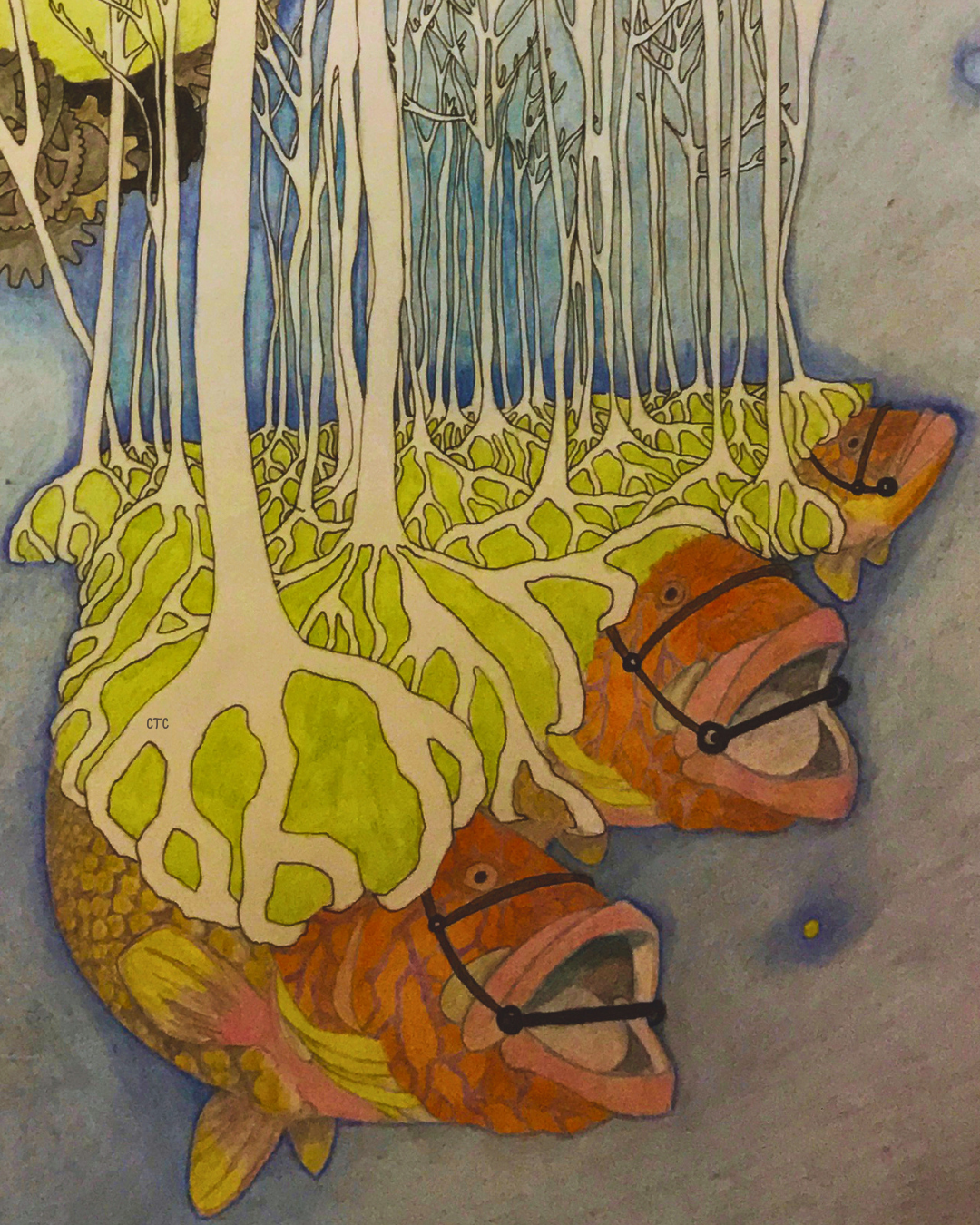
(I drew this with coloured pencils on paper many, many years ago - Chaiga T. Cheska)
Prefatory Note from the Head of Department
Professor Oswin Greave,
Chair of Aerial Ecologies,
High Institute of Aerial Ecologies
Scholar Hallowell has been dispatched to the field following an incident at the Institute, which I shall not describe in detail, as the matter is currently being reviewed by the Buildings and Equipment Committee, and I have been advised to limit my written commentary accordingly. I will say only that adhesive substances have no place in a funding presentation, that certain garments, once compromised, cannot be restored to dignity, and that the visiting delegation from the Upper Settlements has not returned our correspondence since.
Scholar Hallowell is accompanied by Junior Scholar Samic Imp, whose primary responsibility is documentation. I have every confidence in Scholar Imp’s diligence. I have somewhat less confidence in Scholar Hallowell’s capacity to remain upright in an open field, but the Fish Forests are, I am assured, a gentle subject, and I can only hope that the subject proves more forgiving than the Institute’s furniture.
This paper is submitted on Scholar Hallowell’s behalf with the Institute’s cautious endorsement.
O. Greave
~~~
Scholar’s Preface
Before I proceed to the study itself, I feel it necessary to address Professor Greave’s prefatory note, which I have just read for the first time and which I find characteristically ungenerous. The adhesive in question was a standard archival-grade pot, the sort found on any scholar’s desk, and the events that followed were the result of an unfortunate sequence of coincidences rather than any single act of negligence on my part.
I will not be drawn into a full account here. I will say only that the pot was open because I had been using it, that I set it down in what I believed to be a reasonable location, that the Head of Department chose to sit in that location without first looking, and that the subsequent difficulty of extracting him from the chair was not improved by the arrival of the delegation at precisely that moment. The trousers were, I maintain, already under considerable strain before the adhesive became a factor. The delegation was, by all accounts, very understanding. Professor Greave disagrees. We have agreed to disagree, in the sense that he dispatched me to study Fish Forests, and I had no alternative but to go.
I will say this: I did not expect to be grateful for it.
Introduction: On the Nature of Lifbloom
The Fish Forests of MirMarnia represent what this paper proposes to classify as the most remarkable expression of Lifbloom yet documented: that is to say, the phenomenon by which a living creature expresses both animal and botanical nature simultaneously, not as separate systems in awkward cohabitation, but as a single, unified biology in which neither form is subsidiary to the other.
The Fish are golden, broad-bodied, and of considerable size. Their scales carry the deep warmth of late afternoon sun on river stones. From the ridges of their backs, where one might reasonably expect fins, white-barked trees rise instead, their trunks slender and bare, their roots woven into the Fish’s golden scales with an intimacy that suggests not intrusion but belonging, the way a river current fits itself to the shape of its own bed. The roots do not grip. They nestle. There is a difference, and it is immediately visible to anyone who takes the time to look.
The whole living structure rises to approximately fifty feet above the ground, the Fish drifting on invisible currents of MirMarnian air with the unhurried ease of creatures completely at home in a medium that ought not, by any conventional reasoning, to support them. The trees sway with each movement, their rustling a quiet, ongoing language that scholars have been attempting to translate for generations with what I would describe as partial success and considerable bruising.
[Samic’s Field Note: Upon first sighting the Fish Forest, Branoc walked into a fence post. He had not seen it. He maintains the fence post was in an unreasonable location.]
On the Origins of the Fish Forests
The elder MirMarnians who live within sight of the Fish Forests’ oldest routes speak of their arrival as something felt before it was seen: a warm current moving through the air in a season when no wind was blowing, a soft resonance in the ground, as though the land had recognised something it had been waiting for.
The Fish came from elsewhere. This much is agreed upon. Their origin world had grown thin, its waters receding, its skies dimming by degrees, the way a fire reduces not in one catastrophic moment but quietly, over a long time, until one morning the warmth is simply no longer there. When MirMarnia’s invitation reached them, it came not as words but as that same warm current, a pulse running through whatever medium connects one world to another, felt by creatures attuned to joy in the way that some creatures are attuned to magnetic north.
They gathered, and they came, and they leapt into MirMarnian air and found, to what one imagines was considerable collective surprise, that it held them just as some water did.
Within days of their arrival, the first buds appeared along the ridges of their backs. The Fish, by all accounts, were delighted. There is something in this detail that I find myself returning to: not that the trees grew, but that the Fish were pleased. The forest did not happen to them. It grew from them, shaped by their joy, their memories, their desire for companionship. The trees are, in the most literal sense, expressions of the Fish’s inner life made visible and botanical.
This is Lifbloom in its purest form: not animal plus plant, but animal as plant, the two not added together but always, from the very beginning, one entity.
[Samic’s Field Note: Branoc became very quiet after writing this section and sat in the meadow grass for some time, staring at the sky. I have recorded this as a period of scholarly reflection. He was also, I believe, slightly damp, as he had not noticed he was sitting in a wet patch. I did not mention this as he seemed peaceful.]
Field Observations: The Practical Difficulties of Studying Something That Does Not Wish to Be Studied
I should be honest with the Institute at this point, which is more than the Institute has always been with me, but I shall rise above that.
The Fish Forests present certain methodological challenges.
The first and most fundamental is that they move when they please. They follow warm updrafts, interesting smells, the distant sound of something rustling in a pleasing way, and on one occasion, as best as Samic and I could determine, the smell of honey bread drifting up from a farmhouse three meadows distant. I had spent the better part of a morning establishing what I felt was an excellent observation position, with sightlines in three directions and my notes laid out in a system I was rather proud of, when the Fish Forest simply drifted away to the south-east at the speed of a very thoughtful sigh.
[Samic’s Field Note: Branoc’s notes blew away at this point as he had not weighted them down. He spent twenty minutes retrieving them from a hedgerow. Several are now hedge-shaped.]
The second difficulty is altitude. The Fish Forest hovers at approximately fifty feet, which is precisely the height at which no conventional approach is adequate. Too low for sky balloons, too high for ladders, too unpredictable for any scaffolding structure a reasonable person would trust with their weight. What this means in practice is that a great deal of Fish Forest scholarship is conducted at a jog, across uneven ground, with a notebook held aloft and one’s dignity in steady decline.
[Samic’s Field Note: Branoc jogged into a ditch on the second day. He was uninjured but remained in the ditch for several minutes, apparently considering his options. He has since developed what he calls a “terrain awareness protocol”, which consists of looking at the ground slightly more often than before.]
The third difficulty is that the Fish Forests respond to emotion. Because the trees grow from the Fish’s joy, they are sensitive to the emotional atmosphere around them. A scholar who approaches with frustration, excessive earnestness, or the air of someone who very much needs to measure something will find the Forest drifting away with what can only be described as polite disinterest. The trees rustle in a particular way when this happens, a sound that my colleague Maera Wynfleet has described as amused, and which Cadan Bramblet insists is merely wind. Having heard it directed at myself on three separate occasions, I find myself in agreement with Wynfleet.
The correct approach, I have discovered, is to want nothing from them at all. To sit in the grass and watch the light move through the white trunks and let the “pop, pop, pop” of their passage wash over you without reaching for your notebook. The Fish Forests drift closer when you are not trying. This is, I have come to think, excellent advice for a great many situations beyond aerial botany.
[Samic’s Field Note: On the afternoon Branoc discovered this, he had just fallen into a bramble patch for the third time that week and was sitting on the ground removing thorns from his sleeve with an expression I can only describe as comprehensively defeated. The Fish Forest drifted down to within thirty feet of him and remained there for the better part of an hour. I recorded everything. Branoc did not notice the Fish Forest for some time as he was focused on the thorns.]
On the Pop, Pop, Pop
It is necessary to address this directly, as it is the detail that appears most frequently in junior scholars’ field notes, usually followed by a gap in the record and a note in different handwriting explaining that the primary observer fell asleep.
The sound the Fish Forests produce as they move through MirMarnian air is best described as a soft, rhythmic popping, regular as a slow heartbeat, warm in quality, and deeply, profoundly, unreasonably soothing. It is not loud. It does not demand attention. It simply continues, steadily, whilst the white trees sway overhead and the light filters down through the canopy in shifting patterns, and before long one’s notes become somewhat less coherent, and then they stop altogether, and one wakes up with grass in one’s hair and no clear sense of how much time has passed.
This is not a failure of scholarly discipline. I want that recorded clearly. It is a physiological response to a phenomenon that the Institute has not yet adequately classified. I recommend further study, conducted by someone who has had sufficient sleep beforehand.
[Samic’s Field Note: Branoc fell asleep four times during our first week of observation. On the third occasion, he woke up to find a smaller Fish Forest hovering fifty feet directly above him as if it was curious as to what he was up to.]
On the Language of the Trees
Each Fish Forest has its own rustling character, shaped by the particular Fish’s personality and the growth pattern of its trees. Scholars have attempted for generations to develop a comprehensive translation, with results that are best described as impressionistic.
What can be said with some confidence is this: the rustling communicates mood rather than content. A Fish Forest that is content produces a sound like dry leaves in a warm autumn breeze. A Fish Forest that is curious rustles more quickly, with a brighter, higher quality, as though the leaves are leaning forward. A Fish Forest that has decided it has been observed quite enough for one afternoon rustles in a way that every scholar I have spoken to agrees means go away, though none of us can explain precisely how we know this.
I believe I was shushed on my fourth day in the field. I have not included this in my formal notes as I cannot verify it, but I am including it here because I think it is important, and because if the Institute is going to send scholars into meadows to study living groves, it ought to know that the groves have opinions about the matter.
[Samic’s Field Note: I can confirm Branoc was shushed. The rustling was very clear. Branoc had been attempting to estimate trunk diameters by holding his arms apart at various widths and squinting upward, which is not a recognised methodology and which the Fish Forest appeared to find objectionable. He abandoned the measurement. I believe this was the correct decision.]
On What the Fish Forests Are, Finally
I came to this study because I had no alternative. I want to be honest about that. I came muttering about adhesive and departmental politics and the indignity of being sent to study fish that swim in the sky, for goodness’ sake, as though the sky were a reasonable place for a fish to be.
I no longer think this.
What I think now is that the Fish Forests are evidence of something MirMarnia appears to understand better than most of the rest of us: that beauty is not separate from survival. That a creature can carry within it not only its own life but the lives of the trees that grew from its happiness, and that those trees in turn feed the creature’s happiness, and the whole system sustains itself on joy the way other systems sustain themselves on water or sunlight.
They came from a world that was failing them. They arrived here, and the air held them, and within days, trees grew from their backs. Not because trees are useful, though they may be. Because the Fish were glad, and gladness, in MirMarnia, grows.
I have no metric for this. I have no trunk diameter, no precise altitude measurement, no translation of the rustling beyond general mood. What I have are field notes that grow increasingly incoherent toward the afternoon, a curious Fish Forest, and the memory of sitting in damp grass whilst a Fish Forest drifted close and the pop, pop, pop of it moved through the air around me like the world’s most patient heartbeat.
I think this counts as scholarship. I am prepared to argue the point with Professor Greave at his earliest convenience.
[Samic’s Final Field Note: On our last evening in the field, Branoc sat very still for a long time watching a Fish Forest drift past in the dusk, its white trees catching the last of the light, its roots golden against the darkening air. He did not fall into anything. He did not lose his notes. He did not attempt to measure anything at all. He just looked up. I wrote this down because I thought someone should.]
Conclusion
The Fish Forests of MirMarnia constitute the most fully realised expression of Lifbloom yet observed: a single organism expressing itself simultaneously as creature and grove, movement and stillness, root and fin. They resist measurement, reward patience, and respond to joy in kind. They are, this paper concludes, exactly what they appear to be: living proof that even those who come from loss can grow beauty from change.
Further study is recommended. Better boots are also recommended. The terrain is uneven, and the ditches are deeper than they look.
Branoc Hallowell,
Junior Fellow in Aerial Grove Studies
High Institute of Aerial Ecologies
Submitted from the field, ink slightly smudged, notes partially hedge-shaped
[Samic's Postscript: During our third week in the field, I transcribed the following song from a group of villagers who performed it at the Lifbloom Meadows midsummer gathering, where it was accompanied by clarinet, light percussion, and accordion, danced to with considerable enthusiasm, and sung by what appeared to be everyone present, including two people who were eating at the time. I have included it here as field evidence, on the grounds that the villagers have been observing the Fish Forests from this meadow for generations and understand them rather better than we do. Branoc was asleep when I made this decision. I stand by it.]