On the Acoustic Properties of Patterned River Stones
With Particular Reference to the Amentine Hypothesis and One Researcher’s Ongoing Difficulties
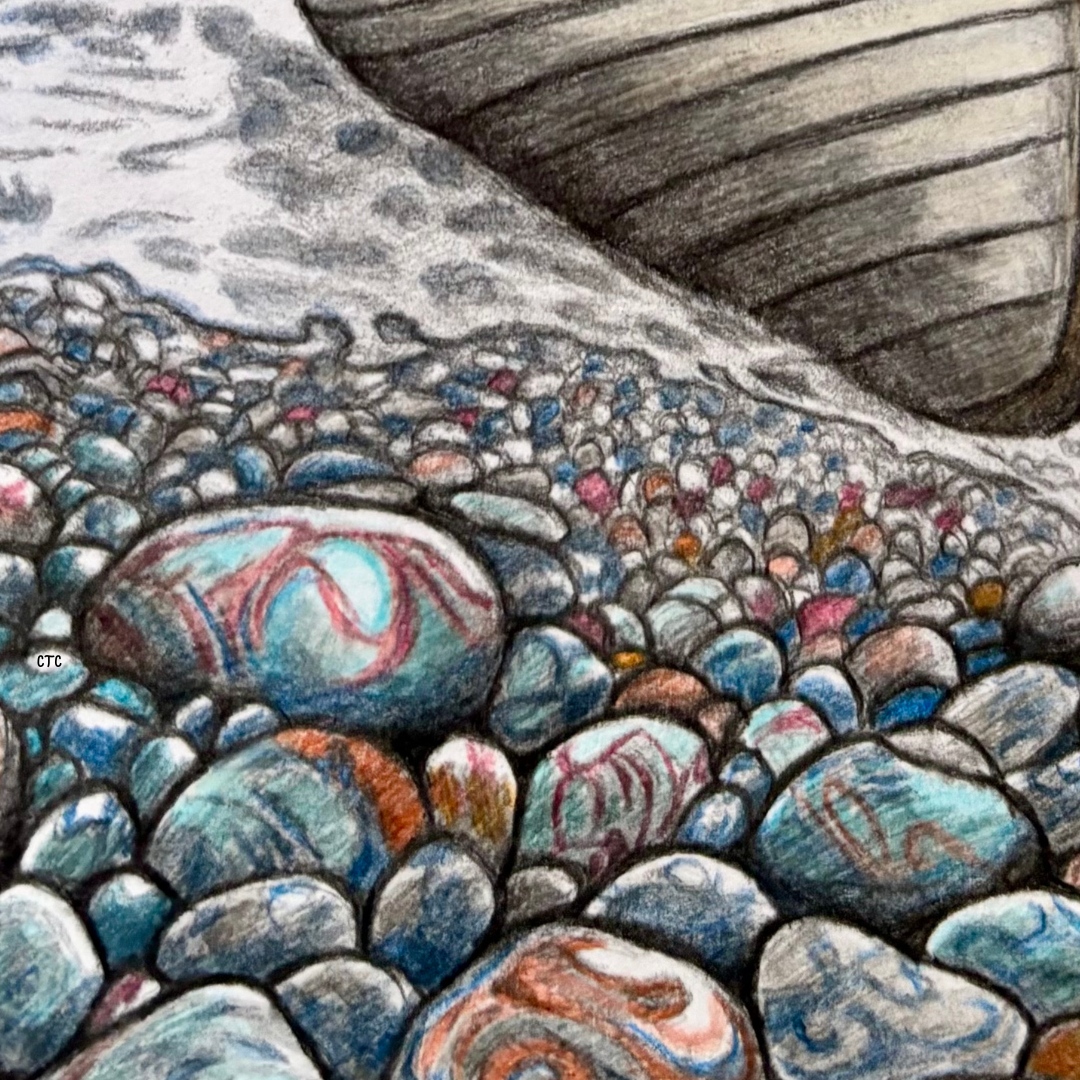
(For those of you reading my main story, you’ll recognise my colour pencil drawing of the coloured river stones when my main characters leave the Mistwing on the River Emaris. This is the zoomed in view of those stones, drawn on paper with colour pencils. - Chaiga T. Cheska)
~~~
By Dr Ignatius Wobblebottom, Junior Lecturer in Antiquarian Acoustics
Commissioned by the Institute of Mirhaven following the incident at the Autumn Colloquium. The Institute has asked that the incident not be described in the title.
The Institute’s request has been noted.
~~
I should begin with the Colloquium, because it is where this research begins, and because leaving it out would give the impression that I volunteered for this assignment, which I did not.
The Autumn Colloquium of the Institute of Mirhaven takes place each year in the main meeting hall, and each year the hall is too cold, the tea is too weak, and the papers are too long. These are constants. What was not constant, in the forty-third year of the Colloquium, was the stone.
I had brought it as a prop. I had recently acquired it from the riverbank near Thornwill on a private collecting walk, as I occasionally do, and I thought it an interesting specimen to hold up during my remarks about pattern formation in geological deposits near running water. It is a dark stone, small enough to fit in the palm, with a streak of pale blue running through it at a diagonal and a pattern around the blue that is, I have always felt, unusually deliberate for something produced by a river.
I was mid-sentence. I was making a point about sediment behaviour. And then the stone, without any consultation with me whatsoever, sang.
Not loudly. Not dramatically. A single phrase, four notes curving upward and then resolving, quite short, as though beginning something it had changed its mind about continuing. But audible. Audibly audible, in a meeting hall in which twenty-three scholars had, until that moment, been sitting in the particular state of polite endurance that characterises the mid-afternoon session of any academic gathering.
The hall went very quiet.
I stood at the front of it, holding a singing stone, looking at twenty-three colleagues who were looking back at me.
“Did that,” said Professor Minn, “come from the stone?”
It had very clearly come from the stone, and I said so.
There was a pause of the kind that academic institutions produce when something has happened that does not fit into any existing category of event. No one has yet decided whether to be excited or alarmed. Then everyone spoke at once, and then there was a great deal of arguing. Then Professor Minn made a unilateral decision that the stone required investigation, that the investigation required someone with relevant expertise in acoustic phenomena, and that the relevant person was me.
I pointed out that my expertise is in historical acoustic theory and not in field research.
Professor Minn said that was the Institute’s problem now and took the last of the biscuits.
The stone has not sung since. I have been studying it and its companions for one hundred and sixty-one days.
On the Stones Themselves
The patterned river stones of the lower Emaris and its tributaries have been noted in passing by various scholars over the centuries, catalogued briefly, admired mildly, and then largely left alone. This is, in retrospect, an oversight of considerable proportion. The patterns are not random. Once you have looked at enough of them, and I have now looked at a great many, this becomes impossible to maintain. They loop, double back, resolve into shapes that suggest letterforms without quite being legible as any script currently known to scholars. The colours run in threads: deep blue, teal, pale ochre, and, regrettably, pink.
I will explain the pink in a moment.
The local populations who live along the rivers have their own understanding of these stones, which varies by village but tends toward the same general conclusion, namely, that the stones hold something old and that picking them up casually is the sort of thing you should probably ask about first. This piece of folk wisdom is one I have encountered twelve times across six settlements in the past five months, and I find it fascinating.
On the Conditions Required for Song
The stones do not sing reliably. I wish to state this plainly and early, because the Institute has sent three separate letters enquiring about reproducible results, and the answer continues to be: not yet, and possibly never, and I would appreciate it if the letters stopped arriving on Mondays, as Mondays are difficult enough.
What I have established, across twelve stones and eleven instances of song, is the following:
The songs occur at the last quarter of the moon. They occur when the air has a specific quality, cold and washed and sharp at the edges, which tends to follow rain by some hours. And they occur, most inconveniently, when the researcher is in a state of alert, or standing very still in a river.
I wrote in my diary that the song seemed to require anticipation from the researcher. I stand by this. I also acknowledge that it is not the sort of conclusion I can present to the Institute without extensive qualification, which is why I have placed it here, in the middle of the paper, where Professor Minn will have lost interest before reaching it.
The songs themselves are fragments. This became clear once I had twelve stones and had heard them together. Individually, each stone produces a phrase of four to seven notes. Together, at the right conditions, they produce something that is not twelve fragments simultaneously, but one assembled phrase, a chord becoming melody, melody becoming instruction.
“…dance of dimensions, wheel upon the hollow axis where the…”
And then there’s the arch.
The first time the twelve stones sang together, something grew out of the wall of my study. I say grew because it is the closest word I have: lines forming out of the old plaster, the way frost-fern forms on glass, tracing an arch with light running along the edges. A threshold. A door of some kind, or the suggestion of one, held for twenty seconds and then was gone when the song ended.
It was not complete. The arch had gaps in four places, lines ending in nothing, the shape of it interrupted and unfinished. The door cannot fully appear. The song is not whole.
“…and the beasts within that older dark will know the turning of it, will follow where the dancer goes before the door remembers what it was…”
I have more stones to find it seems.
On Field Research and the Village of Thornwill
The village of Thornwill sits above a bend in the Emaris River where the current slows and spreads wide over a bed of coloured shingle. It is a small village, and a quiet one, and it has not had a great deal happen in it recently, by its own admission. My arrival there has therefore been received with a degree of interest that I had not accounted for, and which has significantly complicated the research.
The villagers are aware that I have come to study the river stones. They find this interesting. They find it very interesting when I conduct fieldwork at the riverbank, which I must do to collect and observe the stones in situ, and which I cannot do without an audience of somewhere between eight and twenty residents standing at a comfortable distance on the bank and watching me.
They are not hostile. They are, in fact, perfectly pleasant. They bring stools to sit on. One family even brings lunch.
The difficulty is the colour, pink.
I mentioned the pink stones earlier. Every stone I have examined from the Thornwill stretch has pink in it. Not as a dominant colour; the blue runs through most of them quite prominently, and there are the familiar ochres and grey greens. But the pink is there, a pale insistent pink, threading through the blue patterns in veins that are impossible to avoid once you have seen them.
I have had a difficulty with the colour pink for as long as I can recall. I cannot account for it. It is not rational. It manifests, when I encounter pink, as a sneeze: one sneeze, violent, immediate, and complete, which interrupts whatever I am doing at the moment of encountering it and temporarily disperses my concentration. The sneeze is followed by a brief but intense irritation, primarily directed at myself, which I manage by setting my jaw and proceeding as though it did not happen.
In a study that requires me to handle pink-veined stones with my bare hands, in good light, over an extended period, the sneeze occurs with reliable frequency. In front of an audience, this frequency has been found, by the audience, to be apparently very funny.
The first time it happened at the riverbank, I was crouching in the shallows, turning a stone over in my hands to examine the underside where the pink veining is most concentrated, when I sneezed directly into the river. The audience, who were on the bank above me, fell very quiet and, with admirable self-restraint, waited until I had straightened up before beginning to laugh. I am grateful for their self-restraint. I do mind the laughter, but hence is the life of a scholar.
The second time, I sneezed sideways into my own notes. The third time, I was wearing my new waterproof coat, and the sneeze was so violent that I sat down in the shallows. The coat is waterproof. The rest of me is not.
By the sixth or seventh incident, the audience had begun to anticipate the sneeze. They watch my hands. When I turn a stone to the angle that exposes the pink, a sort of hush falls over the bank. I find this hush considerably more distracting than the snorting laughter that follows it.
I continue to work in good light and handle the stones properly. There is no alternative. The stones require it, and the research requires the stones, and the Institute has commissioned me, and the Institute has paid for the waterproof coat.
On What the Stones Are
My current understanding, which I hold with the caution appropriate to a field in which I have been surprised repeatedly, is this.
The Amentine, that half-mythical people whose name appears in the oldest footnotes of MirMarnian scholarship and is usually followed by the phrase “if they existed at all,” which I believe they did, left their voices in the riverbeds. Not inscriptions, not monuments, not the kind of record a civilisation leaves when it knows it is leaving: something older than that, something pressed into stone while the world was younger and the relationship between sound and matter was, apparently, less fixed than it subsequently became.
The patterns in the stones are notation. The songs they contain are fragments of one larger working, an incantation, perhaps, or a key, or something for which we do not presently have a useful word. When enough fragments sing together under the right conditions, they begin to construct a door.
I do not yet know where the door goes. I have seventeen stones. The arch has three gaps remaining. The pink-veined stones of the lower Emaris, which I am currently studying, include at least four candidates that may carry the missing phrases.
The villagers of Thornwill have suggested a villager named Marta Greyholm, whom I am apparently welcome to visit and see her stone collection as often as required. One family has indicated they will bring a larger riverside lunch from now on, on the grounds that this appears to be a long project.
Dr Ignatius Wobblebottom, Junior Lecturer in Antiquarian Acoustics Written on the fifty-third day of the Amber Season In the fifth year of his appointment, the hundred and sixty-first day of this survey, and the sixth consecutive day of sitting in wet trousers
Addendum: I have since been informed by Marta Greyholm that her grandmother wrapped three stones, from her collection, in cloth, not because she found them alarming but because she had once, in an otherwise quiet Tuesday afternoon, heard them sing the same phrase three times in succession and found, as she put it, “the whole business very pointed.” I have noted this in my research diary. The phrase, repeated three times, would be: “…dance of dimensions, dance of dimensions, dance of dimensions…” which does, I admit, have a pointed quality to it. I am choosing not to dwell on what it is pointing at.
Author’s Note:
The Emaris carries more than water, more than stone, more than the small, pretty pebbles and shells, children's pockets on the way home. It carries what was left there, long ago, by hands that understood something about the world that the world has since forgotten.
Dr Wobblebottom heard only a fragment of it.
The Amentine left more than songs in the bed of the Emaris. Much more. And the echoes, when they come, will be considerably harder to ignore than a startled scholar sneezing into a river.
Chaiga T. Cheska