Lore Segment: Field Notes of Jonas Thinwhorble on the Skrathen
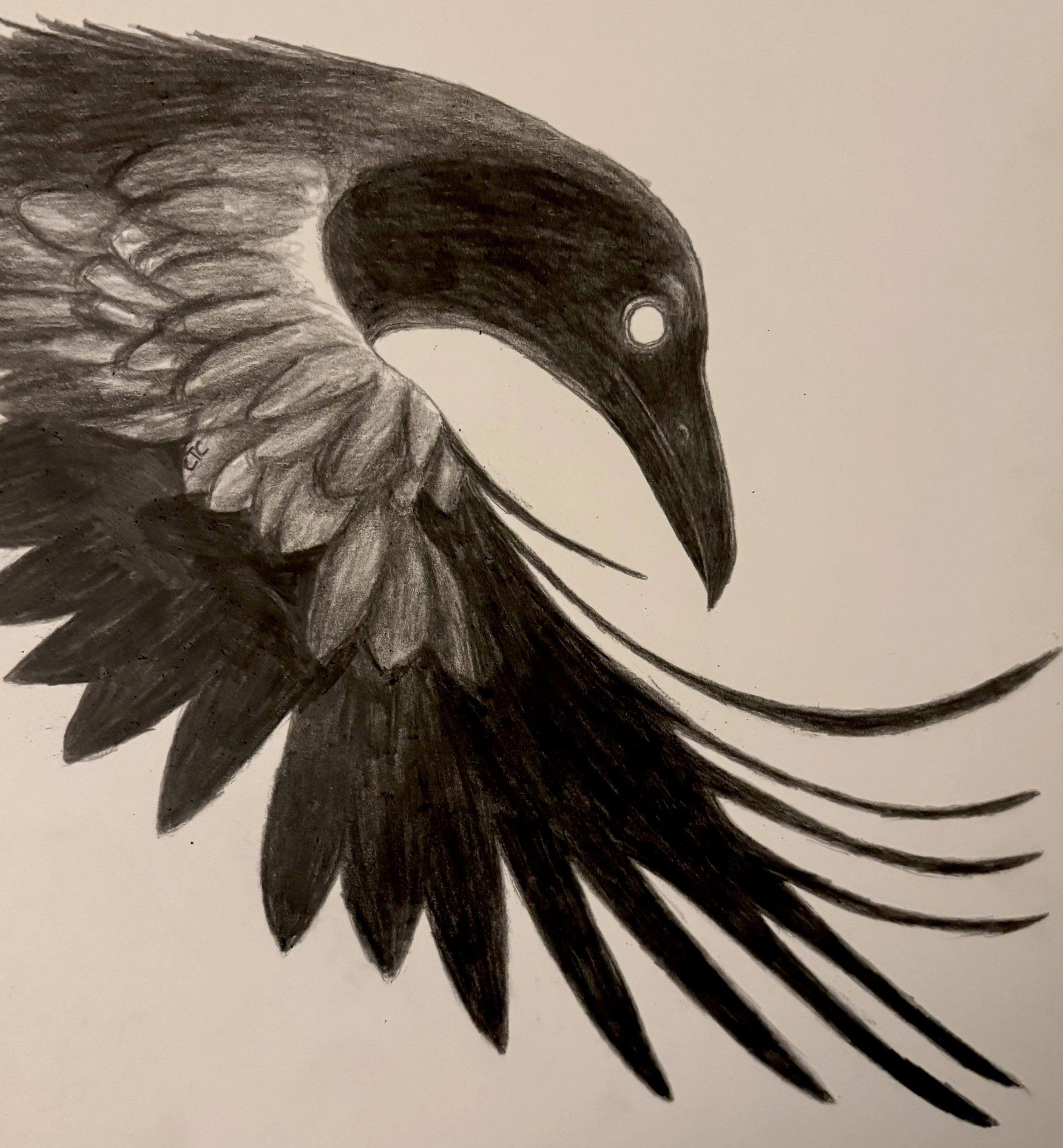
Recovered from a weathered journal, its pages stained with damp and ash, attributed to Jonas Thinwhorble, itinerant wanderer and bird-keeper of no fixed abode.
I did not come to the Ravines for stone nor story, though both cling to a man once he has walked their length. No, I came for the birds. Always the birds. They are my compass, my calendar, my companions. I have followed kestrels across high moors, thrushes through tangled hedgerows, and owls into the hollow dark. But the Skrathen... ah, the Skrathen. They are another matter entirely.
I had heard whispers of them in taverns where the fire burned low, and men spoke only when the wind rattled the shutters. “Sharp as flint,” they said of the cry. “Long as sorrow.” Some claimed the Skrathen were no true birds at all, but shadows feathered into flesh. Others swore they were omens, harbingers of endings. I laughed at such talk, for I am a man of feather and wing, not of superstition. Yet I carried those words with me, tucked between the pages of my field notes, as one holds a charm against misfortune.
The Ravines are not kind to travellers. Their walls rise sheer, their paths twist like serpents, and the air itself seems to weigh upon the chest. I walked alone, boots worn thin, pack heavy with quills and scraps of parchment. Each step echoed, though I could not tell if the sound was mine or the lands. And then, above me, a shadow wheeled.
The Skrathen.
Black-feathered, long-winged, its flight cut the sky into shards. I raised my spyglass, hands trembling, and fixed upon it. The wings were narrow, the tail forked, the eyes (I swear) glinted with a light not of sun. It circled once, twice, thrice, and then it cried.
Reader, I have heard the cries of a thousand birds. The kestrel’s keen, the thrush’s bell, the raven’s croak. None prepared me for the Skrathen’s voice. It was no song, no call, no note of courtship or warning. It was a blade. A sound sharp enough to split thought from bone. It rang in the Ravines, long after the bird had passed, as though the stone itself had taken up the cry.
I wrote, though my hand shook: “Cry sharp as flint. Echo long as sorrow. Not natural. Not safe.”
The Skrathen did not vanish. It lingered, circling, watching. I felt its gaze upon me, though I could not prove it. My heart beat like a drum, and I wondered if the bird marked me for some fate. I walked on, but the cry followed. Always the cry.
Days passed. I saw more Skrathen, sometimes alone, sometimes in pairs. Never a flock. They are solitary, like grief itself. Each time, the cry pierced me. Each time, I wrote. My notes grew darker, more frantic. “Shadow follows. Cry bends air. Ravines remember.”
I began to dream of them. In sleep, I heard the cry and woke with blood in my mouth from biting my tongue. I saw feathers black as pitch scattered on the path, though when I bent to gather them, they dissolved into dust. I asked myself if the Skrathen were real, or if the Ravines had birthed them from my own fear.
Yet I am no coward. I pressed on.
One evening, as the sun bled red across the cliffs, a Skrathen descended lower than before. Its wings brushed the air above me, and I felt a chill as though winter itself had passed. It landed upon a stone, tall and jagged, and folded its wings. I dared not move. I dared not breathe.
It looked at me. Truly looked. Its eyes were not the eyes of a bird. They were deep, hollow, filled with echoes. I saw in them battles long past, griefs unhealed, choices yet to be made. I saw myself, small and fragile, walking a path that was not mine alone. And then it cried.
The cry shattered the stone beneath its talons. Splinters flew, dust rose, and when it lifted again, the mark remained: a fissure carved into rock, sharp as the sound itself. I touched the stone, and it burned cold.
I wrote: “Cry leaves a mark. Not sound alone. Power in it. Ravines listen.”
From that day, I knew the Skrathen were not mere birds. They are omens, watchers, heralds of memory. Their cries awaken the land, stir the stones, remind us of wounds we would rather forget. They do not sing for beauty. They sing for truth.
I have walked far since, and I have seen many things. But the Skrathen remain with me. Their cry rings in my ears even now, as I set these words to page. I do not know if I shall leave the Ravines alive, nor if these notes will ever be read. Yet I must write, for writing is the only way to bear the weight.
If you, traveller, should find these pages, know this: the Skrathen are not to be dismissed. They are not to be hunted, nor mocked, nor ignored. To hear them is to be seen. To be marked. Few endure. Fewer understand.
But if you walk with courage, if you listen not with fear but with resolve, you may find in their cry not despair, but a reminder. A reminder that even wounds can become wings.