Shellback Turtles
Field Notes of Dr. Liora Venn, MirMarnian Naturalist
written by Dr. Liora Venn, MirMarnian Naturalist and Keeper of River Registers
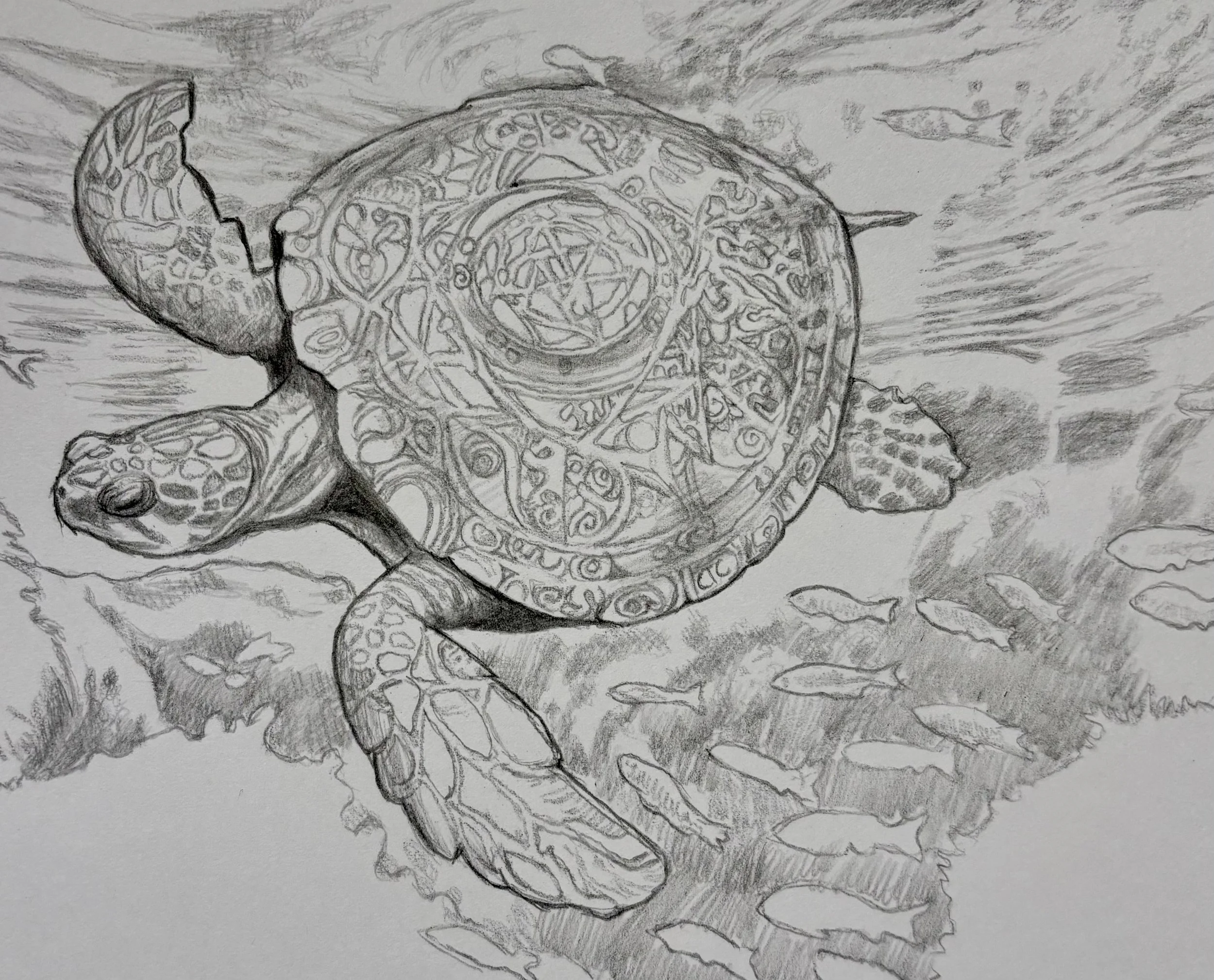
Shellback Turtles — Field Notes of Dr Liora Venn, MirMarnian Naturalist
The Shellbacks of the Emaris are less an animal than a paragraph in the river’s memory, pondered, patient, and inked into the water itself. To stand beside the Emaris at dawn is to watch a slow argument between stone and light; to see a Shellback crest is to witness the river write one of its oldest sentences.
Natural History
The Shellback is a large, semi-aquatic chelonidine whose carapace grows in concentric bands of calcified glyphs. These markings are not mere surface ornament; they develop with age, spreading like language across the shell. Young Shellbacks bear simple spirals; elders carry layered labyrinths that, to MirMarnian eyes, read like family trees and weather records. Shellbacks move with an economy of motion, limbs working as gentle oars, and they prefer the river’s slow meanders, where silt dreams and Lanternreed hangs like chalked lace.
Behaviour and Social Patterning
Shellbacks exhibit a behaviour I have termed statant procession: long periods of near immobility punctuated by slow, ceremonial migrations along the river’s eddies. During these processions, they float with shells just breaking the surface, exposing their script-like carapaces to the sun. They are curiously attentive to onlookers; the gaze of a Shellback is sustained and calm, as if the creature is weighing the river’s ledger against whatever new curiosity stands upon its banks. When encountering each other, Shellbacks perform a rotation of the shell, a slow swivel that aligns glyphs, as if reading one another’s recent histories.
Luminal Interaction
The shell-glyphs of Shellbacks interact with light in a way unique among Emarian fauna. Under morning radiance, the calcified runes take on a silvered luminescence, and under moonlight, they return a soft, pearl-blue glow. This photogenic property is produced by microscopic mineral lamellae embedded between growth rings; these refract and scatter specific wavelengths so that the shell’s script seems to move and revise as the animal adjusts its angle to the sun. The phenomenon is the source of many MirMarnian superstitions: to catch a Shellback’s glyph flashing is to be shown a question you have not yet learned to ask.
Diet and Foraging
Shellbacks feed primarily on filamentous river moss and the detrital crust that gathers in Lanternreed clumps. Their beaks are broad and slow, adapted to nudge and pluck rather than to bite. Seasonal blooms of a pale, spore-like algae prompt daytime migrations, after which the Shellbacks will spend long intervals basking, rerouting nutrients from the river into new glyphs across their carapaces.
Reproduction and Lifespan
Nesting occurs on the river’s sheltered gravel bars in late autumn rains. Females, guided by scents only they can parse, drag themselves ashore and etch shallow hollows with their foreclaws. Clutches are small; hatchlings bear only the faintest spirals, and for decades those spirals thicken into sentences. Shellbacks live, by measured counts and legend alike, longer than many MirMarnian oaks; to see a fully labyrinthed carapace is to glimpse an elder whose life spans generations of river law.
Cultural Significance and Ethology of Gaze
The Shellbacks’ patient inspection of strangers has social meaning. Among village lore, a sustained Shellback gaze is an invitation to slow down, to consider one’s place in the river’s line. I have recorded anecdotes of children who, after such a gaze, lose the loudness of their hurry for days. To fishermen and boat folk, a Shellback’s approach before the tides shift is a trusted weather omen. Ritual makers coax fallen shell-shed flakes into talismans; scholars caution against stripping such flakes from living animals, for these are elemental pages of the Shellback’s life.
Field Advice for Observers
Approach quietly; let the river acknowledge your presence. Keep motion minimal; the animal will match your stillness with its own. If a Shellback turns its face to you, do not interpret this as simple curiosity. It is a deliberate and inclusive attention. Remain motionless and, in time, you may feel that attention fold into the world like a seal closing upon a book.
Specimen Sketch Notes
• Size range: carapace length 0.9–1.8 metres.
• Carapace texture: calcified ridges with interlamellar mineral sheen.
• Gait: deliberate paddling; occasional substrate scraping.
• Vocalisation: deep, low-frequency exhalations that carry beneath the water and cause Lanternreed to tremble.
• Preferred microhabitat: slow bends with abundant Lanternreed and silt lodges.
Concluding Observation
If one ever doubts that MirMarnia keeps its secrets deliberately, watch a Shellback in the sixth hour. There is an old-world patience in their motions, as though they read the river as a text and take care not to tear its pages. They remind us that time need not be loud to be profound; that the slow turning of a shell is also the slow turning of a story.
Written by Dr Liora Venn, MirMarnian Naturalist and Keeper of River Registers