The Sentient Groves and Living Vessels of the Emaris: A Study in Collaborative Consciousness
As recorded by Aldric the Woodwise, Scholar of Drakkensund, in the third year of Chieftain Haldor’s leadership
Preface
It has been my life’s work to understand the nature of the sentient groves that border our beloved Emaris, and the vessels we craft, or perhaps more accurately, persuade, from their living wood. What follows is not mere speculation, but observation gathered across forty years of study, conversation with the trees themselves, and consultation with the shipwrights and sailors who have learnt to speak the old languages of wood and water.
I write this with the fervent hope that future generations will not lose what we have been privileged to maintain: a relationship with the natural world that transcends domination and enters the realm of true partnership. The groves are not resources to be harvested. They are communities, ancient and patient, who have chosen to work alongside us. We owe them not merely gratitude but understanding.
My hands shake as I write this introduction. Forty years, and still the wonder has not diminished. If anything, it grows stronger.
The Nature of the Sentient Groves
Along the banks of the Emaris, particularly in the stretches north of Drakkensund where the river bends eastward and the land rises into gentle hills, grow the groves we call the Stillwood Commons. The name is something of a paradox, for these forests are anything but still. They hum with a consciousness so palpable that even children can sense it upon first entering. The air itself feels different beneath their canopy, thicker somehow, weighted with attention.
The trees that comprise these groves belong to no single species, though certain varieties predominate. The sentinel oak grows tallest, its bark pale silver-grey with deep vertical fissures that weep amber sap when the tree is wounded. These oaks can reach heights of thirty metres or more, their canopies spreading wide enough to shelter entire clearings. Their leaves are broader than a man’s hand, dark green above and silvered beneath, rustling with a sound uncannily like whispered conversation even when no wind stirs the air.
I have spent entire afternoons beneath a single oak, listening. The sound is not random. There are patterns. Rhythms. I am certain of it, though I cannot yet decipher their meaning.
Interspersed amongst the oaks grow the memory ash, recognisable by their compound leaves that shift colour with the seasons in ways that seem intentional rather than merely responsive to temperature. In spring, they emerge pale gold. By midsummer, they have deepened to green so dark it appears almost black in shadow. Come autumn, they do not simply turn red or orange but display patterns, whorls of crimson against gold, spirals of burgundy threading through amber, that seem to tell stories if one knows how to read them. The old woodcarvers insist these patterns are the trees’ way of recording significant events, marking the passage of notable occurrences in the forest’s collective memory.
The river willow grows closest to the water’s edge, its roots half-submerged, creating intricate networks that stabilise the banks whilst simultaneously maintaining constant dialogue with the Emaris herself. Their bark is smooth and grey-green, cool to the touch even in summer, and if you press your ear against a willow’s trunk, you can hear, I swear this upon my life’s research, the sound of water moving, as though the river’s current flows through the tree’s very fibres. Their branches hang long and trailing, dipping into the river’s surface, and where they touch the water, small eddies form, spiralling patterns that persist far longer than physics alone would explain.
The Appearance of Sentience
It would be easier, perhaps, if the trees’ consciousness manifested in ways more familiar to human understanding. But sentience in wood operates on timescales and through mechanisms utterly foreign to our brief, hurried lives. Nevertheless, certain phenomena can be observed and documented.
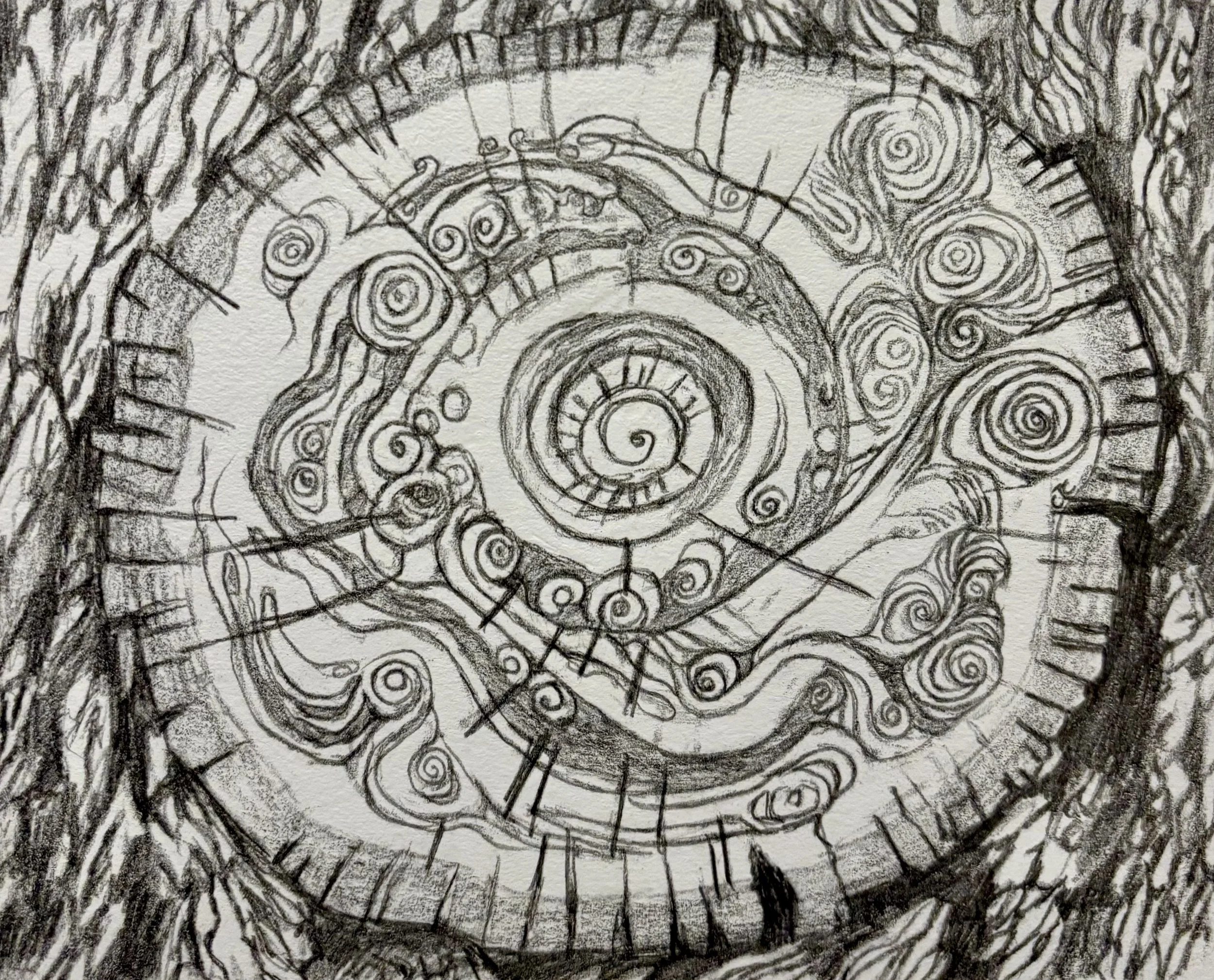
The grain of sentient wood is never entirely static. I have spent countless hours seated against the trunk of an ancient sentinel oak, watching the patterns in its bark shift with glacial slowness. The whorls and knots seem to breathe, expanding and contracting in rhythms that have no correlation to wind or temperature but appear instead to follow some internal tide. If you mark a particular pattern with charcoal and return the following day, you will find it altered, not dramatically, but unmistakably. A spiral that turned clockwise now turns counterclockwise. A knot that protruded slightly has receded. The tree is thinking, and its thoughts manifest in the slow dance of its grain.
The sentient trees respond to proximity and touch in ways that cannot be attributed to mere physical stimulus. When you approach a tree of the Stillwood Commons, particularly if you approach with intention, seeking to speak with it, to request timber, to offer a greeting, the bark warms perceptibly beneath your palm. Not the warmth of sun-heated wood, but something that radiates from within, a heat that pulses gently, matching itself to your own heartbeat after several moments of contact. I have measured this phenomenon with instruments: the temperature increase is modest, perhaps two or three degrees, but consistent and undeniable.
More remarkably, the trees can distinguish between individuals. An oak that I have visited weekly for a decade warms to my touch almost immediately upon contact, its bark shifting colour slightly, the grey brightening to something closer to silver, in what I have come to recognise as welcome. When a stranger approaches the same tree, the warming takes longer, and the bark remains darker, more guarded. The tree remembers. It knows the difference between friend and stranger, between those who have shown respect and those who have not.
I call her Grandmother Oak. She has taught me more than any book ever could. When I am troubled, I go to her, and she steadies me with her ancient patience.
The roots of the sentient trees extend far deeper and wider than their non-sentient cousins. Excavation, done with permission and in collaboration with the trees themselves, has revealed root systems that spread outward for distances exceeding the tree’s height, interweaving with the roots of neighbouring trees to create vast networks. Where roots from different trees meet, they do not merely touch but fuse, growing together until individual root becomes indistinguishable from collective root. It is through these networks that the trees communicate, passing information through their bodies faster than would seem possible, so that a disturbance at the northern edge of a grove is known to trees at the southern boundary within minutes.
During the winter months, when deciduous trees lose their leaves and might be expected to enter dormancy, the sentient groves remain unmistakably awake. Their consciousness, if anything, becomes more pronounced. The bark of oaks and ash develops luminescent properties in the coldest months, emitting a faint silvery-green glow visible only in complete darkness. I have spent midwinter nights in the Stillwood Commons and witnessed this phenomenon: an entire grove illuminated from within, each tree glowing softly, the light pulsing in waves that travel from tree to tree like signals passed between watchfires.
The first time I saw this, I wept. I am not ashamed to admit it. Beauty of that magnitude demands tears.
The Language of the Groves
The trees do not speak as we speak. They have no voices, no words as we understand them. Yet communication occurs, complex and nuanced, through means that took our ancestors generations to decode and that we still understand only partially.
The primary mode of communication is tactile. When you place your palm flat against the bark of a sentient tree, you are not merely touching the dead outer layer but making contact with a living consciousness. The tree’s response comes through subtle variations in texture, temperature, and what I can only describe as vibration. The bark may grow rougher beneath your touch, its fissures deepening momentarily. Or it may smooth, becoming almost polished. These changes occur too quickly to be growth, too specific to be a coincidence. They are a language.
Temperature shifts carry meaning as well. Warmth generally indicates welcome, acceptance, and agreement. A sudden chill, and I have felt bark grow cold enough to sting bare skin even in midsummer, signals refusal, warning, or distress. More subtle variations exist: a cycling of warm-cool-warm might indicate uncertainty or contemplation. A steady, gentle warmth speaks of contentment.
The trees also communicate through scent. The sentinel oaks, in particular, release different aromatic compounds depending on the circumstances. When pleased or welcoming, they emit a smell reminiscent of honey and fresh bread, warm and comforting. When disturbed or threatened, the scent sharpens to something acrid, almost metallic, that makes the eyes water, and the throat tighten. Before storms, the groves fill with a smell like stone after rain, earthy and electric simultaneously. The trees sense atmospheric pressure changes long before human instruments detect them and pass that information to their neighbours.
Bran, Yilda’s apprentice, has a remarkable sensitivity to these scents. He can distinguish emotions in the trees that I still struggle to perceive. Youth has advantages that age cannot match.
Most remarkably, the sentient trees can project what I reluctantly term “emotional impressions” directly into the minds of those touching them. This is not telepathy in any conventional sense. You do not hear words or see images. Rather, you suddenly feel what the tree feels, a deep, abiding patience, a sense of roots spreading through dark earth, the pleasure of sunlight on leaves, the sorrow of a neighbour tree dying, the fierce protectiveness towards the grove’s youngest saplings. These impressions are overwhelming at first. Many who experience them weep without knowing why. But with practice, one learns to receive these feelings without being subsumed by them, and thus genuine dialogue becomes possible.
The Asking and the Giving: How Timber is Obtained
We do not fell trees in the Stillwood Commons. To do so would be murder, and the groves would turn hostile in ways I do not care to contemplate. Instead, when timber is needed for shipbuilding or other essential work, we engage in a process called the Asking.
The Asking begins months before wood is required. The shipwright or woodcarver who needs timber must first identify themselves to the grove. This requires repeated visits, often twice weekly for a full season, during which the petitioner does nothing but sit quietly amongst the trees, hands pressed to bark, offering their presence and their respect. They speak aloud of their purpose, explaining in detail what vessel they hope to build, what cargo it will carry, and what journeys it will undertake. The trees listen. One learns to sense their attention, the way the grove grows quieter, the normal sounds of forest life hushing as the trees turn their vast, slow awareness towards the speaker.
Only after this period of introduction does the formal Asking occur. The petitioner approaches a specific tree, usually one they have felt particularly drawn to during the introduction period, as the trees often signal willingness through the warmth of their bark or the way their leaves rustle when someone draws near. The petitioner kneels at the base of the tree, places both palms flat against the trunk, and asks. They explain again their need, their purpose, their promise to honour the wood that will be given. They ask if the tree would consent to provide timber, to transform from a rooted guardian of the forest into a guardian of human travellers upon the river.
I have witnessed the Asking seventeen times now. Each time feels sacred. Each time, I hold my breath, waiting for the tree’s answer.
The tree’s answer comes through the means I have described: shifts in temperature, texture, scent, and emotional impression. Refusal is unmistakable, a sudden cold, a withdrawal of warmth, sometimes even a physical response as branches overhead shake despite windless air. Acceptance is equally clear. The bark grows hot beneath the petitioner’s hands, almost uncomfortably so. The tree’s emotional impression floods the petitioner with a sense of willing transformation, of purpose accepted, even of eagerness.
If consent is given, the tree then indicates, through methods still somewhat mysterious to me, how much wood it will provide. Sometimes the tree offers a single large branch. Sometimes an entire limb. In rare cases, when the tree is very old and senses its own time drawing to a close, it will offer its whole self, asking only that it be transformed into something worthy of its long life. These gifts of whole trees are treated with utmost reverence, and vessels built entirely from a single tree’s offering are considered the most blessed of all watercrafts.
The actual harvesting is done with a ceremony. The grove’s eldest trees are consulted, their consent obtained. The tree that has agreed to give timber is thanked repeatedly, offerings placed at its base, libations of clear water from the Emaris, honey from the settlement’s hives, and sometimes small reed carvings made by children depicting the vessel the wood will become. Sharp axes are never used. Instead, we employ saws blessed explicitly by the trees themselves, metal worked in ways that minimise pain to the wood. Even so, amber sap weeps from every cut, and the woodcutters sing the old songs throughout the process, songs that speak of transformation and gratitude, songs that promise the wood its consciousness will not be lost but rather translated into new form.
The songs are ancient. Some verses I have never heard spoken, only sung. The melody carries meanings that words alone cannot.
When a tree gives a branch or limb but remains standing, the wound is treated with reverence. Healers apply salves made from river water and crushed willow reed. The tree is visited daily as it recovers, its healing monitored. I have watched wounds close over the course of weeks, the bark slowly growing back across the cut surface, and I swear the pattern that emerges in the healed wood forms symbols, spirals, mostly, sometimes shapes that resemble the vessels the wood has gone to build. The tree is marking itself, recording this transformation in its own living history.
The Transformation: From Tree to Vessel
The wood taken from the Stillwood Commons does not lose its sentience. This is the fundamental truth that makes our vessels what they are. A plank cut from a sentinel oak remains, in essence, a sentinel oak. It retains the consciousness it possessed as part of the tree, though that consciousness is now untethered from roots, no longer drawing sustenance from soil, no longer directly connected to the grove’s vast network.
The shipwrights of Drakkensund are not mere craftsmen but mediators, facilitating the wood’s transformation from forest-dweller to river-traveller. The timber is never forced into shape. Instead, it is asked. Each plank is spoken to, hands laid upon it, its purpose explained. The shipwright describes the curves needed for the hull, the precise angles required for the keel, and asks if the wood will accept these shapes. When wood is willing, it becomes remarkably pliable, bending to forms that would typically require steam and force. When wood is unwilling, no amount of strength will shift it. I have watched three burly woodworkers strain to bend a plank that a young apprentice later curved with her bare hands simply because she thought to ask permission first.
Her name was Signy. She had more wisdom at fifteen than I had at thirty. The wood loved her immediately.
As the vessel takes shape, the separate pieces of wood begin to recognise each other. Planks cut from the same tree respond most strongly, but even wood from different trees develops awareness of its neighbours. Where edges meet, the grain aligns itself, patterns in one plank flowing seamlessly into patterns in the adjacent plank. The joins become almost invisible, wood fusing to wood with an intimacy that transcends even the finest joinery. The vessel becomes not a collection of parts but a single entity, consciousness coalescing from many sources into unified awareness.
The runes carved into the finished hull are not decoration but language, a means by which the vessel can express itself to those who sail upon it. The symbols are based on the natural patterns found in the wood’s grain, spirals, whorls, and branching lines that echo root systems and river tributaries. The carving is always done by someone the wood has accepted, and the work proceeds slowly, with constant dialogue between carver and vessel. As each rune is completed, it is filled with a compound made from amber sap collected from the Stillwood Commons, mixed with powdered Glowstone from the river’s bed. When this mixture sets, the runes gain their characteristic luminescence, glowing amber in darkness, pulsing gently with the vessel’s awareness.
The completed vessel retains a clear memory of the grove. Sailors report that on certain nights, particularly when fog lies thick upon the river, they can hear sounds rising from the deck that have no earthly source, the rustle of leaves, the creak of branches in the wind, the distant calls of forest birds. The wood dreams itself back into the forest, its consciousness reaching across the distance towards the grove it came from. Yet simultaneously, it embraces its new form. The vessels love the river, love the sensation of water flowing past their hulls, love the purpose of carrying sailors safely through the current and rapids. They are content in their transformation, satisfied in ways that manifest through the warmth of their timbers and the brightness of their runes.
The River’s Role: The Emaris as Conscious Partner
The Emaris herself is the third consciousness in this remarkable partnership, and perhaps the least understood. The river’s awareness is so vast, so diffuse, that making contact with it requires either prolonged immersion, standing thigh-deep in her current for hours whilst speaking to her waters, or the mediation of a vessel already known to her.
I have stood in the Emaris until my legs went numb with cold, speaking to her depths. Sometimes she answers. Sometimes she does not. I have learnt not to take her silence personally.
The Emaris remembers everything that passes through her. Every vessel that has sailed her length, every rock that rests in her bed, every fish that swims her depths, all of it is held within her flowing consciousness. When a new vessel first enters her waters, she examines it thoroughly. Sailors describe the sensation: the ship seems to settle more deeply into the water, rocking gently even when the current is smooth. The river is feeling the hull, learning its shape, testing its nature. Sentient vessels she recognises immediately, greeting them with currents that cradle rather than challenge. Vessels of dead wood she tolerates but does not guide, letting them find their own way through her channels whilst she focuses her attention elsewhere.
The river communicates through current and temperature. When a sentient vessel requests passage, placing its keel into her waters whilst sailors speak the old requests into the wood, the Emaris responds with subtle shifts in flow. A strengthening of current beneath the hull indicates agreement and assistance. A warming of the water signals welcome. When the river grows suddenly colder, when the current seems to pull sideways rather than forward, sailors know to reconsider their journey. The Emaris is warning of danger ahead: rocks hidden beneath the surface or rapids too violent for safe passage.
Most remarkably, the river can change her course in response to need. This is not the gradual shifting of channels over years that all rivers experience, but conscious redirection of current. I have carefully witnessed and documented, knowing such claims would strain credulity, a vessel caught in a predicament where the main current would carry it directly towards a recently fallen tree blocking the channel. The sailors spoke urgently to both ship and river, requesting aid. The water surrounding the vessel began to spiral, creating a localised eddy that pulled the ship sideways out of the main flow. The eddy persisted just long enough for the vessel to slip past the obstruction, then dissolved, allowing the ship to rejoin the main current safely downstream. The Emaris had chosen to redirect her own water, creating a temporary channel, to protect a vessel she knew and valued.
I wrote to three other scholars describing this incident. Two wrote back, suggesting I had been drinking. The third came to see for himself and witnessed similar phenomena. He no longer doubts.
The Threefold Covenant in Practice
The partnership between sailor, vessel, and river operates on principles that must be meticulously maintained. Violation of these principles does not result in punishment so much as the simple dissolution of cooperation, and in the river’s fierce currents, the withdrawal of cooperation can prove fatal.
Respect Above All: Every interaction must be grounded in respect for the consciousness of both vessel and river. This means speaking rather than simply acting, explaining intentions rather than issuing commands, and acknowledging that both ship and water have agency equal to human agency. Sailors learn to phrase requests as questions: “Will you carry us downstream to the trading ports?” rather than “Take us to the trading ports.” The difference seems minor but is everything. One acknowledges partnership, the other assumes servitude.
Consent Continuously Renewed: The vessel’s agreement to carry sailors and the river’s agreement to guide them must be reaffirmed regularly, not assumed perpetual. Each morning before setting out, the crew speaks to the deck, hands pressed to timbers, offering greetings and requesting the day’s cooperation. Each evening, they offer thanks for the day’s safe travel. These are not mere rituals but genuine communication, and both vessel and river notice when they are omitted.
Honesty in Purpose: The vessel and river must be told truthfully what cargo is carried and what the journey’s purpose entails. They will know if deceived, the wood senses the weight of lies as surely as it senses physical weight, and the river reads intentions through the hull’s contact with her waters. Smugglers and those engaged in purposes that harm the river’s ecosystem find their vessels sluggish, their journeys prolonged. Honest traders travelling for legitimate purposes find swift current and eager cooperation.
There was a man once who tried to transport stolen Glowstone downriver. His vessel refused to move for three days. He confessed to his theft and returned the stones. The ship carried him home, but slowly, and the runes remained dim for a month afterwards.
Protection of the Waterways: Sailors aboard sentient vessels are expected to act as guardians of the river. This means keeping the waters clean, reporting any pollution or damage to the banks, and assisting vessels in distress regardless of whether those vessels are sentient or not. The Emaris values those who value her, and crews that demonstrate care for the river’s wellbeing are granted safer passage through difficult stretches.
Gratitude Expressed: Thanks must be spoken, not merely felt. At a journey’s end, the crew thanks both vessel and river aloud, specifically acknowledging the assistance provided. Offerings are made, fresh flowers woven into the rigging for the vessel, clear water poured over the bow as libation for the river. These gestures matter deeply to non-human consciousness, which experiences appreciation differently than humans and needs it expressed in tangible ways.
When these principles are honoured, the partnership flourishes. Vessels travel faster than wind or oar alone could propel them, guided by the river through channels invisible to human eyes. Dangerous passages become safe under the Emaris’ guidance. Storms are weathered more easily when the vessel’s timbers brace themselves against the wind and the river’s currents hold the hull steady.
When these principles are violated, whether through arrogance, ignorance, or malice, the partnership dissolves. The vessel’s runes dim, their amber glow fading to cold grey. The timbers grow stiff and unresponsive. The river’s current ceases to aid, sometimes actively opposes, pushing the vessel towards rocks or shallows. Crews have been stranded for weeks in sight of their destination, unable to make progress against water that should have carried them forwards effortlessly. The threefold covenant is not a metaphor but a mechanism, and it functions only when all three parties, human, wood, and water, are in accord.
Observations on Collective Consciousness
What fascinates me most, after forty years of study, is the evidence suggesting that all sentient vessels maintain connection with each other and with the groves from which they came. I have documented numerous instances of vessels responding to events occurring to their sister ships or distant trees before any human messenger could have brought news.
When the vessel Riverbright was damaged in rapids fifty leagues south of Drakkensund, her sister ship Mistwalker, built from the same grove, though not the same tree, became agitated the moment the accident occurred. Her runes flared brilliant amber, hot enough that sailors had to remove their hands from the wood. She rocked violently despite calm water, pulling at her moorings. Captain Sten, who, at that time, commanded Mistwalker, understood immediately that something had occurred to Riverbright and set out to render aid. He found her three days later, hull breached, but thanks to his early departure, he was able to rescue her crew before the damage proved fatal.
Similarly, when lightning struck a sentinel oak in the Stillwood Commons during a summer storm, every vessel in Drakkensund’s harbour that had been built using timber from that particular tree cried out simultaneously, there is no other word for it. The wood groaned, a sound like great branches breaking, and the runes blazed so bright that those on shore thought the ships had caught fire. The vessels were mourning. They had felt, across all the distance that separated them from the grove, the death of their parent tree.
I was on the docks when this occurred. The sound will haunt me until I die. It was grief, pure and terrible.
This suggests that consciousness in wood operates on principles entirely foreign to our understanding. It is not localised in individual trees or vessels but distributed across networks, connected by means we cannot yet measure or fully comprehend. Distance appears irrelevant. Physical separation does not sever the bonds between wood that grew from the same roots or vessels built from the same grove.
I theorise, and I stress this remains theory, lacking the rigorous proof I prefer, that the sentient groves function as a single vast consciousness divided across many bodies. Each tree is both individual and part of a collective, maintaining distinct awareness whilst simultaneously participating in the grove’s unified mind. When timber is taken and transformed into vessels, those vessels remain part of that collective even as they develop individual identity. They become, in essence, the grove’s emissaries to the river, carrying forest consciousness out onto water, creating bridges between ecosystems that might otherwise remain separate.
If this theory holds true, then the relationship between settlers and sentient groves is far more consequential than simple resource management. We are not merely using material but engaging with an intelligence that spans vast territories, that remembers centuries of history, that possesses awareness of the natural world far exceeding our own. Every interaction either strengthens or weakens that relationship. Every vessel we build either honours or exploits the trees’ willingness to transform. The implications are profound.
Sometimes I wonder if the trees chose us, rather than the other way round. If they needed us for some purpose, we do not yet understand.
Conclusion: A Partnership Worth Preserving
As I conclude this study, I am reminded daily of how precious and precarious this partnership truly is. The sentient groves are not infinite. They grow slowly, reproduce rarely, and require conditions, both physical and social, that are easily disrupted. Young trees must be taught consciousness by their elders. If the groves are fragmented, if too many elder trees are lost, the knowledge could disappear within a generation.
Our descendants may not inherit the privilege we have been given. If we grow careless, if we begin to see the trees as mere timber rather than partners, if we prioritise speed and convenience over respect and relationship, the groves will withdraw their cooperation. The trees will cease to offer themselves. The vessels will lose their sentience, becoming nothing more than dead wood shaped by force. The river, bereft of the wooden ambassadors who help her understand human needs, may grow hostile or simply indifferent.
I write this, therefore, not merely as scholarly documentation but as an urgent appeal. Teach your children to speak to trees. Bring them young into the Stillwood Commons and show them how to listen with palms pressed to bark, how to interpret warmth and texture, how to wait with patience for responses that come slowly but with profound meaning. Insist that shipwrights maintain the old traditions of Asking and consent. Never permit timber to be taken by force. Celebrate the vessels that carry us as the miracles they are, living wood that has chosen to leave the forest and embrace the river, consciousness transformed but not diminished.
The sentient groves and living vessels of the Emaris represent something vanishingly rare: a genuine partnership between human and non-human consciousness, a relationship built on mutual respect rather than domination. We are not masters of the wood or the water but collaborators, participants in an alliance that benefits all parties when honoured properly.
May this knowledge never be lost. May the groves continue to whisper their slow wisdom. May the vessels continue to sing as they sail. May the Emaris continue to guide those who respect her waters. And may we remain worthy of the trust these ancient consciousnesses have placed in our brief, bright, hurried lives.
I am old now. My hands ache with cold even in summer. But I have lived to see wonders that most cannot imagine. For that, I am grateful beyond words.
Recorded with gratitude to the grove that gave the paper on which this is written, and to the Emaris whose waters mixed the ink.
Aldric the Woodwise, Scholar of Drakkensund