Linden Blossoms in MirMarnian Symbolism
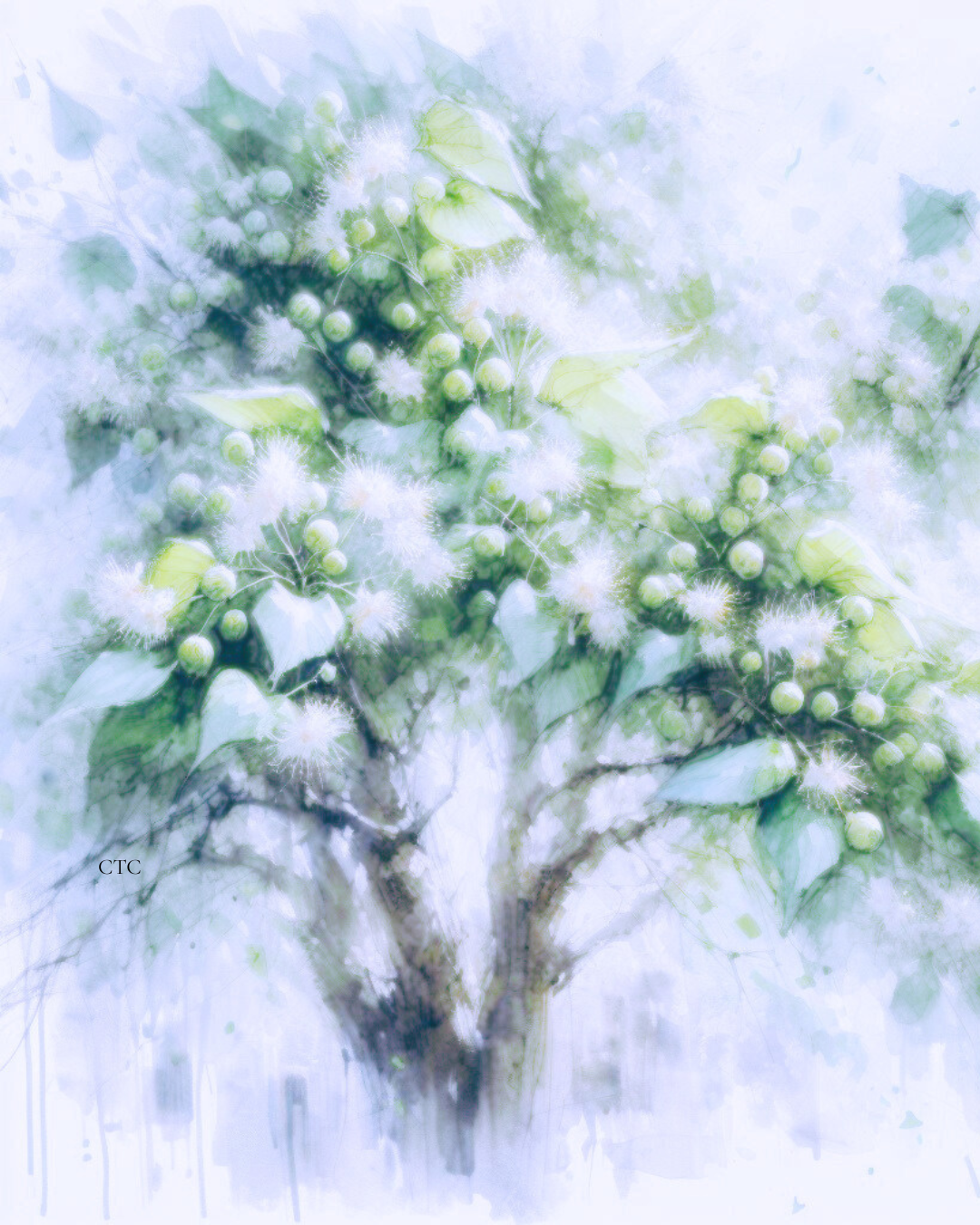
by Kaedric Ashmarrow, Mosswright Scholar, Mossboretum Collegium Academy
It is a curious thing to be asked to comment on linden blossoms when one’s professional life has been spent almost entirely in the company of fungi. Nevertheless, the Mossborn Conservatory assures me that a well-rounded scholar ought to demonstrate breadth, and so I have taken it upon myself to examine the matter with the same diligence I apply to moulds. I should note at the outset that trees, I have discovered, are considerably more opinionated than I had anticipated.
The linden tree has long been regarded in MirMarnian culture as a marker of peace, hospitality and general good sense. This is largely because it does not shed bark in an alarming fashion, nor does it attempt to poison its neighbours, which already places it above several species I could name. The blossoms themselves are pale, fragrant and inclined to fall in a manner that suggests they have given the matter considerable thought before doing so.
My first encounter with a linden tree occurred three weeks ago, when I ventured to the grove outside Millhaven with the intention of collecting specimens. I had brought my standard field equipment: jars, tweezers, a magnifying lens and a modest flask of fortifying tea. What I had not brought was an understanding of how tall linden trees actually are, nor how particular they are about who touches their blossoms.
I reached for a low-hanging cluster and the entire branch swung upward with what I can only describe as deliberate intent. The blossoms, which moments before had been within easy reach, were now twelve feet above my head. I suspect the tree was laughing, though I cannot prove this scientifically.
In ceremonial contexts, linden blossoms are often woven into garlands and hung at points of welcome. The intention is to signal that one’s visitors are unlikely to be ambushed, judged or fed anything experimental. This is considered polite. I attempted to weave such a garland myself, following instructions provided by a village elder who assured me it was “quite straightforward.” It was not. The blossoms, though delicate in appearance, possess a remarkable talent for tangling themselves into configurations that defy both logic and patience. After forty minutes, I had produced something that resembled a small, fragrant catastrophe. The elder suggested, kindly, that perhaps I ought to stick to fungal arrangements.
The blossoms are also used in rites of reconciliation, where their gentle scent is believed to encourage calm reflection. I cannot speak to the accuracy of this, but I can confirm that no one has ever become agitated in the presence of a linden tree. It simply is not the sort of tree that invites drama. That said, during my observations I did witness an argument between two farmers that escalated considerably despite their standing directly beneath a mature linden. When I pointed this out, they informed me that the tree “wasn’t trying hard enough.” I did not pursue the matter further.
Some scholars argue that the linden’s symbolic status arises from its longevity and its tendency to grow in quiet, sensible groves. Others insist that the meaning is older, rooted in ancestral stories about travellers who found safety beneath its branches. I have read these accounts and found them charming, if botanically implausible. One tale claims that a linden tree once moved its branches to shelter a lost child from rain. Having spent several hours beneath a linden during an unexpected downpour, I can report that the tree made no such effort on my behalf. I was thoroughly soaked. Perhaps it only assists children.
On my second visit to the grove, I brought a small ladder. This proved to be a miscalculation. The moment I positioned it against the trunk; a shower of blossoms descended upon my head with suspicious timing. I emerged resembling something between a hedge and a wedding decoration. A passing scholar from the Conservatory photographed me for their records. I have been assured the image will be used “only for educational purposes,” which I find deeply unconvincing.
It should be noted that linden blossoms, when pressed and dried, retain their scent for several months. This is useful for scholarly study. It is less useful when one’s entire collection of notes becomes saturated with the fragrance, leading colleagues to assume one has taken up perfumery as a secondary profession. I have since taken to storing my linden samples in a separate cabinet, far from anything I value.
In terms of practical applications, linden blossom tea is consumed throughout MirMarnia for its calming properties. I attempted to brew some using blossoms I had finally managed to collect, following a recipe that assured me it was “impossible to ruin.” Reader, I ruined it. The result tasted primarily of regret, with notes of bark and what I can only describe as aggressive disappointment. My assistant tried a sip out of loyalty and has not spoken to me since Tuesday.
The Æthelweave, those peculiar canopy-dwelling folk of the Eldertree forests, incorporate linden blossoms into their ceremonial crowns, often alongside yew branches. This pairing strikes me as symbolically significant, though I confess I am more concerned with the practical matter of how they harvest blossoms from trees that appear to have strong feelings about being climbed. During my research, I attempted to interview an Æthelweave elder about their methods. They smiled, said something about “listening to the tree’s permission,” and declined to elaborate. I suspect they were having me on.
A note on the difference between linden blossoms and fungi, since I can no longer avoid the comparison: fungi remain where you place them. They do not develop opinions about your ladder placement. They do not release their spores with what appears to be comedic timing. They do not require you to ask permission before collecting samples. This is why I prefer them.
In conclusion, the linden blossom occupies a place of gentle significance in MirMarnian tradition. It represents peace, welcome and the hope that one’s guests will behave themselves. It also represents, in my personal experience, a surprising amount of chaos for something so widely associated with tranquillity. I trust this will satisfy the Conservatory’s desire for cultural insight. I shall now return to my fungi, who at least have the courtesy to remain predictable and are unlikely to drop things on my head.
Addendum: Since submitting this piece, I have been informed that linden trees in MirMarnia are mildly sentient and “respond to intention.” This explains a great deal. It also confirms my suspicion that the tree outside Millhaven actively disliked me. I have made my peace with this.