Lore Segment: From the Private Catalogue of Archivist Bramwell Corin
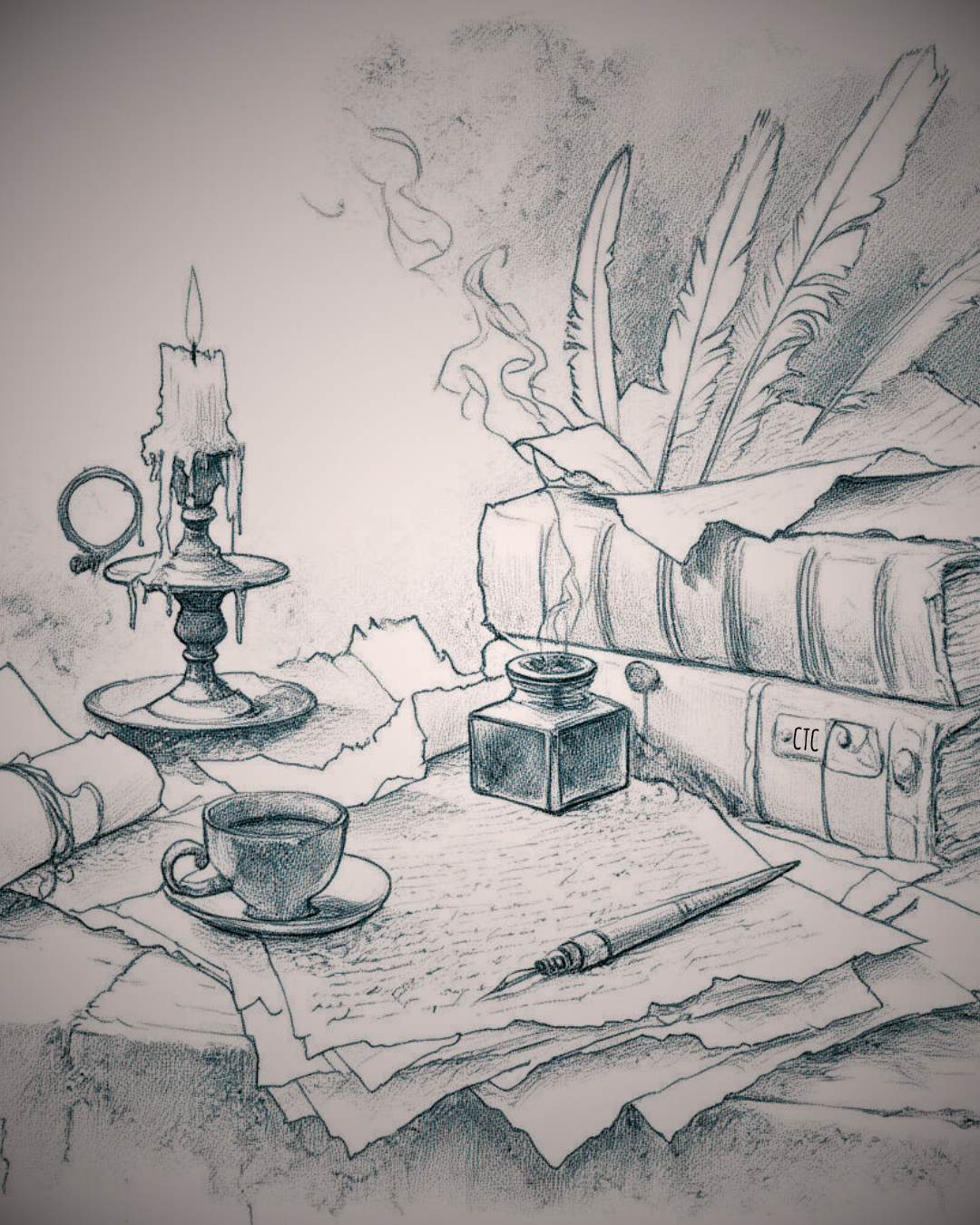
It has long been my belief, though few colleagues have ever agreed with me, that the study of magical mishap reveals more about the nature of the world than any polished success. A triumph tells you what ought to happen. A failure tells you what will. The following entries are taken from my private catalogue of incidents I considered educational. I recorded them during my early years as an apprentice archivist, when I still believed that careful observation might save me from the more embarrassing consequences of my own experiments. It did not.
On the Lantern Moths of Old Wrenford
The lantern moth is a small and rather delicate creature, pale as morning frost and inclined to gather in clusters beneath the eaves of old houses. Their glow is gentle enough to read by, though I would not recommend it for anything requiring accuracy. The peculiarity of the species lies in its response to dishonesty. When a person speaks a falsehood, the moths brighten. When the lie is bold, they flare.
I once attempted to test this phenomenon in a controlled environment. The moths were placed in a glass dome, and I invited a junior scholar to recite a series of statements, some true and some false. The moths behaved as expected until the scholar, flustered by the attention, began to lie about matters entirely unrelated to the experiment. The dome lit up like a festival lantern. The moths refused to dim for three days. I have never again attempted to use them in any formal inquiry.
There was, for a brief period, a proposal to employ lantern moths in court proceedings. The idea was abandoned after a particularly heated trial in which the moths illuminated the entire hall before the accused had spoken a single word. The presiding magistrate declared the creatures unreliable. I suspect the moths simply had a clearer view of the situation than he did.
On the Teacup That Would Not Stop Singing
During my second year in the archives, I encountered a teacup that had been subjected to an enchantment intended to keep its contents warm. The charm was poorly executed. Instead of preserving heat, the cup developed a habit of singing whenever it was filled. The tune varied according to the temperature of the liquid. Lukewarm tea produced a low hum. Hot tea resulted in a rather piercing trill.
The cup was placed in the archives for study, though no one claimed responsibility for it. I attempted to silence it by placing it inside a padded box. The cup responded by increasing its volume until the entire west wing vibrated faintly. Eventually, we learned to tolerate it. The cup seemed happiest when left on a windowsill with a modest amount of steam rising from within. It sang a pleasant melody on those days, something between a lullaby and a warning.
The cup vanished some years later. I have always suspected that one of the senior archivists removed it out of sheer frustration. If so, I cannot blame them.
On the Self Sorting Quills
The self-sorting quills were discovered in a drawer that had not been opened for at least a decade. They appeared ordinary at first glance, but when placed upon a desk they arranged themselves according to a logic known only to them. At times they sorted by colour. At other times by length. On one memorable occasion they sorted themselves by the quality of handwriting they preferred to produce.
The quills refused to work for certain scholars. They would roll away, fall to the floor, or simply refuse to take up ink. One quill in particular developed a strong dislike for a visiting historian and would fling itself from the table whenever he approached. The historian took this as a personal insult. I took it as evidence that the quills possessed better judgement than most of us.
The quills eventually staged what can only be described as a strike. They gathered in a neat row at the far end of the desk and refused to move for an entire week. When they finally returned to their usual behaviour, they did so without explanation. I have learned not to question the motives of enchanted stationery.
On the Archivist’s Lost Apprentice
The Archivist’s Lost Apprentice is not a person, though the name has caused confusion. It is a slim volume bound in faded green cloth. The book has a habit of misplacing itself. One might leave it on a shelf only to find it later in a corridor, or tucked beneath a chair, or resting on a windowsill as though it had paused to admire the view.
The book opens to pages I do not recall writing. The handwriting is mine, but the words are not. They appear to be observations from other texts, as though the book has been reading in its spare time. I once found an entire paragraph on the migratory habits of cloud herons, a subject I have never studied. The book seemed pleased with itself.
I have attempted to catalogue the volume on several occasions, but it refuses to remain in the archives long enough for a proper entry. I have come to accept that the book is pursuing its own education. I wish it well.
These entries were never intended for public eyes. Yet I offer them now in the hope that they may provide some small insight into the peculiarities of our world. Magic is not always grand. More often it is inconvenient, unpredictable, and faintly ridiculous. It is also, in its own way, rather wonderful.