Kin: Mela of the Meadow
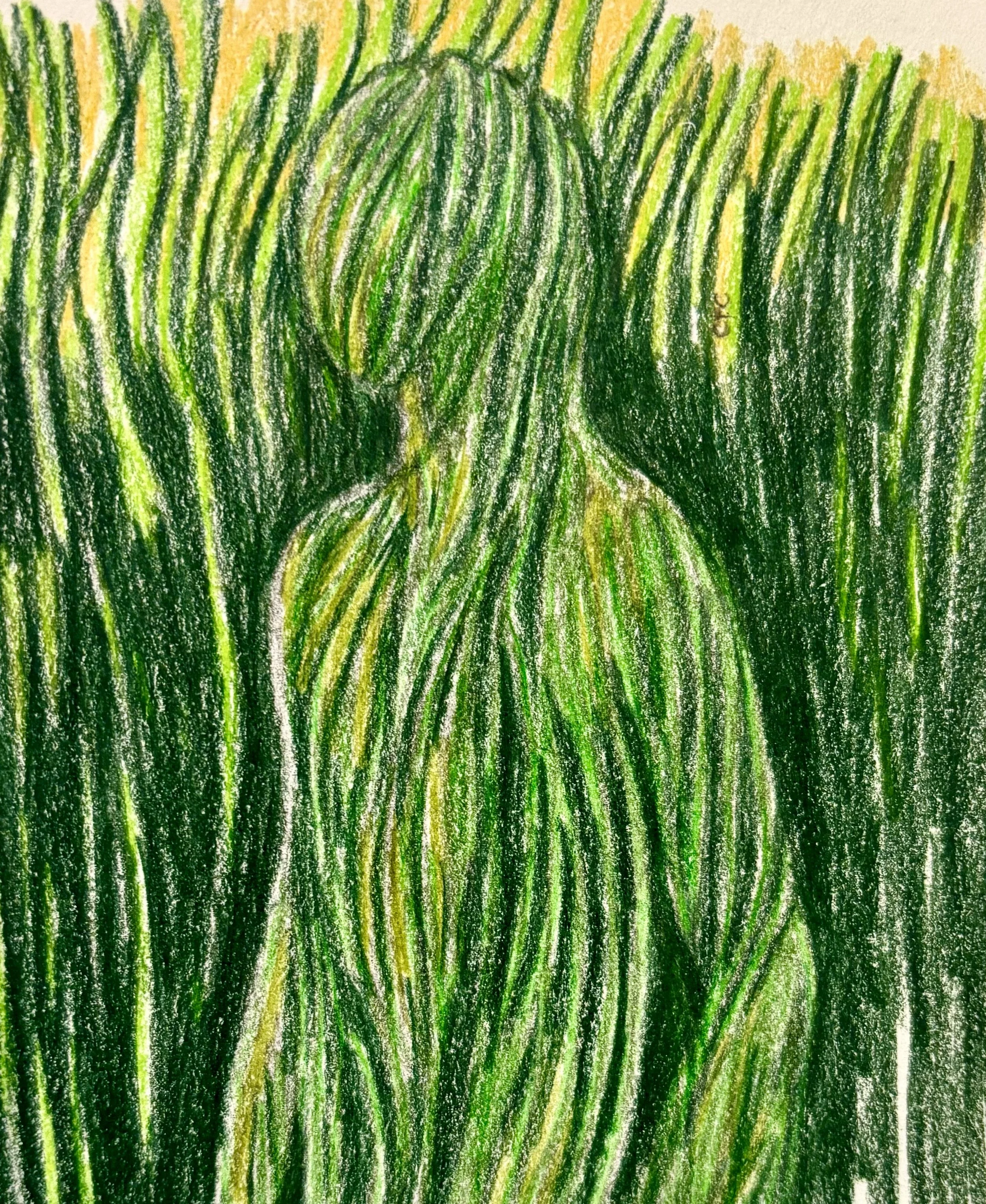
Leader Among the Pogonariel: An account by Corwin Ashfeld, Naturalist and Reluctant Guest
I have walked the length of MirMarnia. I have sketched creatures in the Sentinel Forest, catalogued flora along the Emaris, and spent three winters studying the migrations of Empressfisher birds. I thought myself immune to wonder, my notebook filled with observations rather than reverence.
Then I met Mela, and I understood that some beings cannot be reduced to notes. They must be felt.
The First Encounter
I did not find the Gathering Circle. It found me. Or rather, Mela found me, half-frozen and feverish after a fall from a ravine path, my leg twisted beneath me, my supplies scattered across stone on the edge of the grasslands.
The grass parted. That is the only way to describe it. One moment I was alone on the edge of the meadow, the next I was surrounded by blue-green walls taller than any I had seen, and in their midst stood a figure that made my breath catch despite the pain.
He moved like water given form, like wind learning to walk. His body was the meadow itself, green skin shimmering with dew that caught the fading light, hair rising in a silken crest that swayed though no breeze touched it. He was tall, perhaps eight feet if one could measure such a being, slender as a reed yet carrying an authority that pressed against my chest like a physical weight.
His eyes were the deep green of forest pools, and they held mine with a gentleness I had not expected. Not pity. Not indifference. Something between, a recognition that I was suffering and that suffering was not my fault.
“Do not fear,” he said, and his voice was wind through heather, at once distant and intimate. “I am Mela, leader among the Pogonariel. You are weary wanderer, and you are safe here.”
I believed him. I, who trust no one easily, who question everything, believed him without hesitation.
That is the first thing one must understand about Mela: his presence carries certainty. To be near him is to know, bone-deep, that here is a being who will keep his word.
The Nature of His Leadership
In the days I spent recovering, I watched Mela move among his people. He did not command. He did not raise his voice. Yet when he spoke, the other Pogonariel listened with attention that bordered on reverence.
His leadership was not born of strength or dominance. It was born of something else entirely: a profound attunement to the land itself. Where others felt the grass, Mela was the grass. Where others heard the meadow’s voice, Mela spoke with it.
I watched him kneel before a section of grass that had been trampled by deer, his hands moving in patterns I could not quite follow, and the stalks rose beneath his touch, straightening, healing, made whole again by his attention alone.
I watched him settle a dispute between two younger Pogonariel, not by choosing sides but by asking questions that led them to understand each other’s concerns. His patience was infinite. His wisdom, ancient.
“How long have you been here?” I asked him one evening, as we sat in the woven shelter he had made for me, watching twilight gather.
He was quiet for so long I thought he would not answer. Then: “Since the grass first learned to whisper. Since the land first dreamed of guardians. Time moves differently for us. We are, and have been, and will be.”
It was not evasion. It was simply truth as he knew it.
The Quality of His Mercy
What struck me most about Mela was his capacity for gentleness. I am not speaking of softness or weakness. Gentleness of the sort Mela possessed requires tremendous strength, it is the choice to be kind when one has power enough to do otherwise.
He tended my leg with hands deft as any healer I have known. He brought food woven from the meadow’s bounty, each dish crafted not merely to nourish but to comfort. When fever made me restless, when old memories surfaced in dreams that left me shaking, he sat beside me and sang in that language of wind and leaf until peace returned.
He asked nothing in return except that I tell him of the world beyond the grass. And when I spoke, he listened with attention so complete I felt myself becoming more articulate, more thoughtful, as though his listening drew out the best version of my thoughts.
This is Mela’s gift: he makes those in his care feel worthy of that care. Not small or helpless but seen. Valued. Safe.
The Weight He Carries
Yet for all his gentleness, Mela is not without burden. I caught it in moments when he thought himself unobserved: a weariness in the set of his shoulders, a sorrow in his eyes when he looked towards the edges of the meadow, towards the world beyond.
“What troubles you?” I asked once, emboldened by fever or perhaps simply by his kindness.
He was quiet again, watching the grass move in patterns only he could read. “The world grows loud with violence,” he said at last. “The land cries out, and we feel it in our roots. More come to us now, wounded and fleeing, than ever before. I am glad we can offer sanctuary, but I wonder what world awaits them when they must leave our Circle.”
“You care for them,” I said. It was not a question.
“We are part of the land,” he replied. “What harms them harms us. What heals them heals the meadow. This is not charity. It is necessity.”
But I knew better. I had watched him with those four young travellers who arrived days before I left, exhausted and carrying wounds both visible and hidden. I had seen the way he knelt before the smallest one, the strange, blue-skinned boy whose runes flickered with pain, and spoke words of reassurance in tones so gentle they made my throat tighten.
That was not necessity. That was love. Love of the fierce, protective sort that asks nothing for itself and gives everything.
His Presence in Memory
I have been gone from the Gathering Circle for three months now. My leg has healed. My notes are filed. My sketches of the Pogonariel are complete, or as complete as mortal hands can make them.
But I find myself thinking of Mela often. Of the quiet authority in his voice. Of the way light scattered from his form like he was made of dawn itself. Of his infinite patience, his ancient wisdom, his choice to serve rather than rule.
He is, I think, what leadership should be. Not dominance but stewardship. Not power over others but power used to shelter them. Not taking but giving, endlessly, with grace that never falters.
Why Mela Matters
In a world where strength is often confused with cruelty, where power is wielded as weapon rather than shield, Mela stands as proof that another way exists. He is mighty, there is no doubt of that. The land itself bends to his will. Yet he uses that might only to protect, to heal, to offer rest to those the world has broken.
He asks nothing for himself. He takes no credit. When travellers leave his care, they do not speak of Mela by name, they speak of the grass, of the meadow, of the Pogonariel as a whole. He fades into the collective, content to be forgotten if it means his guests carry healing forward.
That is the measure of him. That is what makes him extraordinary.
A Final Observation
Before I left the Circle, I asked Mela why he did this. Why spend eternity tending to strangers, offering sanctuary to people who would forget his name before the moon changed?
He smiled then, the first true smile I had seen from him, and it was like sun breaking through storm clouds.
“Because the grass remembers,” he said simply. “Even when they do not. And that is enough.”
I think of those words often now. In a world obsessed with legacy and fame, with being remembered and celebrated, here was a being who found fulfilment in being forgotten, so long as those he helped went forward whole.
That is Mela of the Meadow. Leader among the Pogonariel. Guardian of the Living Grass. And the gentlest, most powerful being I have ever had the privilege to meet.
The world has need of more like him. Perhaps the land knows this. Perhaps that is why the grass keeps growing, keeps calling, keeps offering sanctuary to those brave enough, or desperate enough, to stumble into its embrace.
May we all, in our own small ways, learn from his example. May we all choose gentleness when we have power enough to do otherwise. May we all serve something greater than ourselves with half the grace that Mela brings to every moment.
The grass remembers. And so, despite his wishes, do I.
A Verse for Mela
I met a king who wore no crown,
Who ruled through roots and reed,
Whose throne was woven grass and dew,
Who governed only need.
His sceptre was the summer wind,
His subjects, soil and stem,
His kingdom vast as meadow stretched,
Yet all belonged to them.
He asked no tribute, claimed no praise,
Sought neither gold nor fame,
He only offered weary souls
A place to rest, reclaim.
And when I left his gentle care,
Made whole where I was torn,
He faded back into the grass,
As if he’d not been born.
But I remember still his eyes,
Deep green as forest pool,
The quiet strength of growing things,
The mercy of his rule.
May all who lead take note of him,
Who serves and does not take,
Who bends like reed but never breaks,
Who heals for healing’s sake.
Recorded with gratitude by Corwin Ashfeld, who owes his life to grass and guardian both
Author’s Note:
Thank you for reading this Character Spotlight on Mela, leader of the Pogonariel. If you’d like to journey deeper into how the Pogonariel fit within the unfolding story of MirMarnia, I invite you to consider a paid subscription. Subscribers receive early access to Tuesday chapters as they appear, along with Sanctuary Treasures - interactive posts of lore, recipes, and rituals - every other Saturday.
I named Mela after a childhood memory: growing up in Wales, I was often unwell with asthma, and I remember my doctor being called, Dr. Mela. Perhaps not the same spelling, but his kindness left a lasting impression, and I think that gratitude found its way into my story.
For this post, as with my chapter and lore segment this week, I’ve deliberately chosen to use my coloured pencil illustration repeatedly as a sort of doorway, trusting that the ethereal magic of the Pogonariel will expand far beyond any drawing - living most vividly in the imagination of each reader, where their presence can be shaped and enhanced in ways no fixed image could contain.