Creature Spotlight: Chronoveks
Written by Alaric Fenweather, Temporal Naturalist and Keeper of the Chronological Bestiary
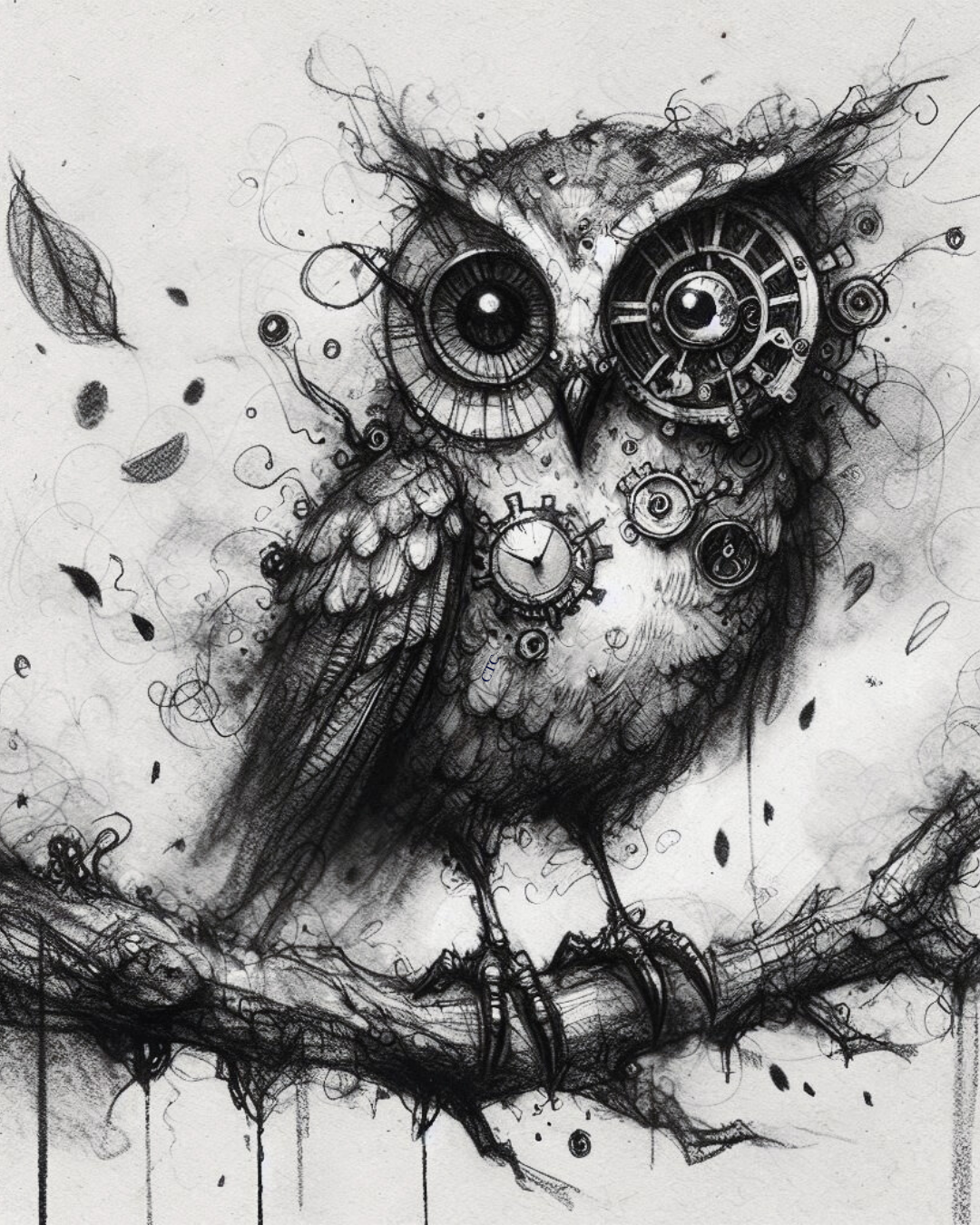
Field Notes of Alaric Fenweather, Temporal Naturalist
I should start by saying that studying creatures with time magic is deeply inconvenient. You can’t just watch them in the present and call it a day. No, you’ve got to account for what they were doing five minutes ago, what they’ll be doing in twenty minutes, and, most annoyingly, what they might have done in seventeen alternate timelines if you hadn’t stepped on that bloody twig during the fourth observation session, thus buggering up the entire sequence of events.
The Chronoveks don’t make this any easier.
Physical Description
The Chronovek is an owl, though not like any owl you’d find in a sensible forest. Imagine a tawny owl that’s been taken apart by a particularly creative clockmaker and put back together with more attention to looking impressive than actually making sense. They stand about two feet tall, with wingspans approaching four feet when fully extended, which they do constantly, usually right in front of your face.
Their plumage displays patterns I can only describe as mechanically organic, if you can stomach that contradiction. Feathers arrange themselves in interlocking sequences that look like gear teeth, each barb and barbule positioned with geometric precision. These patterns shift, literally, flowing across the owl’s body in waves that follow no pattern I can chart, though I’ve tried. Repeatedly. I’ve got seventeen notebooks devoted entirely to failed attempts at mapping Chronovek plumage sequences, and my wrist has never forgiven me.
The eyes are silver. Not silver-grey, or silvery-blue, or any of those poetic approximations you usually get in natural history. Actual metallic silver, luminescent, and possessed of a gaze that suggests the owl knows exactly what you’re about to do and finds it vaguely amusing. I don’t appreciate being patronised by owls, but here we are.
Habitat and Range
Chronoveks nest exclusively in the Eldertree Forest, specifically in the upper canopy where sensible naturalists can’t reach them without considerable risk to life and limb. I’ve made three attempts to locate a nesting site. The first resulted in a sprained ankle. The second, a torn coat and the loss of my favourite observation journal, which I watched fall in slow motion, naturally, whilst dangling from a branch some sixty feet above the forest floor. The third attempt I don’t discuss, except to say that I now have an irrational fear of rope.
They seem to prefer the oldest Eldertrees, those massive specimens whose branches have witnessed centuries pass beneath them. Whether this is because of some temporal significance or merely because ancient trees provide better vantage points for judging hapless naturalists, I can’t say.
Behaviour and Temporal Manipulation
Here’s where matters become philosophically troublesome.
Chronoveks don’t move through time in the linear fashion you’d expect from an owl. Instead, they fold it. I watched a Chronovek travel from a high branch to a low root, a distance of some eighty feet, and I can state with absolute certainty that it didn’t fly the intervening space. It was simply there, then here, with a soft displacement of air that smelled faintly of copper and old parchment.
More distressing still, they occasionally arrive before they leave. I’ve witnessed the same Chronovek in two locations simultaneously, which suggests either they exist in multiple temporal states at once, or I’ve gone quite mad from inhaling too many Lumisilk spores. My physician assures me it’s the former, though she said it with the sort of careful tone you use when addressing the potentially unhinged.
Their calls are equally peculiar: low, resonant sounds somewhere between an owl’s hoot and a bell chiming the hour. The pitch varies depending, I think, on what time the owl believes it to be, which isn’t necessarily the same time the rest of us are experiencing. I’ve heard them call midnight at noon and dawn at dusk, and I’ve learned to simply nod and accept it.
Diet
Chronoveks consume temporal anomalies.
I realise this sounds absurd. I assure you, it is.
They hunt moments that have gone wrong: time caught in loops, seconds that have folded back on themselves, minutes that never quite happened. I observed a Chronovek pluck something invisible from the air, swallow it with evident satisfaction, and the headache I’d been nursing for the past three hours vanished instantly. I can only assume I’d been experiencing a temporal migraine, and the owl had consumed whatever paradox had caused it.
They also eat moths. Regular moths. I’m including this detail because after pages of temporal impossibilities, it’s deeply reassuring to report that sometimes a Chronovek simply fancies a moth.
Interaction with Time Magic
Chronoveks have an uncanny ability to sense temporal manipulation in others. If you’ve got even a trace of time magic, whether it’s Caelvarae heritage or the result of some questionable experimentation with Chronos herbs (not that I’d know anything about that), a Chronovek will know. They’ll appear, circle your head with those great silent wings, and deliver a series of chittering sounds that I’ve come to interpret as either approval or mockery. Possibly both.
I once witnessed a Chronovek interact with a young practitioner attempting their first time-fold. The owl materialised beside them, observed their fumbling efforts with those luminous silver eyes, then demonstrated the proper technique by folding itself through approximately fifteen seconds of local time whilst the practitioner watched in apparent mortification. The Chronovek then chittered once, which I choose to believe meant “like that, you dolt,” and vanished.
It was, I confess, rather satisfying to watch someone else be patronised by these infernal owls for once.
Conservation Status
Chronoveks are neither rare nor common, which is exactly the sort of unhelpful designation you expect from temporal fauna. There might be six of them or six hundred and counting becomes meaningless when the same owl can exist in multiple locations simultaneously. The Chronological Bestiary currently lists their population as “yes.”
They appear to be thriving, insofar as creatures that exist in non-linear time can be said to thrive in any measurable sense.
Final Notes
After five years studying Chronoveks, I’ve arrived at the following conclusions:
One: They’re deeply aware of their own temporal nature and find it endlessly entertaining that we aren’t.
Two: They serve some guardian function within the forest, though whether they guard time itself or merely ensure it continues flowing properly, I can’t say.
Three: They have a wretched sense of humour and enjoy appearing directly behind naturalists at the precise moment said naturalists are attempting to sketch them from memory.
Four: I should have studied something sensible like Shellbacks.
I remain, as ever, devoted to the pursuit of temporal natural history, despite my physician’s concerns and my sister’s repeated suggestions that I take up a hobby involving fewer head injuries.
Alaric Fenweather Temporal Naturalist (Reluctant) Keeper of the Chronological Bestiary Current Location: The Eldertree Forest, Nursing a Bruised Ego and a Sprained Thumb