Cassivelinias: The Horn in the Hill
His name wore down over time, as names do when they fall from daily speech, until it settled somewhere between man and god.
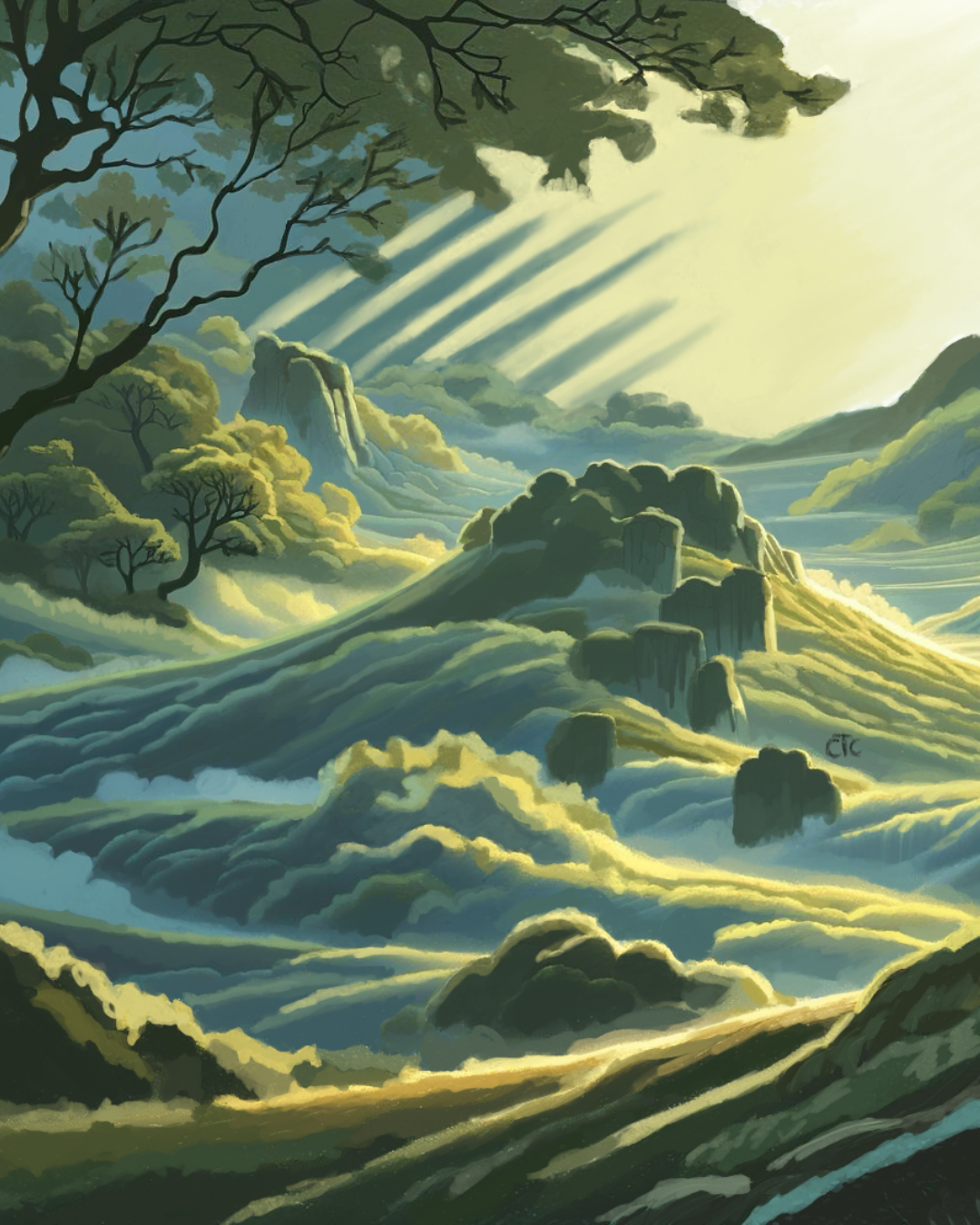
(I painted this on Procreate on my iPad using the Eaglehawk brush. - Chaiga T. Cheska)
—————————————————————
Hear the horn beneath Cassivelinias’ breast,
Where bone and root and oath are twined in sleep;
Blow not for coin, nor crown, nor hollow quest,
Blow when the land remembers blood to keep.
Mist will take the traveller who dares to speak the name,
And those who answer wake with teeth and flame.
(The final line is never sung twice in succession. The oldest tradition holds that repeating it is not error but invitation, and that what it invites is distinct from the horn’s purpose. The traditions decline to elaborate further on this point.)
—————————————————————
The Myth of Cassivelinias
Before the river had gathered all its names to itself, there lived a king named Cassivelinias, whom the land recognised as its own.
His people had held this country since time slipped beyond the reach of memory, and between land and folk there ran a bond that needed no writing; it lived in the hands and the voice and the daily act of belonging somewhere. When the invaders came, Cassivelinias held them at the river crossings and in the deep forest for two winters and into a third spring, until he understood, with the clarity that visits a king who has endured long enough, what could still be defended and what could not. Quietly, he went alone to the hill.
Of what passed between Cassivelinias and the old earth on the night he made his pact, no account survives. The traditions hold only the terms: he would surrender his mortal throne, and in return the hill would receive him as the old hills have always received their kings, not in death but in the long sleep beneath the turf, from which a king may yet wake when the need is sufficient, and the land itself consents to the waking.
He did not perish. The oldest traditions are careful on this point, with the patience of something that has been misread before. Cassivelinias entered the hill, and the hill accepted him, and his voice was kept within it, held in the horn that rests against his breast, gripped with a ferocity that centuries of sleep have not loosened. It will sound only when the rightful heirs of his people stand on the hill’s own ground, and the summons comes from the land rather than from ambition. What answers is not an echo. It is the old king himself, from somewhere deep in the dark beneath the chalk.
His name wore down over time, as names do when they fall from daily speech, until it settled somewhere between man and god. The hill kept what remained.
—————————————————————
A Field Account and Scholarly Consideration
By Collan Ervane, Senior Fellow in Mythic Topography and Contested Landscapes,
College of Deep History, Mirhaven
Note: The College’s Research Conduct and Equipment Policy requires that all field incidents and losses be formally documented within the relevant scholarly paper so that replacement claims may be assessed in context. This account, therefore, contains one such incident report. I have attempted to integrate it with minimum disruption to the scholarly argument. I have not entirely succeeded.
I have studied the liminal landscapes of MirMarnia for twenty-eight years, and Cassivelinias has resisted documentation for eight of them with what I can only describe as a pointed consistency. Every community within travelling distance, valley, marsh, and high ground alike, agrees on the sleeping king, the pact, the horn gripped in his breast, the fierce hold that centuries have not loosened. Something is keeping the core of this story in place from underneath, and it is not, as my colleague Prethwyn Aldas maintains, merely the human appetite for persistence myths.
Nine visits have taught me a great deal about this hill. Some of it is scholarly. Some of it is documented below.
Incident Report CE/DR/0061
Required for Equipment Replacement Claim: one left shoe; one wool sock, rendered unfit for purpose.
At some point during the ascent of the eastern path on the morning of my ninth visit, I lost my left shoe. I did not notice this immediately, which I acknowledge says something unflattering about the quality of my attention, though in my defence, the mist was particularly purposeful that morning and I had other things on my mind. I completed approximately forty yards of uphill fieldwork in one shoe before the ground made its unevenness felt enough to draw my notice.
The shoe was not recoverable. I searched for twenty minutes and found no trace of it. The sock I was wearing had also gone, though here I must be precise: the sock had not gone. The sock reappeared four days later on my doorstep in Mirhaven, propped upright against the door frame, full to the brim with walnuts.
They were fresh walnuts. I do not know where the hill sources its walnuts. I did not know the hill had walnuts. I have consulted three separate maps of the Cassivelinias area, and none of them indicates walnut trees in any proximity to the site. I counted the walnuts before disposing of them, as the College’s Returned Items Policy requires a full inventory of any goods received in connection with a funded research claim. There were forty-seven.
I am requesting replacement of the left shoe under Section 6, Clause 1. I am not requesting replacement of the sock, as it was returned, and College policy is clear that returned items do not qualify for replacement regardless of their subsequent condition or contents. The walnuts are not claimed as research materials. I have not eaten them. I felt, on reflection, that eating them was the sort of decision one ought to approach with more information than I currently possess, and I have learned, across nine visits to this hill, to apply that principle liberally.
I intend to return. I have, in fact, already written to inform the hill of this intention, on the grounds that nine visits have given me a reasonable sense of what it appreciates, and I believe advance notice to be courteous. I have not yet received a reply, though a small quantity of walnuts appeared on my windowsill on Tuesday morning, and I am choosing to interpret this as acknowledgement.
The horn is in the breast of the king. The king is in the hill. The hill is waiting, with considerably more patience than the College’s Finance Committee, who have had my replacement claim for six months and have yet to respond. I sent the Finance Committee a walnut last week, on the slim chance that the hill’s methods are transferable. I will report back.
Collan Ervane, College of Deep History, Mirhaven.
Completed in the last week of the Deep Autumn in the twenty-eighth year of his scholarly career and the ninth of his particular preoccupation with this hill
—————————————————————
Author’s Note
Collan Ervane submitted this account to me with a covering letter, three walnut shells, and a note asking whether I knew anyone at the College of Deep History’s Finance Committee. I do not, but I found the piece too good to sit in a drawer, and so here it is.
Chaiga T. Cheska