Aurora Mist Tea: An Official Record of Accounts
Transcribed by Pip Thimble, Junior Librarian (Provisional)
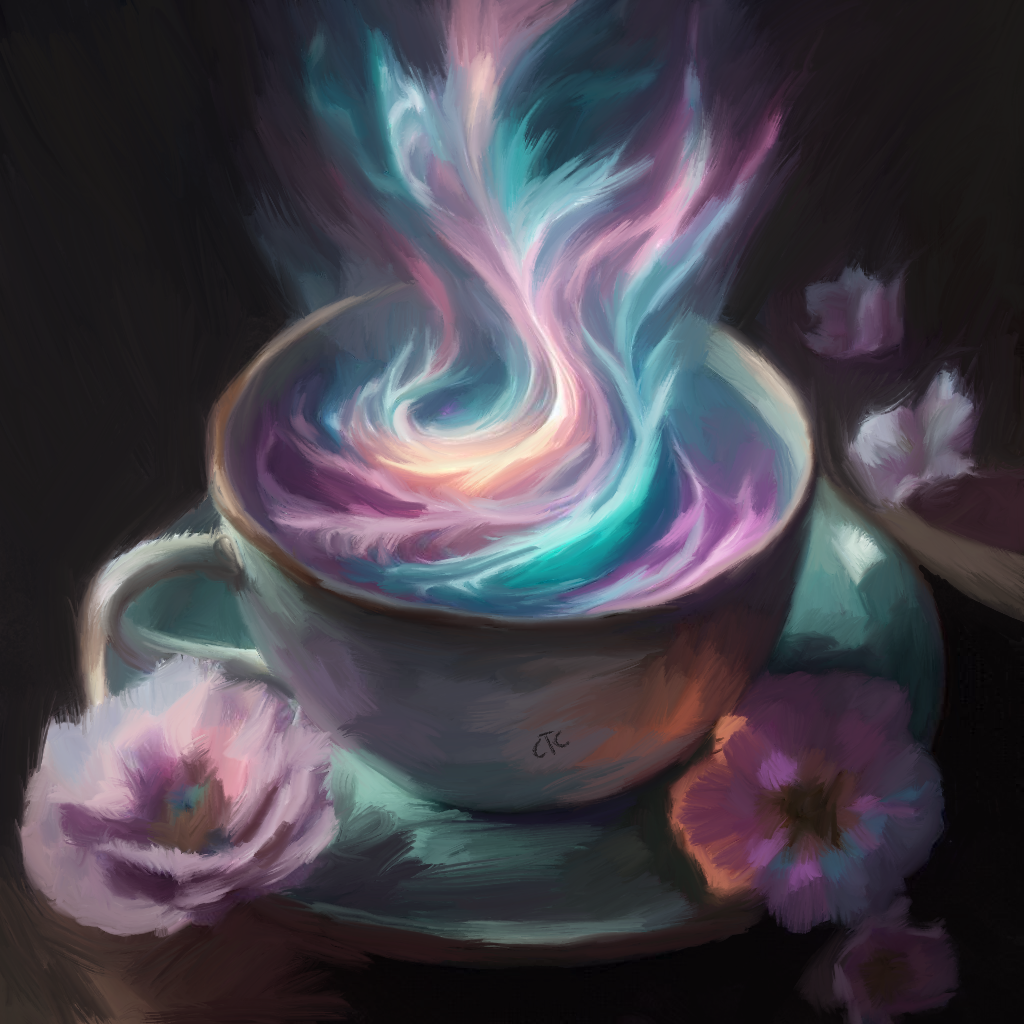
(I painted this in Procreate using the HB Pencil and Oil Paint brush - Chaiga T. Cheska)
———
Sky Ribbon Song
Sung enthusiastically during Aurora Mist seasons by locals and visitors alike to get everyone in the mood to collect the Aurora Mist colours.
(Verse 1)
When the night grows thin, and the wind turns still,
and a hush spreads soft from the hollow hill,
when the frost on the lane takes a trembling glow
and the birdsong falters and will not go,
when the shadows soften, and stars grow pale,
The watchers know by the shift in the vale
that somewhere high in the faraway air,
The Sky Ribbons are waking up there.
(Chorus)
Hold your cup, hold it high,
hold it up to the ribboned sky,
hold your porcelain in the night
and catch the joy in the falling light.
(Verse 2)
They rise like breath from the deep of the air,
green at the edges and violet
where the dark meets the dawn in a trembling seam,
as though the whole sky has slipped into dream.
Then the first ribbon brightens, a slow blooming flare,
and the rest follow after, unhurried and rare,
and their colours grow heavy and loosen and cast
each droplet down warm through the cold sky at last.
(Chorus)
Hold your cup, hold it high,
hold it up to the ribboned sky,
hold your porcelain in the night
and catch the joy in the falling light.
(Bridge)
They land in the porcelain lifted below,
and the mist begins swirling with soft inner glow,
it blooms in the cup like a secret unfurled,
a small, glowing storm from another world.
(Verse 3)
Run for the ridges, run for the height,
the Sky Ribbons are pouring on MirMarnian night!
Up to the cliff path, up to the stone,
each lifting their porcelain, polished and known!
Some taste flowers that bloom in forgotten rain,
some hear music that softens old pain,
some see places the maps have yet to claim,
some find a joy that has never had a name!
(Chorus)
Hold your cup, hold it high,
hold it up to the ribboned sky,
hold your porcelain in the night
and catch the joy in the falling light!
(Outro)
And so, the people of MirMarnia watch the sky,
cups on their shelves and their hope burning high,
for the Sky Ribbons drifting in luminous sweep,
for the joy that falls softly when the heavens grow deep.
AURORA MIST TEA: AN OFFICIAL RECORD OF ACCOUNTS
Transcribed by Pip Thimble, Junior Librarian (Provisional),
on loan from the Wandering Library
At the request of the Institute of Liminal Phenomena,
Season of the Long Drift
~~~
I should explain how I came to be on a ridge in the middle of the night in a hat with a chinstrap, one bare foot, and what remained of my left trouser leg.
The Wandering Library received a formal request from the Institute of Liminal Phenomena for a recorder of accounts to accompany two of their senior researchers into the field during the Aurora Mist Tea season. Someone to document proceedings with rigour and impartiality, the letter said. Someone detached, observational, and unlikely to interfere. Bramwell read this letter, looked up, and looked directly at me, which told me everything I needed to know about how the next several days were going to go.
“You’ll need proper field equipment,” Bramwell said, with the enthusiasm of a man for whom this was the most interesting part.
He outfitted me himself. The coat was waxed and reached my knees and had seventeen pockets, most of which contained things Bramwell considered essential, and I considered alarming. The boots were excellent, or at least one of them remained so for the majority of the evening. The hat was waterproof, broad-brimmed, and secured under my chin by a leather strap that, Bramwell explained, would prevent it from being taken by unexpected updraughts. I asked when an unexpected updraught had last claimed a hat on a hillside in MirMarnia. Bramwell said he didn’t know, but that he wasn’t going to be the one who’d failed to plan for it.
I wore the hat. I felt I looked like a very small and unconvincing naturalist. I kept this to myself because Bramwell had gone to considerable effort, and I am not unreasonable.
The two scholars were waiting for me at the base of the Thornwick Ridge at dusk, and they were already arguing.
Their names were Aldric Pell and Sonnet Grieve, both Senior Researchers of Liminal Phenomena at the Institute, and both, I gathered, within approximately four minutes of meeting them, constitutionally unable to occupy the same space without treating it as a competition. The Institute had not sent them together because they worked well together. The Institute had sent them together, the letter explained in a careful postscript that the researchers themselves were apparently not supposed to have read but clearly had, because their mutual rivalry had become, and I quote, “an atmosphere of ongoing professional disruption that has now affected three departments, one administrative hallway, and the biscuit rota.”
Fresh air, the Institute felt. Shared purpose. Common ground.
The common ground they’d found so far was the ridge path, and they were disputing which side of it was the correct side to ascend.
“The eastern approach,” Pell said, “has the superior angle of observation.”
“The eastern approach,” Grieve replied, “puts the wind at our backs, which contaminates the olfactory sample.”
“We are not, at this stage, at the olfactory level.”
“We should always be at the olfactory level.”
“Good evening,” I said. “I’m Pip Thimble, from the Wandering Library. I’m here to document…”
“Western approach,” said Grieve, and started walking, completely ignoring me.
“Eastern approach produces better light refraction data,” said Pell, who started walking in a slightly different direction. I stood between the two departing paths for a moment, wondering what impartiality looked like in practical terms and then went after Grieve because she was faster and I was genuinely concerned about losing sight of both of them at once.
Aldric Pell was a tall, narrow man with the posture of someone who had spent many years peering at small things from a great height. He carried a leather case containing, amongst other instruments, a refraction prism, three folded charts, a small mechanical counter for tracking atmospheric events, and his teacups: six of them, wrapped individually in chamois cloth and nested in a box lined with what appeared to be river moss kept faintly damp. He handled the teacups with the careful reverence of a man who knew their precise individual histories and had opinions about their relative merits he was prepared to defend at length, and at volume, if the ascent was any indication.
Sonnet Grieve was shorter, broader, and moved with the decisive efficiency of someone who had decided long ago that hesitation was the enemy of data. Her equipment was strapped about her person in an arrangement that looked complicated but worked, and her teacups, twelve of them, were distributed in padded pouches at various angles so that no single impact could compromise the full set. She had brought, additionally, a portable wind gauge, two types of thermometer, a folded measuring cloth, and a jar of what she described as comparative baseline liquid and Pell described as tap water, and they had not agreed on this terminology for the duration of the ascent and showed no signs of beginning to.
What neither of them had mentioned, and what I had not thought to ask about, was everyone else.
I had understood the Aurora Mist Tea season to be a phenomenon of some local interest. I had not understood it to be an occasion. By the time we reached the upper ridge, the path had filled behind us, and the ridge itself, which I had imagined as a quiet expanse of dark hillside with two scholars and one librarian and a great deal of sky, was in fact crowded with what appeared to be most of the surrounding settlements, all of them wrapped in good cloaks and carrying, without exception, their best teacups.
There were fires burning in small iron baskets along the ridge path. There were vendors moving through the crowd with trays of warm beverages. Children sat on their parents’ shoulders. Old men had brought stools. A group of women near the far end of the ridge had set up a table with what appeared to be a very serious arrangement of matching teacups and were engaged in quiet, focused preparation with the air of people who had been doing this for a long time and intended to do it properly. The general mood was one of collective, unhurried anticipation, the comfortable warmth of people who knew exactly what was coming and had been looking forward to it since the last season.
Pell looked at the crowd with the expression of a man who had expected a laboratory and found a festival.
Grieve looked at the crowd with the expression of a woman who had arrived to find someone else already using the equipment.
I looked at the crowd and wrote “considerably more MirMarnians than anticipated” in my notes, and then had to move smartly sideways as a family of five came through with a hamper and a folding table and absolutely no intention of going around anyone.
We found a position near the centre of the ridge where, Pell maintained, the refraction conditions were optimal, and Grieve maintained the olfactory sample remained uncontaminated, which was, I noted, directly beside a large family group with three very small children and a dog who took an immediate and personal interest in Pell’s chamois-wrapped teacups. Pell repositioned the box. The dog repositioned itself. This continued for some minutes.
The Sky Ribbons came up the way they always did, without announcement, without hurry, as though they had all the time in the world and knew it. Green at the first edge, then violet where the dark met the deepening of the sky, and the whole upper air went luminous and slow and faintly shivering, and the crowd along the ridge went quiet in the way that crowds go quiet when something very large and very beautiful arrives, and there is nothing useful to say about it.
I stopped writing for a moment just to look.
Pell and Grieve did not stop.
They had arranged their teacups on small folding stands and were conducting their observations with the focused intensity of two people who were each entirely certain the other was doing it wrong.
“Teacups should face east,” Pell said, adjusting the nearest one by a precise degree.
“Teacups catch what falls on them,” Grieve countered. “Orientation is irrelevant to a receptive vessel.”
“A receptive vessel with optimal exposure to the refraction angle…”
“The light doesn’t care which way the teacups are pointing, Aldric.”
“I have seventeen years of documentation suggesting otherwise.”
“Your documentation,” Grieve said pleasantly, “has seventeen years of the same bias in it.”
Around us, the assembled MirMarnians lifted their teacups to the sky with the comfortable ease of long practice and waited, and the ribbons moved overhead in great slow sweeps of colour, and nobody else appeared to be arguing about anything at all.
The first drops fell at half past nine, or nine forty-two and a half, depending on which of the two people arguing about it you believed. They came down through the ribboned light and landed in the teacups with a sound like a fingertip on crystal, and the mist that rose from each one was soft and faintly luminous, spiralling upward in slow curls that caught the aurora light and held it briefly before dispersing into the cold air. All along the ridge, people held their teacups in both hands and bent their heads to drink, and the quiet that settled over the hillside had a different quality to it then, something content and unhurried, the quiet of a great many people experiencing something privately and simultaneously wonderful.
It was, I will say, genuinely remarkable.
I wrote this down.
Then Grieve turned to look at me with the evaluating expression of someone who has just noticed an available resource.
“You’re here to record what happens,” she declared. “Recording what happens to a subject in real time is considerably more valuable than recording what happens to a teacup.”
“I am here,” I said, “to record what happens to you. Both of you. Specifically. That is the arrangement.”
“You’d be recording yourself. It’s first-person documentation. I’m sure the Wandering Library values primary sources.”
“The Wandering Library,” I said carefully, “values its junior librarians.”
This was, I admit, an optimistic framing of my relationship with an institution that had once filed me under Persons of Uncertain Classification for three days while the shelving resolved an administrative disagreement with itself. But it felt like the right position to take.
Grieve considered me. Then she said, “One teacup. Just to see.”
The first teacup had already caught three drops of Aurora Mist. The mist rising from it was the colour of the inside of a shell, faintly pink and faintly gold, and it smelled of something between old wood and open water with something sweeter underneath, like the memory of fruit rather than fruit itself. I drank it slowly, because she told me to, and reported the experience in precise terms: music, faint and under everything, not playing from anywhere near the ridge but felt rather than heard, a low sustained note in the air that had apparently always been there and I had simply, for a moment, been able to notice it.
Pell wrote it down. Grieve wrote it down. They compared what they had written and found they had interpreted the same account in two very different directions, which surprised neither of them.
“Second teacup,” said Pell, producing one from his chamois cloth.
“His first experience sets a precedent for comparative analysis,” Grieve said, which I realised too late was not an argument against it.
The second teacup was Pell’s, oriented eastward throughout the collection period, and tasted of rain on warm stone and the very first week of autumn, that specific narrow window when the green hasn’t fully left, but the gold has started. Pell looked vindicated. Grieve said the flavour profile was consistent with her own results and that orientation remained irrelevant. I sat on my folding stool between them and waited for this to resolve.
It did not resolve.
What happened instead was that Grieve said she needed a height measurement, by which she meant she needed to know at what elevation the mist changed, and that the most efficient way to establish this was to hold a test subject up into the lower edge of the aurora and observe the response. I said that sounded like a task for a measuring pole. Grieve said a measuring pole couldn’t report a sensory experience. Pell said Grieve had a point. I said I didn’t think Pell should be agreeing with Grieve on things that were primarily about lifting me up, and by this time, Grieve had already handed her notes to the nearest MirMarnian, who accepted them with the cooperative goodwill of someone accustomed to scholars doing unusual things on this particular ridge, and she and Pell had each taken one of my arms.
I am five feet tall. I weigh, as Bramwell once noted when I had needed to retrieve something from the higher shelves using a pulley system of his own devising, considerably less than you’d think. This is, in most circumstances, unremarkable. On a crowded ridge at half past nine during the Aurora Mist Tea season, in the hands of two highly motivated researchers, it turned out to be a significant practical factor.
They lifted me without any apparent difficulty whatsoever.
The lower edge of the aurora was, I can report with considerable firsthand authority, cold and wet and full of light, and it smelled of the sky the way a river smells of rain, which is to say it smelled of something that had been travelling a very long time and had only just arrived. The mist came in around my face and my shoulders and the brim of the hat, which I was at that particular moment grateful for, and for a few seconds I was simply suspended in it, looking up at the ribbons moving overhead, which was, I will admit, extraordinary.
Then the mist got into my left boot.
Not a drop. Not a trickle. The boot simply filled, in the manner of a small vessel left out in moderate rain, except that the rain was aurora mist and the vessel was on my foot, and when Pell and Grieve set me down again the boot made a sound that the surrounding MirMarnians apparently found very funny, because several of them laughed, and the three small children from the family beside us shrieked with delight, and the dog barked.
I stood on the ridge and felt the mist settling cold around my left sock and wrote “left boot: compromised” in my notes with the composure of a professional.
I should, at this point, have said that I was not interested anymore in being a test subject.
I should have said it after the second lifting, when Grieve decided that the first result needed a control measurement and Pell agreed that the comparative data would be valuable, and they lifted me again, somewhat higher this time, and I came down with mist on my shoulders and in my hair and a sensation in my left arm that felt briefly like the arm was made of something other than the usual material before resolving back into normality. I should have said it then.
I did not say it then because I was writing things down, which is, I acknowledge, a failure of self-preservation in favour of professional thoroughness, and Bramwell would probably consider it admirable, and I am choosing to frame it that way.
What finally ended my involvement as a research subject was my trouser leg.
Grieve had identified a spot approximately thirty feet along the ridge where the aurora light came in at a low angle, and the mist had a different character, denser and more sustained, with a deep violet quality that moved inside the teacups with a slow, deliberate purposefulness the other collections hadn’t shown. She wanted to know how this mist behaved at the point of contact with a surface-level subject, by which she meant she wanted to know what it did to a person standing in it, and she and Pell had walked me to the spot and positioned me in it before I had fully followed the chain of reasoning to its conclusion.
The mist was extraordinary. It moved around my ankles and wound up past my knees, and it was warm, which none of the other mist had been, and faintly luminous at the edges, and I was in the middle of reporting this when I noticed that the left leg of my trousers had begun to behave oddly.
I cannot be more precise than that. It simply began to feel less like something I was wearing and more like something that had made a private decision, and before either Pell or Grieve had registered what was happening the left trouser leg detached at the hip with the quiet, unhurried inevitability of something that had been considering this for a while, and crumpled to the ground around my foot, and the night air of the Thornwick Ridge arrived around my left leg with immediate and comprehensive thoroughness.
The MirMarnians nearest to us saw it happen.
Several of them hooted. Two of them clapped. The three small children shrieked again, possibly with the same energy as before, or possibly with considerably more. The old man on his stool, twenty feet along the ridge, called something that I did not catch precisely, but which produced a ripple of laughter through his immediate vicinity. Someone behind me said, in a tone of genuine interest, “Oh, that’s the separation effect. I’ve heard about that,” and someone else said, “I’ve only ever seen it with a hat,” and there was a brief, animated discussion about this that I found difficult to fully attend to because I was standing on a crowded ridge in front of what felt like a considerable number of people, with one bare leg and one bare foot and my left trouser leg on the ground and the aurora moving overhead in its magnificent, entirely indifferent sweeps.
I thought, with some intensity, about the time Bramwell had gone upside down in the Library during a disagreement with the shelving on the upper floor. I had laughed until my sides hurt. I had told the story to three separate people. I understood now, with a clarity that felt instructive, that this had been unkind of me, and that there was a specific quality of mortification that came from being witnessed in a state of accidental undress by a large number of strangers who were all, individually and collectively, finding it very funny, that was quite distinct from any other variety of embarrassment and considerably worse than most.
“Fascinating,” said Pell, and crouched to examine my remaining trouser leg with his refraction prism.
“Consistent with the separation phenomenon in the Glum records,” said Grieve, and wrote something down.
“That,” I said, with the steadiness of someone managing his situation, “was my trouser leg.”
“The phenomenon is almost certainly reversible,” Pell said.
The word almost was doing an enormous amount of work in that sentence, and we all knew it.
I stepped out of the crumpled trouser leg, and Pell retrieved it from the ground. He inspected it. He handed it back to me. I held it with the dignity available to a person holding a detached trouser leg on a public ridge and waited, and the aurora moved overhead, and the MirMarnians nearest to us had the decency to return to their own teacups after a few minutes, though the old man on his stool glanced over twice more with an expression of quiet, settled amusement that I expect he would be describing to people for some time.
I stepped back into my trouser leg, and it reattached after approximately twenty minutes, which Pell timed, and Grieve disputed. It reattached slightly crookedly, which I noticed when I walked around and could do nothing about. My left boot remained full of mist-water for the rest of the evening and made a concerning farting sound at every step.
I documented all of this. I am a librarian, even if only provisionally, and I said I would write everything down, and I have, including the old man, the clapping, and the precise quality of standing in public with one’s left leg exposed to the elements while two senior researchers argued about data.
I would like Bramwell to read this section carefully. I would like him to appreciate that I remained professional throughout. I would like him to understand that I continued to take notes whilst one-legged, cold, wet, and observed by most of what I estimated to be four hundred MirMarnians, and that this represents a level of dedication to the Wandering Library’s good name that I feel ought to be noted somewhere in an official capacity.
By the time the ribbons had thinned and the Long Drift had settled back into ordinary sky, Pell and Grieve had between them consumed fourteen teacups of Aurora Mist Tea, filled six pages of comparative notes, disputed the methodology of every measurement taken, and arrived at three separate conclusions that contradicted each other so completely that I suspected the Institute would be occupied with them well into the following season. They packed their teacups with the care of people wrapping things that mattered and barely spoke, which was the most peaceful the evening had been, and I wrote my closing notes by the light of a small lantern Pell produced from his coat, which was the first thing he’d done all evening for which I was straightforwardly grateful.
Around us, the crowd was dispersing in the unhurried way of people who had had a satisfying evening and were in no particular hurry to leave it behind. Fires were damped down. Children were collected. The women with the matching teacups packed them away with the methodical care of a long tradition. The old man on his stool rose, tucked it under his arm, and walked past me without saying anything, though he did look at my left trouser leg with the briefly renewed appreciation of a man revisiting a fond memory.
The Wandering Library is due to arrive any moment to collect me, and I can’t wait, as I feel like I need to be rescued from standing here on the lower ridge path, wrapped in my seventeen-pocketed coat while feeling windblown, cold and slightly damp with a crooked trouser leg.
Bramwell, if you are reading this: I was professional throughout. I did not complain once, though if anyone enlists me for this sort of activity again, there will be words!
Please hurry.
~~~
Author’s Note:
This account was passed to me by Bramwell Corin, who found it filed under “Provisional Staff: Incidents of a Minor and Largely Recoverable Nature” and felt, after careful consideration, that it deserved a wider readership. He was very clear that this decision was motivated entirely by archival generosity and had nothing whatsoever to do with the paragraph in which Pip reflects on Bramwell’s own encounter with the upper floor shelving.
Bramwell also wanted me to assure you that Pip doesn’t read these posts.
He said it twice, which I found interesting.
-Chaiga T. Cheska