An Observer's Account of the Tumian of Hæthrun Cross
Submitted to the Institute of Lithic Animacy by Lira Hemswick, Institute Observer
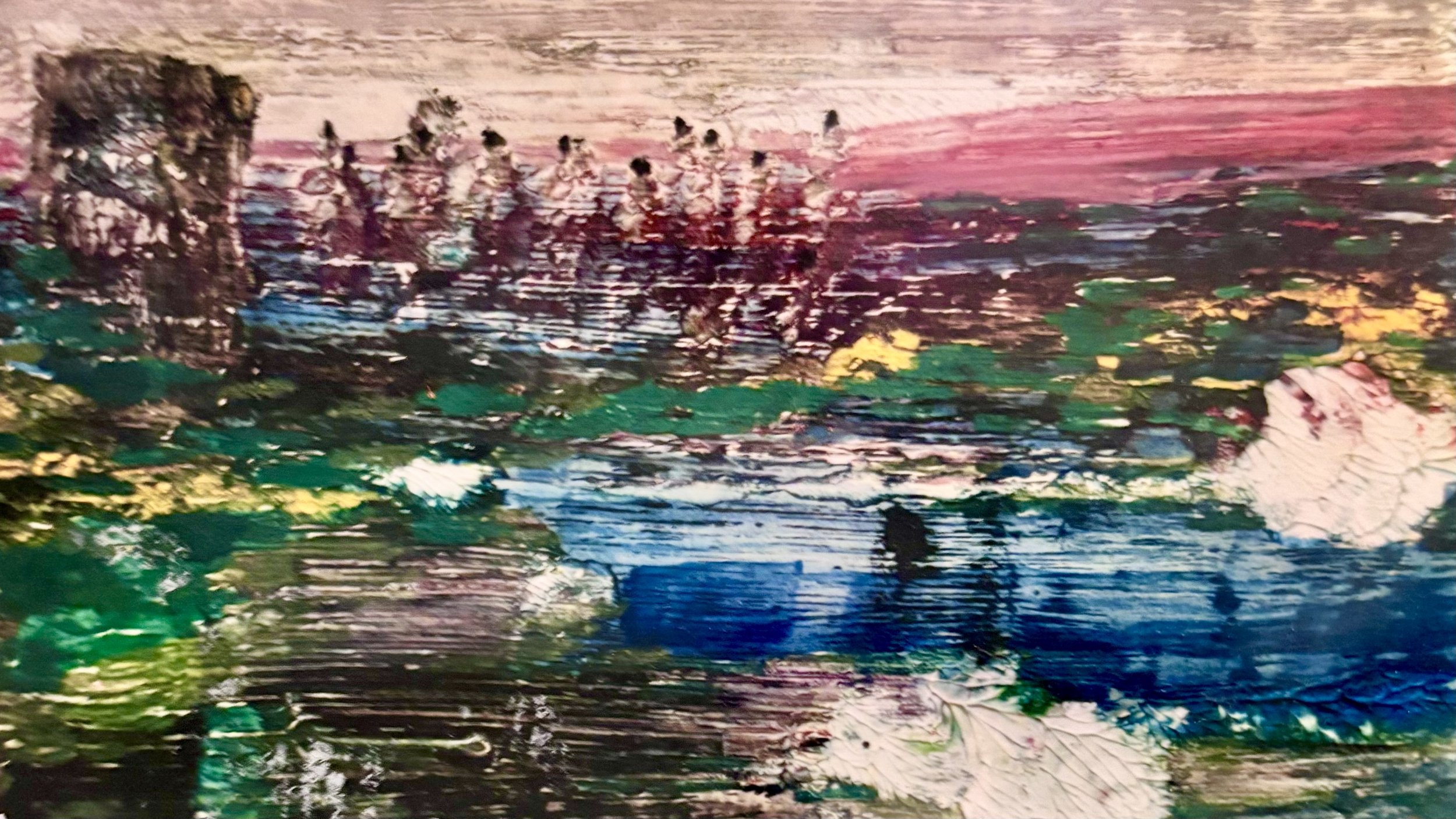
(I painted this over 30 years ago on cardboard that I primed, then drew on with hot glue, then painted over with oil paint, and finally drew on with powdered charcoal. Nice to be using it at last for what it was intended for. - Chaiga T. Cheska)
(The Tumian Song is sung from the perspective of the Tumians themselves, which seemed right. Written in the Way of Lon, as creatures of MirMarnia typically speak only in the sacred language, I feel. Lyrics, musical key, and style were created by me, with Suno used to put it all together. - Chaiga T. Cheska)
Researchers Under Observation: Tuvin & Wulfric Osbarrow, brothers
A Note on the Nature of This Document
This report began as field notes. I intend to submit it as field notes. The Institute requested an assessment of the Osbarrow brothers’ research progress at Hæthrun Cross, and what follows is an accurate account of everything I observed during my eight days on site. I was initially asked to stay two.
I should note that Tuvin and Wulfric Osbarrow became aware, on day six, that these notes were to be submitted as an official document. Their response to this information is reflected in the character of their bracketed contributions, which shift noticeably around that point. They have requested, separately and together, that I remove their earlier additions on the grounds that they were, in Tuvin’s words, “informal observations made in a spirit of collegial warmth,” and in Wulfric’s words, “absolutely not representative of my professional capabilities and I would like that noted.”
I have not removed anything.
Lira Hemswick
Day One: Arrival at Hæthrun Cross
The path to Hæthrun Cross descends through forested ridges, the trees growing thicker and more salt bitten as the land drops toward the sea, their roots gripping the soil with the specific determination of flora that has learned to hold on. The air changes before the sea comes into view. It sharpens. It carries a vibration beneath its surface, faint as a held breath, as though the ground itself is quietly anticipating something.
Then the trees thin, the slope opens, and Hæthrun Cross is simply there.
I had read the Osbarrow brothers’ preliminary reports. I had formed a reasonable picture of a coastal research site. The picture was inadequate.
The cliffs rise on the southern edge, layered brownish rock stacked in ancient horizontal seams, their tops softened by grass that rolls down to meet the shore. The beach itself is stone, all stone, not sand, not shingle in the ordinary sense, but great smooth round stones of every size, worn to a perfection that seems impossible until you have stood amongst them long enough to understand what centuries of what the sea can do. Some sit comfortably in the palm of a hand. Others are the size of a man’s torso. A few, further along the shore where the cliff’s shadow falls, are the size of small huts, so smoothly spherical that they seem placed rather than natural, like the deliberate work of something with very large hands and a great deal of patience.
The Neoshera sea at Hæthrun Cross does not behave like an ordinary sea. Its surface is rarely still, even on calm days. Waves leap rather than roll. The wind arrives sideways, with a kind of laughing sharpness, threading through the cliff grasses and sending it into rippling waves of its own. Everything here feels awake. The tidepools flicker. The cliff face vibrates with the pressure of the tides against its base. Even on this first afternoon, with the sky clear and the sea lively rather than wild, the air carries tremors, that sense of the world holding something joyful just below the surface.
The Osbarrow brothers were on the beach when I arrived. I identified them immediately.
Tuvin Osbarrow stood at the waterline with his notebook open, his coat collar turned up against the wind in a way that somehow managed to look considered rather than hasty. He is tall, broad-shouldered, with brown wavy hair that the sea wind was doing its best to disorder and failing. He was pointing at a cluster of large stones and speaking with great animation to no one in particular, as his brother was some distance away and not listening.
Wulfric Osbarrow was some distance away and not listening. He was crouched at the edge of a tidepool with his face approximately six inches from the water’s surface, so absorbed in whatever he could see at the bottom that he had not noticed his cloak had caught in the rocks behind him and was pulling him gradually backwards at the collar. He had light brown curly hair in which I could already identify, from a distance of thirty feet, that it had in it a small twig and what appeared to be a fair amount of dried grass. He was, from the evidence available, a man in a state of profound intellectual engagement with a tidepool and mild physical difficulty with everything else.
[Tuvin’s note: I would like it recorded that I noticed Lira’s arrival immediately and went to greet her in a prompt and professional manner. Wulfi was unavoidably occupied with an important preliminary observation.]
[Wulfric’s note: The tidepool had three species in it I had not previously catalogued. I maintain this was the correct priority. Also, my cloak was fine.]
Day One, Continued: First Impressions of the Research Site and Its Stones
Tuvin introduced himself with great warmth, shook my hand, and immediately began explaining the Tumian beings before I had fully put my bag down. He has the quality of a man who assumes everyone is as interested in his subject as he is, and who has not yet been given sufficient evidence to doubt this assumption. It is, I note, not a completely incorrect assumption in my case, though I attributed my interest at the time to professional diligence.
He walked me along the beach with the proprietary ease of someone who has been here long enough to feel the place belongs to him a little, pointing out stone groupings, discussing what he and Wulfric had observed about their distribution, and occasionally stopping to crouch beside a large round stone and rest his hand against it with a quality of attention that was, I noted in a purely observational capacity, rather striking.
The stones are extraordinary. Even knowing what the brothers’ reports have suggested about their nature, standing among them is a very different experience. They sit on the beach in arrangements that seem almost social, clusters of smaller round stones nestled against larger ones, the great hut-sized boulders settled into the shore as though they chose their positions carefully. Their surfaces are smooth in a way that invites touch, cool and grey and faintly luminous in the afternoon light, each one a slightly different shade of silver and ash and pale blue-grey.
They do not look like sleeping beings but just look exactly like ordinary stones.
This is, I am coming to understand, precisely the point.
Wulfric joined us eventually, having extricated his cloak from the rocks and made several notes about the tidepool. He greeted me with a brisk nod, glanced at his brother, glanced at me, and returned his attention to his notebook in the manner of a man who has assessed a situation and filed it away for future reference.
“She’ll want to see the big ones along the south edge,” he said to Tuvin, not unpleasantly.
“Already planning it,” Tuvin said, smiling.
“And the tidepool cluster near the second headland. Significant pre-storm indicators there, I think.”
“Yes, quite.”
“And someone should mention the seaw…”
“Wulfric.”
“I was going to say the seaweed distribution patterns are an interesting secondary feature of the…”
“Wulfric.”
“I’m perfectly fine.”
[Wulfric’s note: I am always perfectly fine.]
Day Two: Rain, Wind, and the Question of Appropriate Field Clothing
The weather at Hæthrun Cross does not change gradually. It arrives suddenly and spectacularly.
I woke on the second morning to a sky the colour of old pewter and a wind that had come in overnight from the Neoshera carrying what felt like the cold memory of deep water. By the time I reached the beach, the sea was running in long, muscular swells, the waves breaking high and sharp against the cliff base, and the stones were already wet and gleaming darkly.
The brothers were already there.
Tuvin was wearing a long weatherproof cloak in deep charcoal grey, belted at the waist, his notebook tucked inside against the rain. The wind was considerable. He looked, I recorded in my notes with strict professional neutrality, as though he had dressed for the weather with the same ease with which he did everything else.
Wulfric was wearing a cloak that was slightly too big.
It was a large cloak, made of some heavy waterproof material in a dark greenish brown, and it had clearly seemed like a practical choice at some earlier point in the morning before the wind had fully committed to its intentions. By the time I reached them, Wulfric’s cloak had wrapped itself around his legs and was working on wrapping itself around his head. He was walking slightly sideways, one hand engaged in pulling fabric away from his face, the other attempting to hold his notebook, achieving neither with complete success.
The rain came in sideways gusts, and the sea grew livelier with each passing hour, the waves beginning to carry a new quality of energy, less rhythmic, more wilful, as though the Neoshera sea was entertaining a private thought it had not yet decided to share. Tuvin noted the swell patterns with focused attention, moving along the waterline with his usual unhurried confidence, pausing to crouch beside the larger stones, pressing his palm briefly to their surfaces.
Wulfric moved parallel to the waterline, slightly further up the beach, where a long hedgerow of gorse and bramble ran along the base of the grassy slope. He was making notes with great determination and would have been doing rather well had his cloak not caught on a bramble and brought him to an abrupt stop mid-sentence.
[Wulfric’s note: My cloak is a highly practical garment. The bramble was in an unreasonable location.]
[Tuvin’s note: I offered to help. He said he was fine. He was in the bramble for eleven minutes.]
A group of villagers appeared on the path above the beach around mid-morning, three women and an older man, wrapped in good weatherproof cloaks and carrying the comfortable ease of people who have walked this coast in all weathers since childhood. They made their way down to the shore with the stated intention, as the older man explained to me cheerfully, of observing the researchers at work.
They observed Tuvin for some time with considerable interest. One of the women asked me several questions about his research, nodding attentively at my answers whilst watching him crouch beside a large round stone with his cloak shifting in the wind.
Wulfric emerged from the bramble at this point, slightly listing to the left, with a new twig in his hair and a long thread of cloak fabric trailing behind him. The villagers turned to observe him instead. Their expressions shifted from admiration to something considerably more entertained.
“Does he do that often?” the older man asked me.
“I’ve been here one day,” I said.
“Ah,” he said, feeling this answered his question adequately.
Wulfric, sensing the attention, straightened to his full height, smoothed his cloak with great dignity, and walked briskly toward the tidepool cluster near the second headland. He walked briskly into a shallow pool he had not noticed, stopped, looked down at his boots, and then continued as though this had been the plan.
The villagers stayed for two hours. They left when Tuvin did, heading back up the path, and two of them found reasons to walk in the same direction.
Wulfric watched them go, then looked at me with an expression of someone who has been living alongside a particular phenomenon for fifty-one years and has made his peace with it, though not without effort.
[Wulfric’s note: This happens everywhere we go. I have stopped remarking on it.]
Day Three: The Tidepools, the Seaweed, and the Brambleberries
The tidepools at Hæthrun Cross are remarkable. They sit in natural basins worn into the rock shelf that extends from the cliff base at low tide, each one a self-contained world of salt water and slow life. The water is extraordinarily clear, the light finding its way in at angles that illuminate the pool’s floor in shifting patterns of blue and green and gold. Small creatures move at the edges. Anemones open and close with the patience of creatures that measure time differently.
These tide pools are also full of seaweed.
This is not, in itself, remarkable. Seaweed in tidepools is very common. The seaweed at Hæthrun Cross is, by any objective measure, no different from seaweed elsewhere: dark green, slippery, draped across the rocks in long trailing ribbons and gathered in dense clumps at the pool edges. It does nothing unusual. It presents no threat of any kind.
Wulfric Osbarrow is nonetheless profoundly, viscerally, and apparently irrationally terrified of it.
I observed the first incident from a distance of approximately fifteen feet. Wulfric was crouched at the edge of a large pool, making notes, his face carrying that expression of sharp-focused concentration that appears whenever he is genuinely engaged with something fascinating. He leaned slightly forward to see the pool floor more clearly. A strand of seaweed, moved by some small current, drifted toward his hand on the rock edge.
He stood up very fast, and both hands came up and pointed at the seaweed with an urgency that suggested it had done something aggressive. The other flapped rapidly in a general gesture of alarm. A sound emerged from him that I will not attempt to transcribe, as I am not certain it contained words, but it sounded a bit like a tea kettle shrieking over a fire. He stepped back smartly, stepped onto the edge of the next pool, and would have gone in completely had Tuvin not appeared at his elbow with the practised ease of a man who has been doing this for years.
“It’s alright, Wulfi,” Tuvin said, steadying his brother by the arm and guiding him firmly away from the pool edge.
“Don’t call me…there was seaweed…it was…”
“I know, I know…. yes, scary seaweed.”
“It was right there.”
“Yes, I saw.”
“It moved.”
“Seaweed does that.”
“Tuvin.”
“You’re fine, stop being ridiculous.”
Wulfric pulled his arm free, straightened his cloak, which immediately rose and flopped over his head, which he yanked off, and turned to find three village children sitting on a large round boulder watching him with expressions of pure delight. He and the children then exchanged superior looks until one of them offered him a handful of brambleberries from a cloth pouch.
Wulfric looked at the brambleberries, which were deep purple, round as the Tumian stones themselves, and clustered together and beaded with sea mist, their small star-shaped green petals still attached at the base. He took one and chewed it thoughtfully, and his expression shifted from residual alarm to something considerably more interested.
He then sat down next to the children on the large round boulder and ate brambleberries for a quarter of an hour.
Tuvin watched this from the tidepool’s edge, laughing quietly to himself and making notes.
[Tuvin’s note: The brambleberries grow in the hedgerow along the cliff base. They favour the salt air. Wulfi discovered them on day three and has visited them every morning since, which has improved his general outlook considerably.]
[Wulfric’s note: They are an important secondary feature of the coastal ecosystem, and I am studying them. Also, they are exceptional.]
Day Five: The Storm
I woke to the sound of a storm before I understood what I was hearing: a low, rolling thunder that was not actually thunder, coming not from the sky but from the shore, deep and rhythmic and vast, as though the beach itself had found a voice. I lay still for a moment, listening, feeling it move through the walls of the cottage and into the floor beneath me and up through the bed frame, a vibration that was less sound than presence.
Then I understood that this was the Neoshera sea that was in the midst of gathering itself.
By the time I reached the cliff path, the sky was the colour of iron and the sea was alive in a way that redefined the word. Waves came in sequence, crashing and crossing and leaping against the cliff base in great white explosions that sent spray up the rock face in sheets. The wind was immense, a laughing, roaring, indifferent force that hit the body broadside and kept pushing. The air tasted of salt and energy and something older than both.
And the beach was moving.
Not all at once. Not immediately visible as motion. But the stones were shifting, rolling, tumbling in the surf as the waves pulled back through them. The sound they made was the sound I had woken to, that deep, resonant, rumbling and tumbling roar: hundreds of smooth round stones rolling against each other in the retreating water, each one knocking its neighbours, each knock rippling outward through the mass, the whole beach a great percussion of stone on stone on stone.
The Tumian were awake and in the midst of their dance.
I understood this the moment I saw what the stones were doing in the surf. Not simply rolling with the water, the way any stone rolls, but tumbling with intention, with direction, with what I can only describe as wilfulness. The smaller ones skittered and spun in the shallows with a lightness that should not have been possible in that surf. The medium-sized ones rolled in great looping arcs, colliding and rebounding and colliding again. The largest, the ones the size of armchairs and small huts, moved with a deep, resonant authority, their impacts sending shockwaves through the stones around them, each collision a bass note beneath the higher clatter of their smaller kin.
The water was not moving them.
They were dancing in it.
The joy of the spectacle was not something I had expected to feel standing on a cliff path in driving rain at five in the morning. I felt it regardless. It came up through the ground and through the air and through the sound of them, that great, clattering, exultant percussion of creatures celebrating the storm they had been patient enough to wait for. The Neoshera sea had called, and they had answered, and the whole shore was alive with it.
Tuvin was already on the beach.
Of course, he was.
He stood at the upper edge of the stones, well back from the surf, his cloak darkened with rain, his notebook open and already running with water despite his best efforts. His hair was utterly lost to the wind. He was writing anyway, with the focused urgency of a man trying to record something he knows he cannot fully capture and intending to try regardless.
Wulfric was beside him, his oversized cloak having achieved complete victory over its wearer. It had wrapped around his upper body in a configuration that pinned his left arm to his side and covered the lower half of his face so that only his eyes were visible, wide and bright and fixed on the beach below with an expression that, even partially obscured by waterproof fabric, was unmistakably one of pure wonder.
He was not taking notes. His notebook was somewhere inside his cloak. He was simply watching, the way a person watches something they have spent a long time waiting to see.
The storm raged for hours. The three of us stood on the cliff path and watched the Tumian dancing.
At some point, Tuvin reached over and pulled the poncho off Wulfric’s face without looking up from his notebook. Wulfric did not object. He did not seem to notice. He was watching a cluster of medium-sized Tumian spinning in a retreating wave, three of them wheeling around each other in a pattern that was so clearly deliberate, so clearly joyful, that it made the watching of it feel like an intrusion and a privilege in equal measure.
When the storm began to ease toward afternoon, the great rollers flattening into long swells, the Tumian settled gradually, the way a crowd disperses after something wonderful, a slowing and a quieting and then a stillness that was not quite the same as the stillness before. The beach rearranged itself. The stones lay where the tide had left them, smooth and round and grey and indistinguishable from what they had always been.
By evening, the shore was silent.
[Tuvin’s note: I have thirty-seven pages of storm observations. Several are illegible due to rain. I consider this acceptable.]
[Wulfric’s note: I lost my notebook in my cloak. I found it the following morning. The notes I made from memory that evening are, I believe, some of my best work.]
Day Seven: The Sunset Walkers
The evening of the seventh day brought a stillness so complete it felt deliberate. The Neoshera sea lay flat and dark, barely moving, its surface catching the last of the light in long, broken reflections. The sky above the western water was extraordinary: deep rose bleeding into crimson at the horizon, the clouds above it stained in shades of amber and old gold, the whole vast expanse of it burning quietly above the sea.
The beach was calm. The stones lay as they always did in the quiet hours, smooth and still and patient.
Then, at the waterline, something changed.
A faint translucence appeared at the edge of the surf, barely distinguishable from the shimmer of wet stone in the fading light. Then another. Then several more, moving with a slow, unhurried grace along the shoreline, drifting among the tidepools without disturbing the water’s surface, their forms catching the red light and shifting like ghosts trying to find their shape.
Tall, slender figures, moving in the patient manner of beings with no destination and no hurry. They cast no shadows. They left no marks at the pool edges. They simply walked, drifting in a slow procession along the shore, the Tumian in their dreaming form.
Neither brother spoke for a long time. Tuvin had his notebook open and his pencil in his hand, but was not writing. Wulfric had his hands in his pockets and his chin up, watching the figures move along the water’s edge in the red light with an expression I had not seen on him before, quieter than his usual range, stripped of the perpetual mild exasperation that seems to be his natural resting state.
The villagers were quiet behind us. A handful of people had come down to the cliff path as the sunset deepened, drawn by some local instinct for when the walkers appear, and they stood at a respectful distance watching in silence. An older woman near me said nothing for a long time, then said softly, as if to herself, “They’ve arrived at last,” in the tone of someone greeting something they love.
The figures moved until the light failed. As the crimson faded to deep blue and the first stars appeared above the cliff top, the translucence dimmed and softened and was gone, sinking back into the stones as quietly as it had risen.
The beach was, once again, simply a beach.
Wulfric turned from the water. He looked at me. He looked at Tuvin. He looked back at the beach.
“Right,” he said.
It was, I noted, perfectly sufficient.
[Tuvin’s note: The sunset walkers appear on evenings following periods of unusual calm. We have observed this phenomenon on only two occasions. Both were on evenings when the Neoshera sea was very still. We believe this is significant.]
[Wulfric’s note: I would like it noted that I remained completely composed throughout. This should be recorded.]
Day Eight: Final Observations and the Matter of Submission
On the morning of the eighth day, I informed the brothers that I intended to submit these field notes to the Institute as my official observer’s report.
The response was immediate.
Tuvin said, with great warmth, that he thought this was an excellent idea and that he had every confidence in my account. He then asked, with slightly less warmth, whether I might perhaps revisit the entry about his hair in the storm.
Wulfric said nothing for a moment. Then he picked up these notes, which I had left on the cottage table, and read through his bracketed contributions from the first several days with the expression of a man watching himself fall into a ditch in slow detail. He set the notes down. He straightened his cloak. He said, with enormous dignity, that he would like to add several clarifying annotations going forward and that the earlier entries should be understood as informal observations made under field conditions and not representative of his scholarly capabilities.
I told him I would note that he had said this.
He said that was not quite what he meant.
I noted it anyway.
They have both been adding bracketed contributions since, in what I can only describe as a considerably more considered register than their earlier efforts. Tuvin’s have become measured and collegial. Wulfrics have become so formally worded that they no longer sound like Wulfric, which is itself a form of information.
I have submitted everything, including this note.
The Tumian of Hæthrun Cross are, this report concludes, precisely what the Osbarrow brothers have spent the past four months attempting to demonstrate: living beings of extraordinary character, patient beyond any reasonable measure, and capable of a joy so complete that it moves the earth when it wakes. The fact that they spend most of their existence indistinguishable from ordinary beach stones is not a diminishment of this. If anything, it is the point. The joy is always there. It is simply waiting for the right conditions.
I find I have some sympathy with that.
Lira Hemswick
Institute Observer
Submitted from Hæthrun Cross, day eight, notes slightly salt-stained
[Tuvin’s final note: It has been a privilege to have Scholar Hemswick observe our work. Her account is thorough, professional, and a credit to the Institute. I would recommend her for any future field assessment. I stand by all my contributions to this document.]
[Wulfric’s final note: I echo my brother’s sentiments fully. Scholar Hemswick’s observations are precise and commendable. I would also like it noted, for the record, that the brambleberries are genuinely significant to the coastal ecosystem and deserve further study. This is a professional opinion. I am a professional.]
[Wulfric’s additional final note added separately and in slightly different ink: My cloak was a perfectly reasonable choice of field clothing. I maintain this.]