A Tune in Pickle Juice
Part Two: A Blue Thing on a High Place
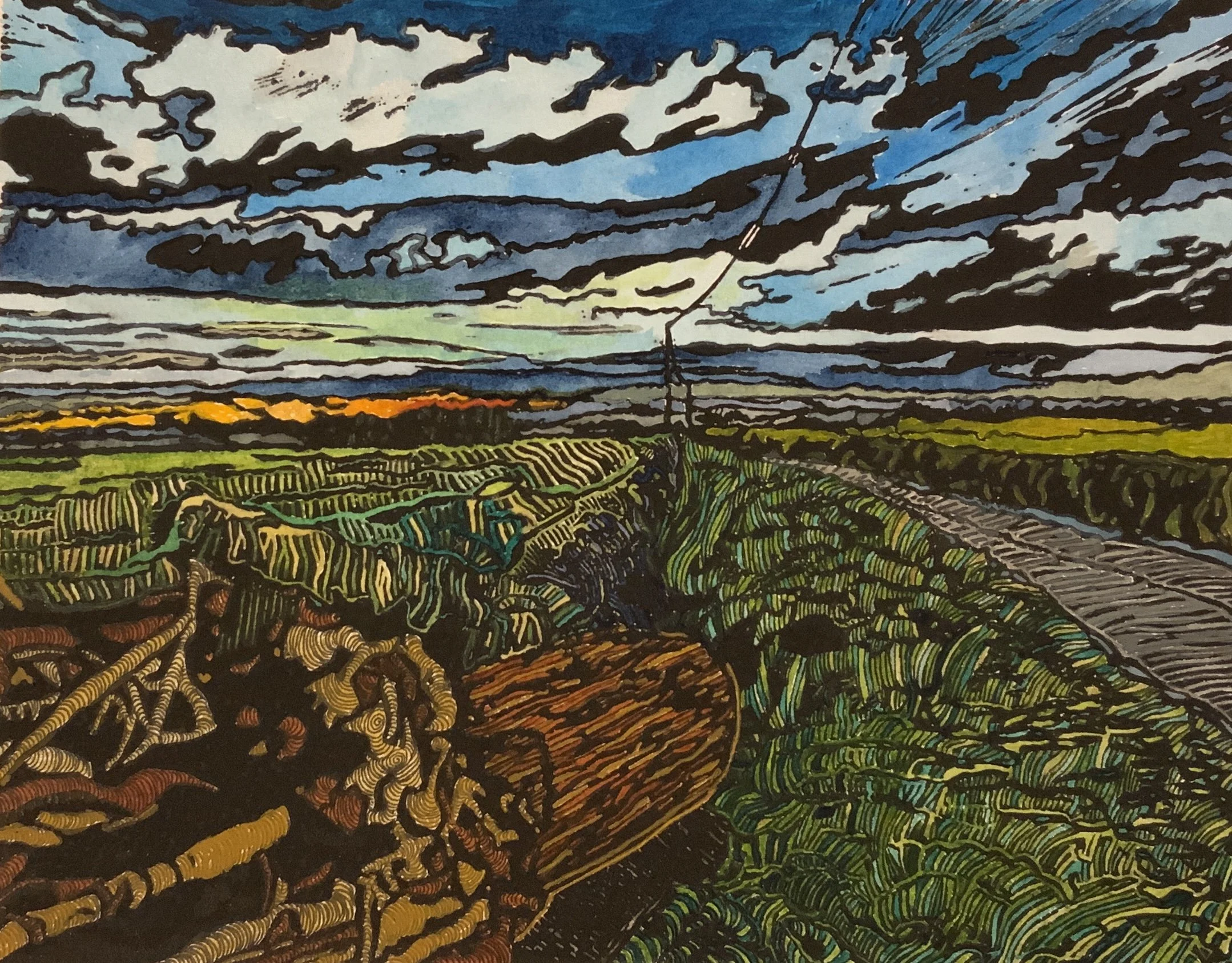
(I drew this in a sketchbook, then redrew it on a bit of lino, then carved it out and printed it on handmade paper, then went into the print with watercolour paint. -Chaiga T. Cheska)
~~~
….Continued from Part 1, previously posted.
“I’ve lost my left sock,” said the troll.
The silence that followed was so complete that a beetle could be heard changing its mind about crossing the path. The birds looked at the puddle. The scholars, behind the hawthorn, looked at one another. Of the several outcomes they had prepared for on the walk, this had not been among them.
“My favourite,” the troll went on, and his lower lip trembled. “The left one. I wore it all the time. And then one day it was just gone. I don’t know what’s happened to it. I came out here to sit and have a think about what I’ll do now, without it.” He sniffed, at a volume that shook the ivy in his ear. “I don’t think I’ve ever been so sad.”
Jeremy Rimpledon, who had knitted four hundred and eleven socks in his career and, by his own reckoning, had lost all the left ones, understood the matter at once. It is known to every knitter that a single sock is the loneliest object in the world. The fear left him in one long breath, and something older and kinder took its place.
“Oh dear,” said Jeremy. “Oh, that is hard.”
“It is,” said the troll. “It really is.”
“Do you know,” said Jeremy, “you’re sitting in a puddle? Isn’t it a bit wet?”
The troll looked down. It was clear from his face that this was the first he had heard of the puddle. “Am I?” he said, and regarded it with mild interest, like someone shown a photograph of a relative they had never met.
“The thing is,” said Jeremy, gathering himself, “if you would like to leave this wood, the scholars and I could help you find your left sock. Then you needn’t worry about it anymore.”
“Scholars?”
“Seven of them,” said Jeremy, with a vague nod towards the hawthorn, which trembled.
“Really? You could do that?” A look of enormous hope crossed the troll’s face, as slowly as a cloud drifting across a field. “Oh, that’s kind. Yes. Yes, please. I should like that very much.”
And he stood up.
He was, at a rough estimate, well over ten feet tall. Puddle water from the puddle fell off him in sheets and rolled across the clearing in a small muddy tide. It lifted a family of reeds. It went over Jeremy’s boots. The troll took a step towards the hedge, then another, and came through the undergrowth as a barge comes through bulrushes, the hazels bowing before him in ranks. Jeremy Rimpledon, standing directly in his path, made a noise like a kettle coming to the boil, ran in a straight line without once looking round, and arrived amongst his colleagues at a speed none of them would have credited to his legs.
Behind them, the birds went into the puddle with great, joyous splashing and flinging of feathers, and did not so much as glance up. Oh, excellent, the whole flock seemed to say; we have our wood back; and that, so far as they were concerned, was that. The scholars, who had put down their sandwiches for this, might have hoped for a bow.
The troll reached the hawthorn and squatted, bringing his face level with the tops of the bushes. Eight scholars were packed together like sardines in a tin. He rested his elbows on his knees and looked very much like someone about to say something reasonable, which was worse.
“Now,” said the troll in a low, pleasant, and alarmingly large voice. “Let me tell you what it looks like.”
“Do,” squeaked Dr Wimplebrush.
“It’s blue. Pale blue. The blue the sky goes when it’s had a long week.”
Eight notebooks appeared.
“Very fluffy. Soft as anything and lovely to wear, but it doesn’t go all the way up the ankle. Only part of the way. It stops about here.” He indicated a spot on his own foot, which, from where the scholars were crouched, was somewhere near the top of the hedge.
Nobody was calm. Every scholar in that hedge was shaking like a jelly on a train. But it turns out that a scholar’s terror can be poured into a pencil, and the notebooks were filled at a pace never before recorded in any Department. “Pale blue,” muttered Dr Marrow, writing. “Fluffy,” wrote Quaverley, underlining it twice. Professor Snisslewit wrote “is a sock a hat?” and drew a box around it. Mr Umberudle took down the whole account in shorthand, in three languages, and later admitted to having spelt “ankle” wrongly in all of them.
The troll, meanwhile, was not being menacing. He was simply large, and when large things lean over small things to be helpful, the effect is much the same. The rumble in his chest that the birds had taken for growling turned out, on closer acquaintance, to be sighing.
“Now,” said Dr Wimplebrush, who had recovered a little of his scholarly manner, “the question with which every investigation must begin. Where was it last seen?”
“On a church,” said the troll at once. “Right on top of it, the pointy bit. In the next valley, I saw it from the road. It was flapping. I think it was waving at me.”
“Then we had better go and look at it,” said Dr Wimplebrush.
The troll set off immediately, and his idea of a stroll proved somewhat quicker than the scholars’ idea of a sprint. Each of his strides covered the ground of six of theirs. They went after him in a tight, panting, notebook-clutching pack, through the wood and out the far side, along a hedge, across a field of extremely surprised cows, and over two stiles, one of which Dr Wimplebrush went under. By the ridge, they were as tired as scholars can be who have not had their tea.
Beyond the last stile, the land fell away, and below them, in the late-gold light, lay the village of Nether Wobbling: a scatter of thatch and chimney smoke, a stream, a bridge, a pub with a very ordinary sign, and, in the middle of it all, a church with a tall grey steeple. And on top of the steeple, something blue.
“There,” said the troll, pointing, and a small flock of sparrows left the neighbourhood. “You see it? That’s my sock.”
The scholars looked. What they saw, if they were honest (and scholars are honest to a fault), was a very large piece of pale blue cloth wrapped round the tip of the spire and snapping in the wind with the confident flap of something put out to dry.
“That,” said Dr Marrow carefully, “looks rather like a bed sheet.”
“It’s a sock.”
“It has hems.”
“It’s a sock.”
“It is blue, however,” said Quaverley, making the best of it.
“And pale,” said Dr Thinwhitter. “And in that wind, one might, I suppose, say fluffy.”
The troll folded his arms, which took a little while. “It is my sock,” he said, with an air of finality.
Dr Wimplebrush, who had spent his working life tracing the origins of a pickle, felt the old scholarly itch. “If I may,” he said. “Where did you first come by it? Its provenance, you understand.”
“Oh, out of somebody’s garden,” said the troll. “They’d got all their washing out on a long string between two poles, clothes and sheets and things. I was going by, minding my own business, when a bit of cloth blew off the string and hit me on the foot. On the left one. And I thought: well, that’s kind. That’s a present. The universe has sent me a present.” He beamed. “So I cherished it from that moment on.”
The scholars looked at one another. It was a brief look, yet it contained a whole conference. A bedsheet, blown off somebody’s line, had landed by pure accident on a troll’s foot. The universe, they agreed without speaking, had not so much given a present as dropped one. But it was a harmless story. Nobody had been robbed. A bedsheet had merely been on an outing. And the troll believed it with the whole of his large heart, and it would have been unkind to correct him, and nobody wanted to be the one to try.
“Then we shall get it down for you,” said Dr Wimplebrush.
They left the troll on the brow of the hill, knees drawn up, watching the steeple with the patience of a dog outside a butcher’s, and went down into Nether Wobbling by the sunken lane, eight scholars in a straggle, then knocked on the door of the Rectory, which stood beside the church behind a low wall and a bed of very orderly dahlias.
The Rector was a mild, grey-haired man in a cardigan the colour of porridge, and, by his own account, he had already had a peculiar day. A bedsheet had appeared on his steeple at breakfast. The choirmaster had said it was a sign. The verger had said it was a bedsheet. There had been a disagreement over who should go up and check, and it had ended, as such things do, with nobody going up and everybody looking.
Now, eight scholars stood on his doorstep, all talking at once, all pointing at the same thing, and all explaining, in eight slightly different ways, that the bedsheet on his steeple was in fact the left blue sock of a troll who was waiting on the hill and would very much like it back, please, and could he possibly get it down?
“A troll’s sock,” said the Rector, perplexed yet trying valiantly to understand.
“Left sock,” said Mr Umberudle.
“Blue sock,” said Dr Marrow.
“Fluffy sock,” said Quaverley.
“Up to about here,” said Professor Snisslewit, patting his own ankle.
The Rector looked at them for a long time. Then, with the air of someone setting down a heavy suitcase, he decided to accept whatever came his way. It is a valuable skill in a clergyman, and one not often taught.
“I see,” he said. “I’ll fetch the pole.”
The pole hung behind his front door, a long telescopic affair he used for the high candles, the hymn boards, and, in summer, wasps. He led the way to the church in a slow gaggle, and at the porch told the scholars that they were all to stay outside and watch, and that he would simply try to unhook it and see whether it blew away.
So they stood in the churchyard among the leaning gravestones, eight faces tipped skywards, as people look at fireworks.
Inside, the Rector went by the vestry and up the tower stair: a stone spiral no wider than a wardrobe, worn into shallow dips by four hundred years of feet, winding round and round in the dark, with a slit of window at every turn, where the outside flashed in like a blade of light. His breath grew short. His knees began to discuss the matter. At the top was a small oak door, low enough to make him stoop, and beyond it a narrow ledge at the foot of the steeple, and there was the wind, and the whole valley laid out like a map, and above his head the long grey steeple of the spire with the bedsheet upon it, cracking and billowing like a sail.
The pole ran out with a rasp: three feet, six, nine. The Rector was a practical man and knew that nothing is gained by hurrying at a height. He leaned on the parapet. He reached. The hook at the end caught a corner of the sheet; he drew, lifted, and the pale blue cloth slid over the tip of the spire. The wind, which had been waiting all afternoon for exactly this, took it.
It flew. It swooped out over the churchyard like a great, soft ghost, straight at the eight scholars below. They screamed in eight different keys, and scattered in eight different directions, over the gravestones, into a yew tree, and, in one case, a wheelbarrow. It passed a foot above the tallest scholar, and the wind, having had its fun, caught it again and tossed it up the valley.
The Rector watched from his ledge, the pole in his hand, with an expression of great peace.
It rode the air over the roofs, over the dahlias, over the sunken lane and the surprised cows, rising up the long green shoulder of the hill like a kite that has been let go, to where a large grey figure sat on the brow, his chin resting in one hand. The troll had watched the whole affair from above, and he did not hurry now. He put out his left foot with the quiet confidence of someone who has been given presents by the universe before.
The bedsheet dropped. It swirled once round his great grey ankle, settled, and fitted at very nearly the right height.
“My sock!” His shout carried across the valley like a bell. “My sock! Oh, thank you! Thank you!”
He wiggled his toes. The blue of it against the grey of him was, the scholars said afterwards, the loveliest sight they had ever seen, and they said it with the sincerity of people who were relieved. Down in the churchyard, eight of them were extricating themselves from a yew tree, a hedge and a wheelbarrow. They waved. The troll waved back with his foot.
All was well at last.
Postscript. The party returned to Dr Wimplebrush’s garden shortly after dusk and found the trestles bare: the seed cake gone, the pie gone, the cake in the shape of a jar gone, and along the fence a long row of small black birds wiping their beaks on the wood with an air of great innocence. Mr Jeremy Rimpledon, who had not eaten since breakfast, had faced a troll for the good of scholarship, and had not so much as glimpsed a gherkin all day, sat heavily on the lawn and said something for which the notebook of Professor Snisslewit declines to vouch. The Rector, when consulted, had nothing to add.
~~~
Troll’s Left Sock Ditty (written and curated by Chaiga T. Cheska)
(Sung as if from the perspective of the Rector’s wife, who heard the whole story later that evening and sang about it in the pub that week, a potential village hit for Nether Wobbling)
Author’s Note:
I came up with this story whilst in the midst of putting on my socks one morning, while also trying to remember to add “chutney” to my shopping list! It seemed the sort of story that involved MirMarnian scholars in pretty little villages, with sandwiches and socks! Absurd, but this is the sort of thing that goes on in my head most of the time!
-Chaiga T. Cheska