A Tune in Pickle Juice
Part One: The Song from the Wrong End
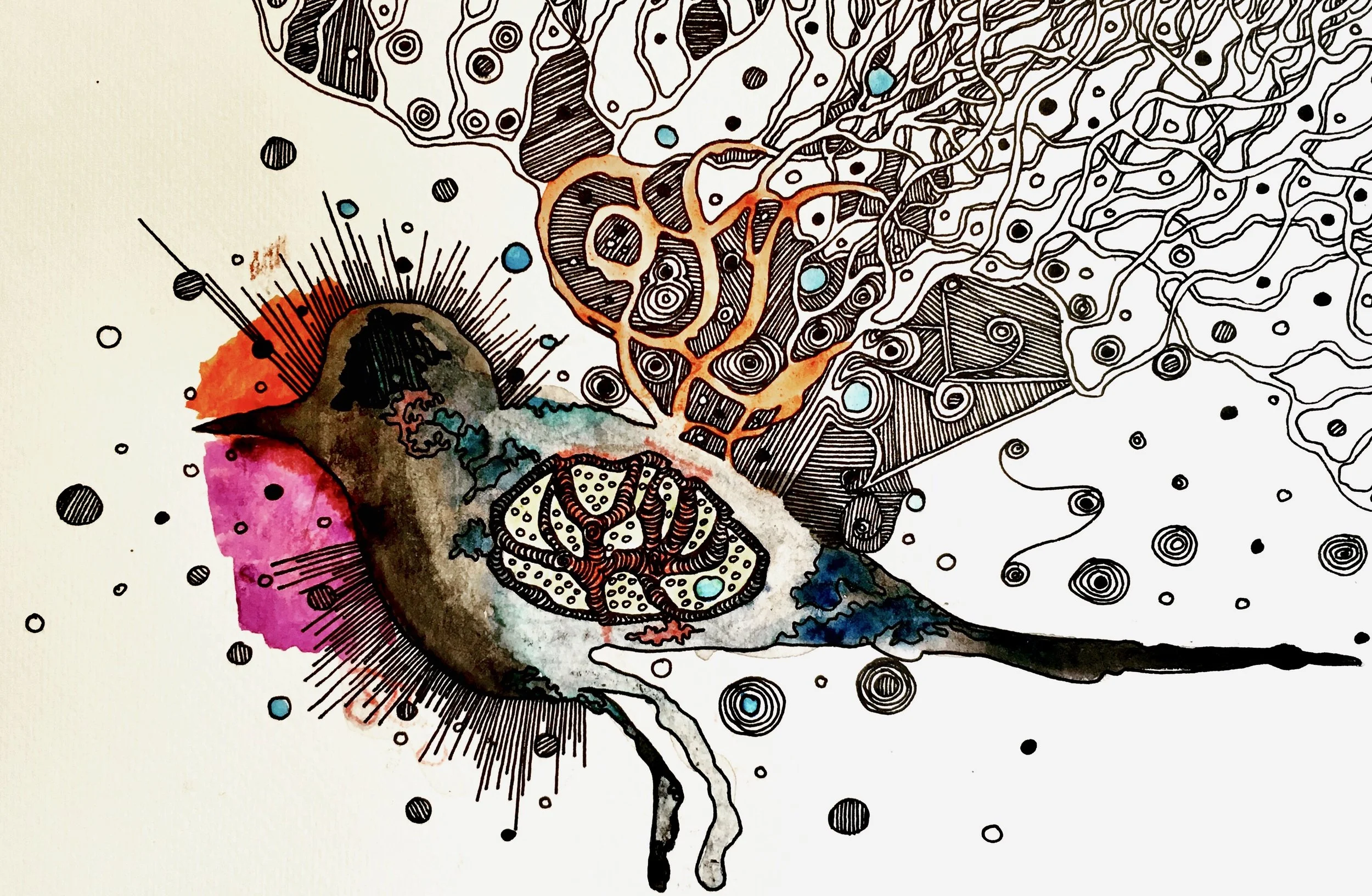
I drew this using an ink pen and coloured inks on paper. - Chaiga T. Cheska)
~~~
It was the last hot Saturday of the year, the kind that arrives late and is faintly embarrassed about it. Dr Joe Wimplebrush, Senior Scholar at the Department of Pickles, was having a birthday.
He had done what any sensible scholar does on such an occasion, namely invite every colleague to his garden and feed them. The garden ran downhill behind his house in a series of untidy terraces, beans on one, hollyhocks on the next, and at the bottom an apple tree so laden that its lowest branches rested on the lawn like elbows on a pub table. Trestles had been draped in linen. There was tea in an urn the size of a large pumpkin, a seed cake, a pie of uncertain intentions, and a second cake baked in the shape of a jar, which only a Department of Pickles could have found amusing.
Dr Wimplebrush himself sat a little apart in a wicker chair that creaked in two keys, holding the thing he had been looking forward to for months.
Cheese and chutney on bread cut thick enough to be load-bearing. The cheese was a farmhouse crumble the colour of old piano keys, and within the chutney juices, laid out in a careful mosaic, were the pickles: three slices of pickled walnut, black and glossy as beetle wings; a curl of sour-cherry gherkin; two rings of red onion, pink as the inside of a shell; and one nasturtium pod, brined to a sharp green that tasted, he always said, like a very small, very good argument.
It was a juicy sandwich. The pickle juice had begun to run down his wrist before he had finished admiring it, and he had tucked a napkin under his chin in case of a spill, a heavy linen napkin with WIMPLEBRUSH stitched in one corner, because his mother had marked all his belongings since the age of six and nobody had ever told her to stop.
He lifted the sandwich. He opened his mouth.
And then a bird landed in front of him and gave him a look.
It came down on the grass directly in front of his chair, close enough that he felt the rush of its wings like an announcement. It was not a blackbird. His colleague, Professor Snisslewit, wrote “blackbird?” in his notebook and later, in a different pencil, wrote “no.” It looked a bit like a blackbird, with a yellow beak, smart dark plumage, and the general air of having just remembered an appointment, but a blackbird has no business being that black. This was a black with depth, the black of the inside of a cupboard, and it did not hop as blackbirds hop. It walked. It walked the way something walks that has been sent on a purpose. A MirMarnian bird, blackbird-adjacent, was the phrase the notebooks eventually settled on.
Dr Wimplebrush lowered his sandwich. The bird regarded him. Then it turned round and presented him with its back, which struck him as ill-mannered until its feathers between its shoulders began to rise.
They lifted slowly, in a broad, flat fan, each one standing to attention like a page held up to the light, until the whole of the creature’s back had become a small shimmering panel, as though somebody had propped a painting on it. Colours moved across the panel, or perhaps the light moved through it: a green that was nearly a hill, a blue that was nearly weather. And then the panel began to sing.
The song came out of the feathers, which fluffed, trembled, and shook themselves out, so that each note arrived preceded by a soft rustle, like someone clearing their throat in a library.
It was a tune one felt certain one had known since childhood and had been unable to place since. It climbed three steps, thought better of it, went down two, then leapt a gap like a child over a stream and landed, wobbling, on a long, low note the colour of marmalade. Then it began again, a little differently, as if explaining.
Dr Wimplebrush suddenly felt compelled to transcribe the bird’s song into a musical score, so he immediately dipped two fingers into the soggy mess of his sandwich and began to draw on the napkin with chutney.
Chutney, it turns out, holds a line beautifully. It ran dark and glossy across the linen, pooling into note-heads where he pressed and dripping into stems where he lifted. He ruled five lines with his little finger and hung the tune from them, note by careful note, with the tip of his tongue between his teeth and chutney juice running down to his elbow. He added a tie at the third bar. He marked a rest with a gherkin seed.
Around them, the party, which had been chattering, fell quiet, one guest at a time, like a row of lamps being put out, until there was only the rustle, the tune, and the strange squashy sound of a finger on a napkin.
“I say,” said someone at last. “I didn’t know you could do that.”
“Nor did I,” said Dr Wimplebrush, not looking up.
“It’s terribly impressive,” said someone else, and a ripple of scholarly applause went round the lawn, the polite sort, delivered with plates in hand.
Dr Hobart Quaverley, Lecturer in Resonance and Adjacent Noises, had been sitting two chairs away, with a slice of seed cake balanced on one knee. He stuffed the entire slice into his mouth, chewed purposefully, crossed the lawn in four strides, lifted the napkin by its corners, and studied it with the frown of someone doing sums in a language they had only just learned. Then he put a hand into his coat pocket and took out something that did not appear to fit.
The Oodle Didgewi Bongo, as any MirMarnian schoolchild who has been made to learn it will tell you, is a hollow tube punched with holes at irregular intervals, which folds down in nine hinged sections to about the size of a sponge bag. Quaverley shook it out with a flick of his wrist, like a deckchair being opened by someone with a grudge. It stood a good head taller than he did, and it had no strings, which did not prevent it from being strummed. To wake it up, one must strike its base on the ground, whereupon it gives a low boom, like a wardrobe clearing its throat; and then one must run a thumb up the holes, whereupon something twanged in the air at about ear height, as though an invisible and slightly cross harpist had been asked to fill in. It was the ugliest and sweetest noise anybody present had ever heard, and Quaverley, who played it every Christmas to the distress of his neighbours, knew exactly what to do with it.
He laid the napkin against the teapot, read the chutney transcription, and played.
It was not quite the bird’s tune. It was the bird’s tune after it had been round the world and had come home with stories. It rolled across the lawn, boomed, twanged, and hummed, and at the bottom of the garden, in the great, heavy apple tree, something went very still.
Apple trees are not quiet in September. They tick with wasps and creak with fruit. This one had gone silent as a held breath, and it was then, and not before, that somebody noticed that a good third of its leaves were black, had been for some time, and had been watching.
The birds came down all together, from the apple tree, the hedge, the hazel, and the ridge of the shed, in a slow black pour, like ink from a jug, and settled across the lawn, the trestles, the back of the wicker chair, and the top of the jar-shaped cake. There were hundreds. They stood in ranks and looked at Quaverley, and Quaverley, who had been playing with his eyes shut, opened them, saw the audience, and carried on with the calm of a professional, though his knees had begun to knock together.
“How very intriguing,” said Dr Thinwhitter, quietly from behind a tea trolley.
The birds, it was later agreed, were delighted. They could not clap, so they fluffed, all together, the feathers on every back rising in one great soft ripple, until the whole lawn shimmered. The noise they made was a deep, contented rustle, like a hundred people turning the pages of a newspaper at once.
It was Dr Ottoline Marrow, Scholar of Odd Shaped Sandwiches, who put down her teacup.
“They aren’t just enjoying it,” she said slowly. “Look at them. They’re saying something. That’s a proper communication, that is. Somebody ought to translate.”
Eight scholars looked at one another. One of them looked at Mr Umberudle.
Mr Umberudle was a small, round, apologetic person with ears he had never grown into, and he had spent most of his career being asked to look at foreign signposts. He had a gift for unusual languages, and he had learned that the trouble with unusual languages is that they do not know they are unusual. He had so far been paying attention to the cake. He came forward now, put his head on one side, listened, and shook his head.
“It’s no good. It isn’t a language. It’s more like weather.”
“Try it through the Bongo,” said Quaverley, and struck it once on the lawn.
Boom. Twang. And something in Mr Umberudle’s face turned, as if a key found its lock.
“Oh,” he said. “Oh, good heavens.”
“What is it?”
“They need our help.” He had gone quite pale. “That one at the front is their dignitary. They sent him to speak to the pickle scholar, which is what they call you, Joe. It’s apparently a title of great respect.”
“Why me?” said Dr Wimplebrush, who had chutney on his elbow.
“I gather it’s the chutney. They consider anyone who takes that much trouble over a liquid to be a person of serious judgement. They’ve been trying to be heard for weeks, and nobody has listened. Now somebody has, and they’re so relieved they’re practically weeping.” He listened again. “There is a troll. In their wood, the one just over the hill. A large one. He has settled himself in the big puddle where they bathe and won’t move. Every time they go near, he glowers, rumbles, and looms at them, and they’re frightened. The word they use for him is difficult. It means disinterested, or possibly clueless. Something to do with not knowing where one’s own feet are.”
There was a pause, of the sort that follows news like that.
“Then we must organise a party,” said Dr Marrow, feeling inspired.
“We’re at one,” said somebody else, waving a sandwich.
“Not that sort. A proper one. The sort that goes out and does things.”
It was suggested that the proper authorities be summoned, the Wardens and the dignitaries of MirMarnia, who have people for this sort of thing. There followed a long silence, during which every scholar present thought of the last time they had tried to explain something to a non-scholar. Mr Umberudle had once spent a full afternoon explaining a gooseberry to the Parish Constable, and it had ended with his being asked, not unkindly, to leave the parish. Dr Wimplebrush had tried to describe a pickled walnut to a ferryman and had come away with the words “like a wet, sad conker?” still ringing in his ears. It would take at least a week to be understood, and the birds needed help today.
They looked at the birds. The birds looked back at them, with an insistence that sits oddly on anything weighing as much as a spoonful of sugar. One tugged at the hem of Dr Marrow’s skirt.
So they put down their sandwiches, which, for a Department of Pickles, was a considerable act of courage. Mr Jeremy Rimpledon, who had been handed a sandwich, lifted it and was about to bite when the bird set the whole spectacle in motion. Then eight scholars set out in the wake of the birds with Mr Rimpledon, bringing up the rear.
They went out by the gate at the bottom of the garden and up a sheep track, in a long, ragged, disorganised column, with the birds hopping ahead in leaps of ten feet or so and pausing, like a black ripple on a green sea, to let the scholars catch up. The hill was steeper than it had looked from the garden, which is the way with hills. Dr Wimplebrush stopped twice to empty his shoes. Nobody had a plan. All of them had hope, in the bright, unfounded way of people who have never been tested.
At the top, the ground fell away into a wood, Little Wick, a scrap of old oak and hazel, with sunlight streaming through it in long yellow planks. They crept the last of the way on their stomachs, or as near as their waistcoats allowed, and lay down behind a hawthorn hedge that had never been asked to hold eight scholars before.
In the middle of the wood lay a clearing, and in the clearing a puddle, and in the puddle a troll.
It was a very large puddle, a shallow silver sheet the size of a pond, holding the sky and the tops of the trees, fringed with willowherb. There were feathers in the reeds and tiny footprints along the mud in orderly queues, and it was plain this was where the birds were used to bathe. The troll sat in the exact middle. He was the grey-green of a wet wall, with moss along his shoulders and a small ivy plant growing peaceably from one ear, and he sat with his knees drawn up and his arms wrapped round them, the water lapping at his hips. The notebook of Dr Thinwhitter describes him as “roughly the height of a cottage, if the cottage were sitting down.” His face was very large and very blank, and it was hard to say whether he was thinking or merely occupying the space.
He did not appear to have noticed the birds, or the scholars, or the day, or the puddle.
“Is he dangerous?” whispered Dr Marrow.
“Too early to say,” whispered Mr Umberudle. “He hasn’t done anything yet.”
“He’s sitting in a puddle in a hostile manner.”
“He is sitting in a puddle in an absent-minded manner,” said Dr Wimplebrush. “It isn’t the same thing.”
They watched him for a long while. He blinked once. It took about a minute.
“Somebody,” said Quaverley at last, “will have to go and talk to him.”
There was a moment of silence.
“Somebody small,” said Professor Snisslewit. “Smaller is less alarming. It’s well established.”
“It is not well established,” said Mr Umberudle.
“It’s well established with small creatures.”
“That doesn’t follow.”
“Then it must be true of trolls.”
Seven heads turned slowly, like a congregation, towards the far end of the hawthorn, where Mr Jeremy Rimpledon was standing behind Dr Marrow, as he generally did whenever there was more than one possible outcome.
Jeremy Rimpledon stood just shy of five feet tall and rather less than that in every other direction. He was Scholar in Knitting, with a special interest in unusual materials, and had worked with hedgerow twine, dandelion floss, spider silk, and, on one occasion for reasons he had never been made to give, a continuous length of liquorice. He was pale and thin, with the general build of a coat hanger and eyes permanently set in an apologetic stare. He had very nearly not come to the party at all. He had very nearly stayed at home with a good cushion and a half-finished waistcoat, and now the sandwich was gone too.
“I came,” said Jeremy Rimpledon, “for a garden party.”
“It has turned into a different sort of party,” said Dr Marrow, and put a hand between his shorter colleague’s shoulder blades and pushed, with great kindness and a good deal of force.
Mr Rimpledon looked at the troll. He looked at his colleagues. Seven faces looked back, the expression of people who were extremely glad it was not them. And he was, whatever else, a scholar, and scholars, however small, do not leave one another in the lurch.
“Right,” said Jeremy Rimpledon, in a voice about a third of its usual volume. “Right.”
And he stepped out from behind the hawthorn.
The ground was soft, and the light was shifting. He took the long way round the puddle to keep out of the troll’s line of sight, a considerable undertaking, as it covered most of the wood. Halfway round, he saw the troll’s face in profile and stopped, because it was not doing what he had been braced for. It was not scowling or glowering. It was doing what faces do after a very long time spent with a bad thought. The lower lip was out. The eyebrows, each roughly the size of several hedgehogs, were tilted at an angle he knew from his own bathroom mirror on rainy Mondays. It was, though he would not have said so aloud, a rather sad face.
He crept closer. He cleared his throat, a sound like a matchbox being opened in a cathedral.
“Excuse me,” called Jeremy Rimpledon. “Are you all right?”
Nobody had asked the troll that for some time. The words took time to reach him, as news does when it has a long way to go. The great head turned, slowly, then the shoulders, and then, with a sound like a barn door on a dry hinge, the rest of him, which took a good deal longer, there being so much of him to bring round.
He looked down at the small, pale person on the bank, with a knitting needle tucked behind one ear. Jeremy Rimpledon looked up, and up, and then a good way further up than that. They regarded one another across the water in a silence the size of the wood. Along the branches, three hundred birds forgot to breathe. Behind the hawthorn, seven scholars clutched one another’s elbows.
The troll’s mouth opened.
“Oh,” said the troll, in a voice like a barrel being rolled slowly down cellar steps, and it was not at all a threatening voice. It was thick with something a keen observer might have called relief. “Oh, you noticed. You actually noticed. I don’t suppose you’ll believe what’s happened to me.”
…….Stay tuned for Part 2 next week to learn what happens next!