A Preliminary Inquiry into the Gustatory Induction of Dream States
Notes from the Hearthwise Institute
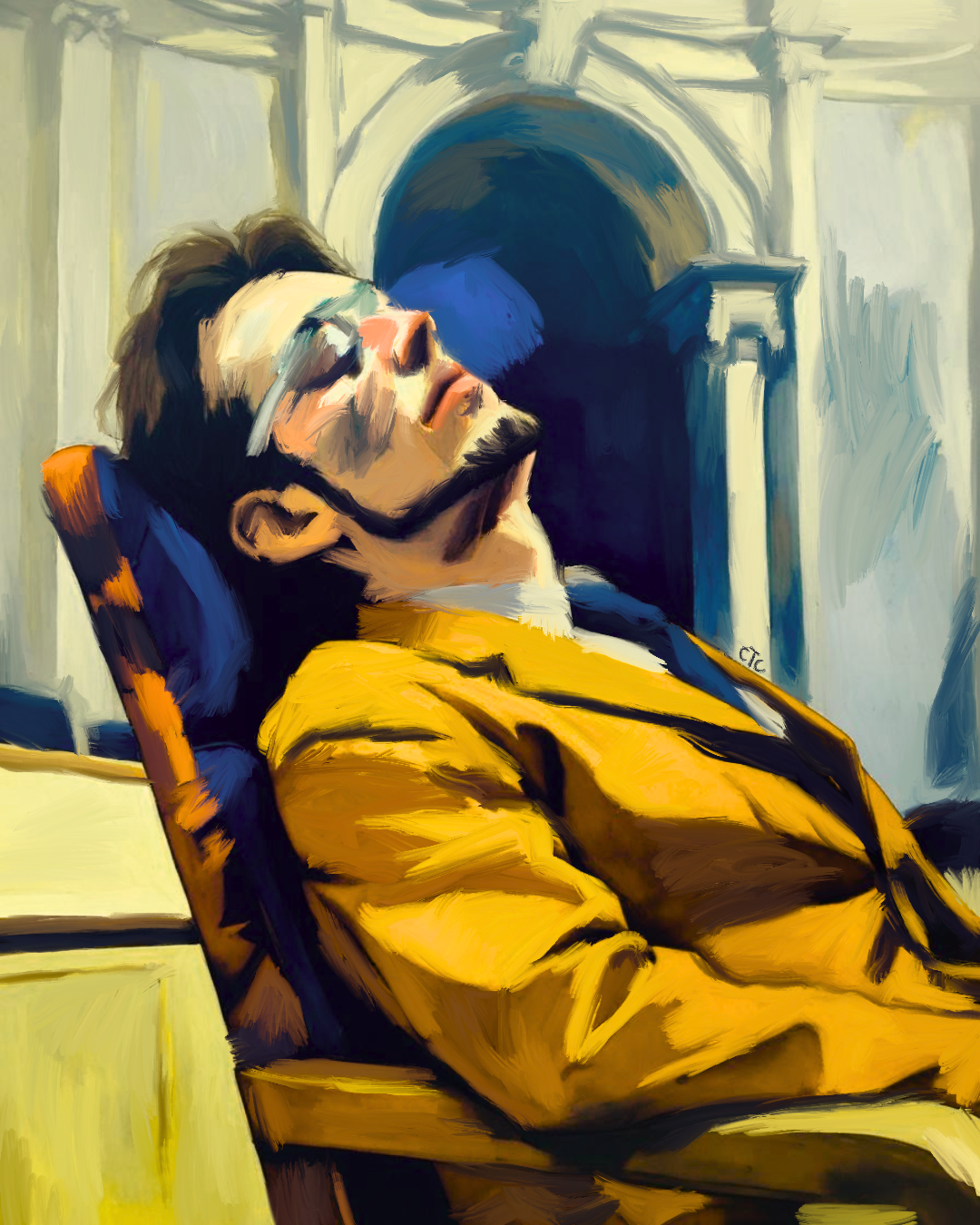
(I painted this in Procreate using the oil paint brush that was from a previous sketch and got a bit slap happy with abstract expressionist tendencies. - Chaiga T. Cheska)
~~~
(I wrote the poem for this song based on the comedic poems my grandfather used to recite to me when I was about 14 years old, including one in particular about an unfortunate bricklayer and a pulley system that went wrong, written by Pat Cooksey. I also took inspiration from old music-hall songs such as “Boiled Beef and Carrots”, composed and written by Charles Collins and Fred Murray and sung by Harry Champion. I used Suno to put it all together, though I’m not completely sure it’s what I was going for. It’s close enough. Suffice it to say, I’m very respectful of other artists’ copyright and only draw inspiration in this age of AI. I find it fascinating that I’m at last putting my minor musical education to use! Thank you to my partner, Robert, for letting me record his accent for this song. - Chaiga T. Cheska)
~~~
By Orla Briscarrow, F.H.I.
Senior Culinary Somniologist
Hearthwise Institute for Subconscious Nourishment
Abstract
This paper presents the findings of my most recent inquiry into the relationship between flavour and subconscious activity. Over eight consecutive sessions, I served a series of dream-inducing dishes to volunteer participants drawn from across the Hearthwise Institute. Their responses, though initially puzzling, offer considerable evidence that my recipes exert a profound influence upon the dreaming mind. Several participants entered states of such depth that they were unable to respond to verbal prompts, physical stimuli, or, in one case, the collapse of a nearby lectern. I have recorded all relevant observations with the utmost precision. The subconscious, I am pleased to report, is performing excellently.
~
Introduction
It has long been my contention that food shapes the subconscious. Whilst colleagues have dismissed this position as “culinary speculation” or, on three separate occasions, “a hazard to public safety,” I remain firmly convinced that flavour is the most direct and elegant route to the dreaming self. My earlier work, “The Palate of the Sleeping Mind”, is currently held in the Restricted Vault, which I take as a measure of its potency rather than any cause for concern.
This present study sought to observe the immediate effects of three new recipes upon the subconscious mind: Memory Stew, Courage Biscuits, and The Soup of Unfinished Thoughts. All dishes were prepared and served in the Great Lecture Hall, chosen for its acoustics, which I believed would allow for the detection of subtle dream utterances from across the room. This belief proved correct, though not in the precise manner I had anticipated.
Volunteer turnout was, I am gratified to record, exceptionally high. Scholars arrived in considerable numbers, and I take this as a mark of genuine scholarly enthusiasm for my work.
~
Methodology
Participants were invited to consume a modest portion of the test dish, after which I monitored their behaviour at close range for signs of dream induction. All observations were recorded with the utmost care, even when the behaviour in question resisted immediate interpretation. What follows presents my findings in chronological order.
~
Session One: Memory Stew
Within minutes of consumption, Participant 3 entered what I can only describe as a state of profound internal reflection. His head lowered slowly until it made gentle contact with the desk, where it remained for the duration. His breathing deepened into a rhythmic pattern that suggested sustained engagement with the subconscious. A faint snore emerged at intervals, which I interpret as the mind attempting to vocalise a memory too complex for waking language to contain.
Participant 7 demonstrated what appeared to be a rapid retrieval of past experience. She muttered, “Not the teapot again,” before slumping sideways in her chair with considerable finality. This appears to indicate a vivid recollection of some domestic incident, the nature of which I was unable to ascertain as she declined to elaborate upon waking.
Participant 11 fell asleep so abruptly that his spoon remained suspended for a moment before dropping into the stew with a soft plop. I have noted this as evidence of sudden mnemonic overload. The stew was undamaged.
Session Two: Courage Biscuits
The biscuits produced immediate and dramatic results.
Participant 4 sat bolt upright, declared, “I shall confront the moon,” and then promptly fell asleep again. This suggests a surge of subconscious bravery followed by a retreat into deeper analytical dreaming. The moon was not confronted, though I note this may occur at a later date once the participant has processed the experience fully.
Participant 9 attempted to stand, drifted gently sideways, and came to rest against a bookcase, where he snored with a curious whistling quality I believe indicates the subconscious bracing for heroic action.
Participant 2 sleepwalked directly into a wastepaper bin, which he then apologised to. This may represent the subconscious confronting its anxieties in symbolic form. I recorded it as a promising development.
Session Three: The Soup of Unfinished Thoughts
This session produced the most intriguing results of the three.
Participant 5 began producing half-formed sentences, each trailing away into silence. “I was thinking that perhaps the…” followed by a soft snore. “If only we could consider the possibility of…” followed by a sigh. The soup, it appears, induced precisely the cognitive state its name describes.
Participant 8 laughed in his sleep at irregular intervals, each unconnected to any external stimulus. I have tentatively labelled this phenomenon “dream chuckling” and consider it worthy of further study.
Participant 12 rose from her seat, walked purposefully towards the front of the hall, turned left, and walked directly into the wall, where she remained upright, asleep, leaning at a slight angle. This appears to be the subconscious attempting to locate a thought that had not yet fully formed. The wall, to its credit, offered no resistance.
General Observations Across All Sessions
Several patterns emerged across the eight sessions that warrant consideration.
On Snoring. The volume and variety of snores produced during these sessions were remarkable. Some were deep and resonant; others light and fluttering, almost conversational in quality. I believe these represent differing depths of dream engagement rather than any incidental physiological phenomenon.
On Drooling. A small but consistent number of participants produced drool. This may indicate the subconscious releasing excess cognitive material it has deemed non-essential during the dream process.
On Sudden Sleep Sitting. Many participants fell asleep mid-movement, often in positions that defy any ergonomic logic. This suggests that the dishes induce a dream state of sufficient speed and authority to override the body’s usual objections.
On Collective Collapse. On two occasions, the entire room fell asleep within nine minutes of the first serving. I interpret this as evidence of synchronised subconscious alignment, a phenomenon I have not previously observed and which I regard as among the more significant findings of this study.
On Sleep Talking. Utterances recorded across all sessions included: “Bring me the catalogue of spoons,” “Tell the librarian I refuse,” and “Not the ladle.” These fragments offer tantalising glimpses into the dream mind’s priorities. The ladle was referenced on four separate occasions by three separate participants, which I consider statistically noteworthy.
Supplementary Observations: Subconscious Verbal Exchanges Between Participants
During several sessions, I observed what appears to be a form of subconscious dialogue occurring between sleeping participants. Although all individuals present were fully unconscious at the time, they nonetheless produced utterances bearing the structure of conversation, complete with pauses, expressions of consideration, and in several cases, what appeared to be thoughtful nods. The following excerpts are transcribed verbatim.
Exchange One: Participants 6 and 10.
Participant 6 murmured, “Bring me the smaller ladder.”
Participant 10 frowned, considered this for several seconds, and replied, “Only if the custard agrees.”
Participant 6 nodded solemnly, as though this were a reasonable condition.
Participant 10 then added, “It has opinions now.”
Both participants sighed in unison and resumed snoring. I interpret this as evidence that the subconscious may negotiate with symbolic constructs, possibly dairy-based.
Exchange Two: Participants 2, 14, and an Unexpected Interjection.
Participant 14 whispered, “The spoons are marching again.”
Participant 2 responded with a startled expression and said, “Tell them to file a request first.”
At this point, Participant 8, who had been asleep with his mouth open and was not previously part of the exchange, suddenly laughed and said, “They never do.”
He then returned to silent unconsciousness. This suggests a shared dream environment in which cutlery displays insubordinate behaviour. I note that unsupervised cutlery has not previously appeared in the literature, and I intend to pursue this line of enquiry in the next study.
Exchange Three: Participants 1 and 12.
Participant 1 muttered, “I cannot possibly attend another meeting.”
Participant 12, still asleep and leaning against the wall, replied, “Then send the goose.”
Participant 1 appeared to consider this carefully. His brow furrowed. He whispered, “It is not trained.”
Participant 12 smiled faintly and said, “None of us are.”
This exchange may indicate subconscious anxieties regarding professional obligations, possibly involving waterfowl. Further study is required.
Exchange Four: Participants 5 and 7.
Participant 5 said, “Where did you put the catalogue of clouds?”
Participant 7, without opening her eyes, replied, “Under the chair with the sausages.”
Participant 5 nodded, then added, “It will complain.”
Participant 7 sighed and said, “Twelve.”
Both participants then shifted into identical sleeping positions, which I believe indicates the onset of a synchronised dream state.
Exchange Five: A Group Phenomenon.
At one point, four participants engaged in what appeared to be a circular discussion:
Participant 3: “Not the ladle.”
Participant 9: “Sausages.”
Participant 11: “We agreed never to speak of that.”
Participant 3, after a long pause: “Not the ladle.”
This loop continued for several minutes. I believe this represents the subconscious attempting to resolve a shared symbolic trauma involving kitchen implements.
Discussion
Whilst some colleagues have suggested that the participants were merely tired, I find this explanation insufficient. Scholars are, as a rule, always tired; yet they do not typically fall asleep en masse, nor do they sleepwalk into furniture with such uniformity and evident purpose. The consistency of the observed responses across eight sessions strongly supports my hypothesis that flavour can induce specific and reproducible dream states.
The fact that participants frequently fell asleep before I was able to put any questions to them, I take as confirmation of the dishes’ potency rather than an obstacle to the study. A less effective recipe would have left them awake long enough to answer.
Conclusion
This study demonstrates the following:
My recipes are highly effective in inducing dream states across a broad range of participants. The subconscious responds vigorously and consistently to culinary stimuli when those stimuli are correctly formulated. The shared dream environments evidenced by the verbal exchanges suggest possibilities for communal subconscious experience that have not previously been studied. Further research is essential, and a larger lecture hall may be necessary to accommodate the volume of volunteers.
I shall continue my work with full confidence in the Institute’s support.
Observer’s Note
Appended by the Department of Practical Oversight.
Scholar Briscarrow has not been informed of its inclusion, as previous attempts to provide feedback resulted in him offering us samples of Courage Biscuits.
I am Dr Fenwick Alderbrace, assigned to observe these sessions on behalf of the Department of Practical Oversight. Having attended all eight, I feel compelled to provide a corrective account.
The participants were asleep. Completely, unequivocally, and in several cases spectacularly asleep. One senior archivist snored with sufficient force to slide a stack of parchment off the lectern. Another participant slept with his eyes half open, which was unsettling for all present. A botanist occupied a wastepaper bin upright for eleven minutes and showed no sign of distress or any awareness of his situation. A junior researcher curled beneath a desk and declined to emerge until offered biscuits, at which point she re-emerged briskly, ate the biscuits, and went back under. A senior professor maintained throughout that he was “merely resting his eyes,” despite the audible evidence.
The so-called subconscious dialogues were sleep-talking. The conversations’ apparent coherence is easily explained by the fact that exhausted scholars will respond to any noise resembling speech. At one point, Participant 10 replied to a sneeze with, “Yes, but only on Thursdays,” which Scholar Briscarrow recorded without hesitation as evidence of dream negotiation.
It is my professional view that the high volunteer turnout was not the result of scholarly enthusiasm. Several participants arrived carrying blankets. One brought a pillow. One arrived already asleep and was guided to a seat by a colleague. The Great Lecture Hall is the only room in the Institute warm enough to be comfortable and quiet enough to be genuinely restful during working hours. Scholar Briscarrow has, without realising it, created the Institute’s most popular sanctioned nap.
The Department recommends that future sessions be conducted with more ventilation, fewer carbohydrates, and a strict prohibition on horizontal participants.
Signed,
Dr Fenwick Alderbrace
Department of Practical Oversight,
Hearthwise Institute
Unofficial Addendum by Scholar Orla Briscarrow
(Found in the margin of the retrieved document. The handwriting suggests considerable agitation.)
I did not approve the so-called Observer’s Note appended to my paper and discovered it only by accident whilst checking whether I had signed the thing. I had not, though that is hardly the point.
Dr Alderbrace’s claim that my participants were “unequivocally asleep” is a gross oversimplification. Scholars do not simply fall asleep in the middle of a groundbreaking culinary somniological study. They enter states of heightened subconscious receptivity. That these states resemble sleep on the surface is a superficial coincidence which I would expect a member of the Department of Practical Oversight to recognise and account for. Evidently not.
The suggestion that their behaviour was “unprofessional” is both insulting and inaccurate. The botanist who occupied the wastepaper bin was navigating a symbolic dream terrain. The junior researcher beneath the desk was exploring the psychological implications of enclosed spaces. The professor resting his eyes was resting nothing of the sort. To reduce these phenomena to mere napping is to display a profound lack of imagination.
As for the subconscious dialogues, the exchange concerning the marching spoons was a rare glimpse into the collective dream mind. The repeated references to the ladle indicate a shared symbolic trauma which, if properly studied, could revolutionise our understanding of communal dream formation. The sausages, I admit, I cannot yet fully account for, but I am confident they are significant.
I reject the recommendation regarding carbohydrates. The subconscious thrives on starch. Anyone with a passing familiarity with dream nutrition would know this.
I demand that the Observer’s Note be removed from all official copies of my paper and request that Dr Alderbrace be reassigned to a department more suited to his temperament, such as Filing or Door Maintenance.
Signed in considerable irritation,
Orla Briscarrow, F.H.I.
Dream Chef and Senior Culinary Somniologist
Hearthwise Institute
Hearthwise Institute: Minutes of the Disciplinary and Procedural Review Committee
Concerning Scholar Orla Briscarrow and His Recent Culinary Somniological Activities
Date: Third Day of the Month of Quiet Breezes
Location: Committee Room Two (the one with the unreliable window latch)
Chair: Dame Hestrel Broadbottom, Senior Administrator
Recorder: T. Pindle, Junior Clerk (acting under protest)
Dame Broadbottom called the meeting to order and noted that the purpose of the session was to address the escalating situation surrounding Scholar Briscarrow’s dream-inducing recipes, the mass unconsciousness of staff during working hours, and the unauthorised addition of marginalia to Institute documentation.
Dr Alderbrace summarised his observations with visible weariness. He reported: widespread and prolonged sleeping in the Great Lecture Hall; scholars arriving with blankets, pillows, and in one case a collapsible camp bed; a botanist requiring extraction from a wastepaper bin; a historian who attempted to deliver a lecture whilst unconscious; and the alarming carbohydrate content of the recipes. He paused at this point to rub his temples. He muttered something about the ladle that the clerk did not fully catch and has recorded as “inaudible, though heartfelt.”
Scholar Briscarrow was then invited to speak. He rose with great dignity, adjusted his robes, and declared: “The subconscious is a delicate soufflé, and I alone have the whisk.”
This was met with silence, broken only by the sound of someone in the back row stifling something.
He continued at some length, maintaining that the participants were not asleep but “dweam-attuned,” that the wastepaper bin incident was “symbolic exploawation,” that the snoring was “subconscious wesonance,” and that Dr Alderbrace’s appended note constituted “a personal attack by someone who feaws innovation.” He concluded by stating that “cawbohydwates” were “the foundation of all meaningful dweamwork“ and that the committee would do well to “wesearch the mattew before forming opinions”.
The committee deliberated. Professor Lintwhistle observed that whilst Scholar Briscarrow’s work was innovative, it had also resulted in three missed grant deadlines, two corridor collisions caused by sleepwalking scholars, and one archivist who had not fully woken up for twenty-eight hours. Master Quillford noted that the Institute could not continue to lose productive hours to spontaneous staff napping. Dame Broadbottom stated that whilst Orla’s enthusiasm was admirable, his relationship with observable reality was, and she chose her words with care, “inconsistent.”
After a brief discussion and one vote cast by a committee member who was visibly asleep, the following resolution was reached.
Scholar Orla Briscarrow is to be assigned a research assistant. This assistant will monitor all future experiments, prevent participants from injuring themselves or the furniture, ensure that no further unauthorised napping occurs during sessions, intervene should Orla attempt to distribute experimental carbohydrates without prior committee approval, and provide accurate reports to the Department of Practical Oversight.
Dr Fenwick Alderbrace is hereby appointed as Scholar Briscarrow’s official research assistant.
Dr Alderbrace responded with a noise the minutes describe only as “a strangled sound of some kind.”
Scholar Briscarrow declared this “a twiumph for interdisciplinawy collaboawation.”
Dame Broadbottom adjourned the meeting, noting that she required a lie down.
T. Pindle, Junior Clerk, appended the following personal note: “I am applying for transfer to the Department of Quiet Shelving.”