A Preliminary Field Account of the Calanvael of the Middle Emaris
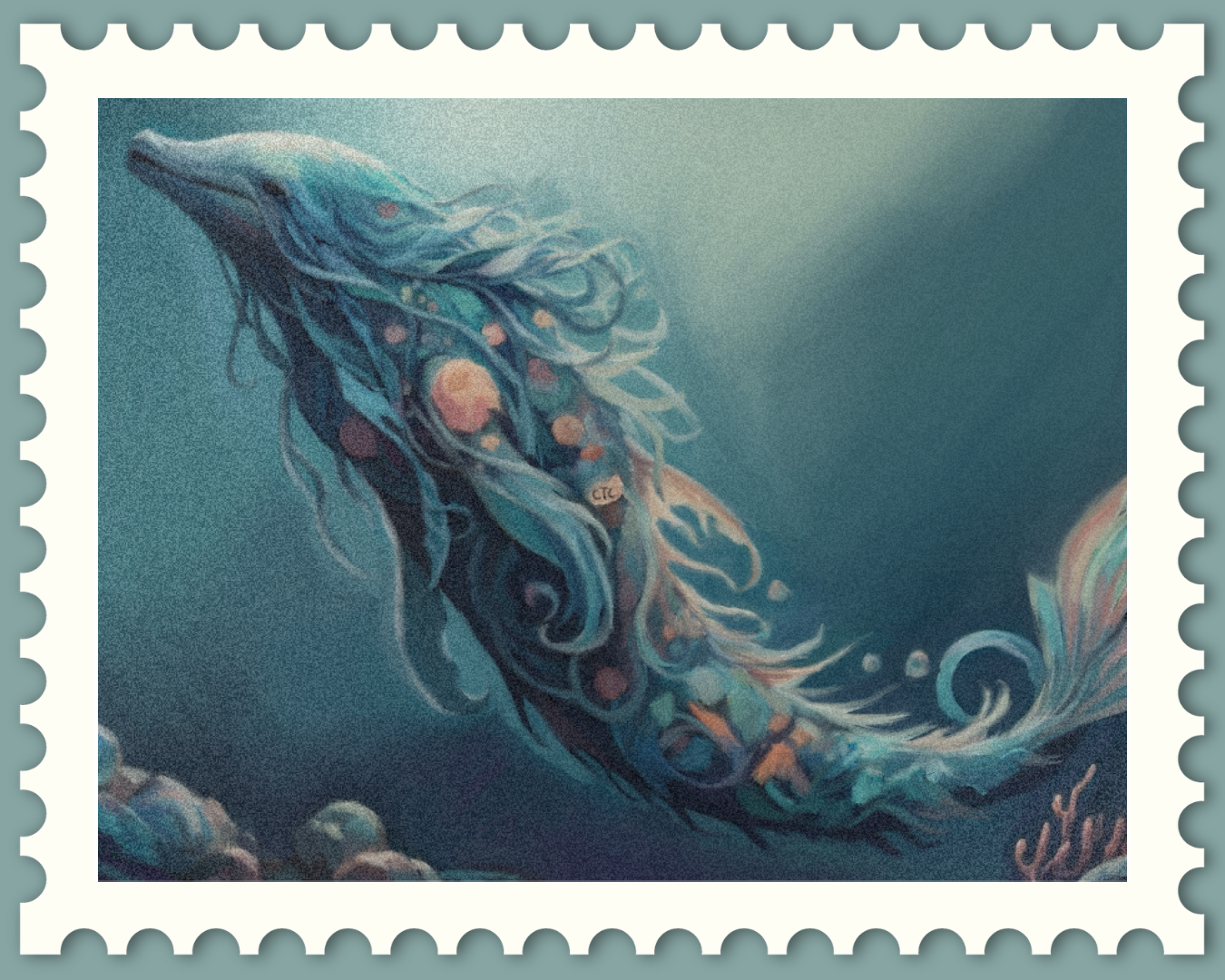
(This image was painted via Procreate on my iPad using the oil paint brush and the pencil and then edited with a filter on Canva. - Chaiga T. Cheska)
———————————————————————————————————
The Calanvael
They say there are bells where the Calanvael swims,
In the warm where the deep water slows,
Where the current runs amber and copper-rose
And the river keeps all that she knows.
You will hear them before you see anything,
Rising soft through the hull of the boat,
A sound without source, like a memory
Of somewhere you once understood.
And then, if the river is willing,
And the light is the colour of brass,
You may see what runs warm in the middle depths,
Like a flame seen through water and glass.
Rose-gold where the afternoon catches it,
Teal where the cold waters stare,
The eye like a well in a winter field,
Patient, and old, and aware.
It will stay for as long as it chooses,
Which is longer than most have the nerve,
Then slip back below where the warm current goes,
Then gone where the deep river curves.
And the bells will grow faint through the planking,
And the river run on as before,
But the light on the water looks different, somehow,
Than it looked when you first set out from shore.
A Preliminary Field Account of the Calanvael of the Middle Emaris
Being an inquiry into the habits, characteristics, and general disposition of a creature that, frankly, could show a little more consideration for the scholar attempting to study it.
By Aldous Fenn, Senior Fellow of Aquatic and River Fauna at the Emaris Institute of Natural Peculiarities, Mirhaven Branch Keeper of the Register of Warm-Current Inhabitants Author of Drakes, Drifters and Difficult Creatures: A Field Study of the Emaris and Her Inhabitants (Volumes I through IV, with Volume V currently delayed owing to an incident that the Institute has asked me not to describe in print)
Prefatory Note
I should begin, as I always begin, with a confession of limitations.
I have studied the river fauna of the Emaris for thirty-one years. I have catalogued fourteen species of river drake, observed the nesting behaviour of three varieties of deep-water serpent, and spent a memorable and deeply regrettable fortnight attempting to interview a Shellback who had absolutely no interest in being interviewed. In all this time, no creature has proven quite so difficult to document, quite so impervious to my methodologies, and quite so indifferent to my professional reputation, as the Calanvael.
I offer the following account not as a definitive study but as a beginning. A scholar of more advanced years and fewer remaining teeth than myself may one day complete what I have started. I wish them well. I recommend, in the strongest possible terms, that they bring a boat with a very solid hull and an extremely good ear.
On the Creature Itself: Appearance and Physical Character
The Calanvael is, at first and indeed at second glance, an animal of extraordinary beauty. It is large, comparable in length and shape to the river dolphins reported in the waters south of the Saltwater Marshes, though it is wider through the body, more massively built about the torso, and moves through the water with a liquid deliberateness that those other creatures, however graceful, do not quite match. It is not a hurrying animal. Nothing about it suggests that it has ever been in a hurry about anything, which is either admirable or profoundly irritating, depending on how long one has been sitting in a boat waiting for it to resurface.
The colouring is the first thing any observer remarks upon, and with good reason. The Calanvael runs teal through the upper body, a deep, cold blue green of the kind one sees only in the very deepest stretches of the Emaris, where the cold currents run beneath the warm. Along the flanks, this shifts: rose-gold in the afternoon light, when the creature is near the surface and the warmth of the upper water catches the iridescent layer of its skin. The spots, which cluster across the midsection in loose, organic groupings, range from burnt sienna through amber to a soft coral pink. They do not appear to serve any territorial or communicative purpose that I have been able to identify. They are simply beautiful, in the same way that the arrangement of stars is beautiful, which is to say entirely without concern for whether anyone is watching.
The tail is a remarkable structure, feathered rather than finned in the conventional sense, its trailing edges resembling the fronds of something botanical, curling at the tips in loose spirals. The effect, particularly when the creature is stationary in the current, is that it appears to be growing rather than swimming. Several of my students, encountering the Calanvael for the first time, have described it as something between an animal and a living flower. I do not entirely disagree, though I would not use the word “flower” in a formal paper without the Institute’s blessing, which they would withhold purely to make my life difficult.
The eye, on those occasions when I have been close enough to observe it, is extraordinary. It is large, set into the skull at an angle that allows for a wide field of vision, and its colour is a deep, still amber, somewhere between dark honey and the last light before a November dusk. There is no quality of vacancy in it. I have met senior archivists with less going on behind their eyes than a Calanvael regarding one from six feet of clear river water. It gives one a feeling, not entirely comfortable but not precisely unpleasant either, of being assessed by something that has been making assessments considerably longer than oneself.
I have, on two occasions, held its gaze for longer than was probably advisable. On both occasions I was also made suddenly and uncomfortably aware of my own nose, which is, I confess, a personal affliction of mine: a tendency, in moments of self-consciousness, to become acutely conscious of the fact of my nose existing on my face, a perfectly ordinary piece of anatomy that one ought not to think about at all, and yet there it is, once noticed, occupying the whole centre of one’s field of vision and one’s thoughts simultaneously. The Calanvael, I believe, knows about this. I cannot prove it. I simply believe it.
On the Bells
The sound for which the Calanvael is most widely known, and which every river trader on the middle Emaris has some version of a story about, is the bell-note. It travels through the hull of a boat rather than through the air, which is why it is so frequently described as seeming to come from everywhere and nowhere simultaneously. The vibration enters through the wood, rises through the soles of the feet and the palms of the hands if one happens to be touching the planking, and is perceived not quite as sound but as something adjacent to it, something one hears in the body rather than in the ear.
The frequency is low, patient, and remarkably complex for an animal sound. I have made extensive recordings of it using the resonance-paper methods developed by the Institute’s former Director of Acoustic Studies, the late and extremely meticulous Dr. Celwyn Tare, and the patterns suggest a structure that is not random. Whether this constitutes language in any sense meaningful to scholars remains a matter of lively debate in the Institute’s common room, usually around the third hour of an evening when the argument has run out of substance and started running on stubbornness instead.
What I can say with confidence is that the bells precede the creature’s appearance by some minutes. The interval varies. This has made systematic observation extremely frustrating, as the standard approach of preparedness, notebook open, charcoal sharpened, is liable to leave one sitting alert and expectant for so long that when the creature finally surfaces, one’s hand has cramped and the charcoal has rolled into the bilge. I have ruined three perfectly good notebooks to river water in this manner. One of them contained five years of field notes. I do not care to dwell on that particular afternoon.
A note of caution: do not use a small brush to attempt to transcribe the resonance patterns in real time, as one of my more enterprising graduate students once proposed. Small brushes and I have a history best described as adversarial. They are always too fine for the purpose, always inclined to catch and splay at the critical moment, and something about the particular combination of a small brush, a moving boat, and a creature one cannot see, fills me with a dread I can neither adequately explain nor fully suppress. The student in question produced seventeen seconds of perfectly good notation before the Calanvael dove and did not return.
On Behaviour and Disposition
The Calanvael is not a sociable creature in the manner of river dolphins, which travel in groups and appear, on the whole, to find the presence of boats rather exciting. The Calanvael is solitary, or at the very least it is encountered singly, and it approaches boats on its own terms and its own schedule, which cannot be predicted, hurried, or petitioned.
It will stay as long as it chooses. This is the detail that river traders, rivermen, and visiting scholars all remark upon, each with slightly different feelings about it. The traders find it reassuring, as a Calanvael sighting is considered by most communities along the Emaris to be a sign of good passage and clean water. The rivermen find it curious, in the quietly attentive way that people who spend long hours on the water tend to regard the extraordinary. Visiting scholars, by which I mean myself, find it maddening, because one never knows whether the creature is about to surface into full view or dive and leave behind nothing but a faint oscillation in the floorboards and a great deal of professional disappointment.
When it goes, it goes without ceremony. There is no signal, no warning, no courteous indication that the audience is ending. One moment it is there, drifting in the current alongside the hull, and then it has curved away below the surface with a motion so unhurried that it seems impossible it has gone at all. The bells fade through the planking over several minutes. The water closes. The river continues.
It is, I have noted on numerous occasions, a very strange thing to watch the light on the water after a Calanvael has departed. Something has changed, and one cannot say precisely what, only that the surface looks different to how it looked before the creature came. Cleaner, perhaps. More aware of itself.
I have included this observation in three separate field reports. The Institute has removed it from all three on the grounds that it is insufficiently scientific. I have reinstated it each time. We have reached an understanding of sorts.
A Final Note on Methodology
I am often asked by students what qualities a scholar requires to study the Calanvael effectively. I tell them the same thing each year: patience, a good waterproof coat, and a willingness to sit with uncertainty for longer than is comfortable.
I do not mention the pebbles in shallow water.
It is a small thing, and a private one, but as Bramwell Corin of the archives was once wise enough to observe, it is the small peculiarities of the observer that most determine the shape of what they observe. The sight of pebbles through clear shallow water, their colours deepened by the wet, their surfaces smooth and slightly wrong somehow, their stillness too deliberate, the way they simply sit there in full view whilst the current passes over them and refuses to move them, fills me with a particular unease I have never been able to account for intellectually and have long since given up trying. On the one occasion when a Calanvael surfaced in water shallow enough that I could see pebbles on the river floor through the clarity of it, I am afraid my notes from that encounter were not my finest work.
The Calanvael, to its credit, appeared entirely unbothered.
Written at the Emaris Institute, Mirhaven Branch, in the first month of the Amber Season
Aldous Fenn, Senior Fellow of Aquatic and River Fauna
In the fifty-seventh year of his life and the thirty-first of his tolerance for river boats
Author’s Note:
I encountered Aldous Fenn briefly at a riverside symposium in Mirhaven, where he spent the better part of an evening explaining, with great scholarly thoroughness, why pebbles in shallow water were deeply unsettling, to a small group of people who could not find a single rational foothold in anything he was saying. He is, despite everything, a remarkably good scholar, and this account of the Calanvael is the finest I have read on the subject. If it has given you any pleasure, do share it with someone who would appreciate it.
- Chaiga T. Cheska